2009
Works on Paper
November 18 – December 20, 2009
November 18 – December 20, 2009
Fictions and Facture: Recent Work by Dennis Kuronen
September 8 – October 25, 2009
September 8 – October 25, 2009
Senior Thesis Exhibition
April 24 – May 15, 2009
April 24 – May 15, 2009
Candida Höfer – Philadelphia
March 12 – April 19, 2009
March 12 – April 19, 2009
Faculty Exhibition: The Artist and the Object
January 31 – March 1, 2009
January 31 – March 1, 2009
2008
A Closer Look 7: Phillip Adams, James Johnson, Kocot & Hatton, Lucy Pullen, and Linda Yun
November 13 – December 21, 2008
November 13 – December 21, 2008
Artists: Phillip Adams, James Johnson, Kocot & Hatton, Lucy Pullen, Linda Yun
Guest Curator: Sheryl Conkelton, Director of Exhibitions and Public Programs, Tyler School of Art, Temple University
About the Exhibition
“A Closer Look 7” continues an ongoing series initiated in 1995 to present in greater depth the work of selected artists who have previously exhibited in Arcadia University Art Gallery’s juried “Works on Paper” shows. The exhibition features recent work by Phillip Adams, James Johnson, Kocot & Hatton, Lucy Pullen, and Linda Yun, all of whom (with the exception of Pullen) currently live and work in Philadelphia. Artists/Guest Curator biographies.
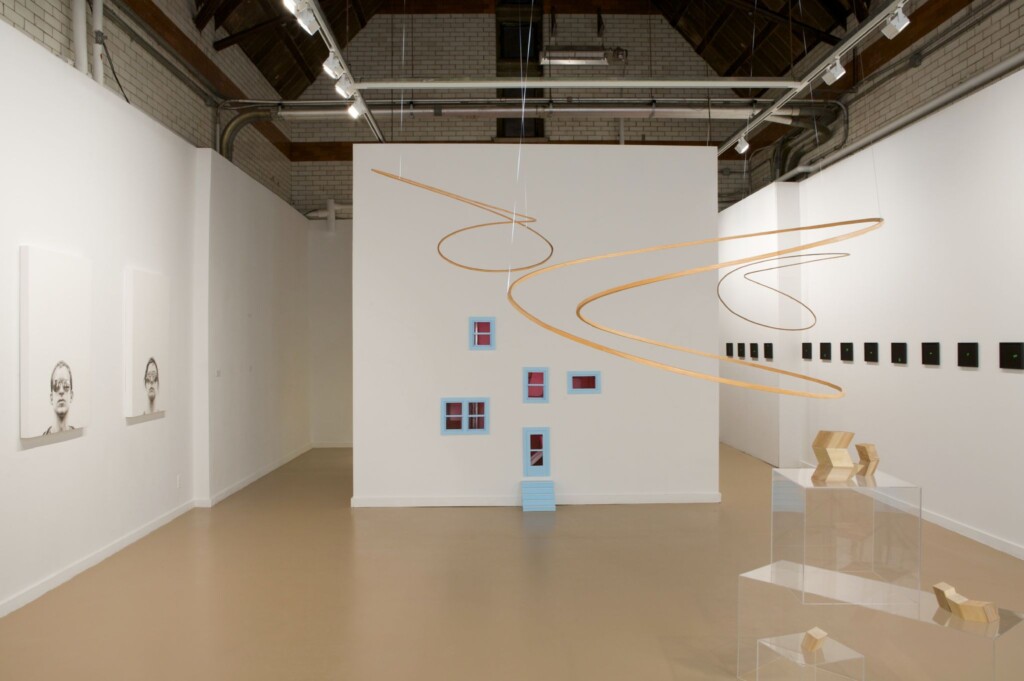
Installation view, A Closer Look 7, 2008, Spruance Gallery
Curated by Sheryl Conkelton, Director of Exhibitions and Special Programs at Tyler School of Art, the show builds on affinities between the selected bodies of work and projects—some of which have been realized expressly for this occasion. The seventh iteration of the series, this exhibition offers a speculative review of aesthetics that foregrounds perception in a range of material experience. “Each of these artists has developed a conceptual artistic practice that engages the material world and perceptual pleasure,” Conkelton says, “using perception as a means of gesturing towards or modeling conceptual and theoretical spaces.”
Phillip Adams‘ life-size charcoal portraits subtly complicate the viewer’s relationship by replacing her with an imaginary reflected world. James Johnson expresses the ambivalence of the artistic position with a brightly lit but partially obscured construction. Kocot & Hatton present glowing hallucinations that record the moment of waking from sleep. Lucy Pullen‘s sculptures model invisible physics using simple shapes complicated by reflective surfaces. Linda Yun uses patently artificial materials to convey a natural phenomenon, crafting her representation through visual and aural rhythms.
The exhibition will open on Thursday, November 13 at 6:30 p.m. with a panel discussion between the six artists moderated by Sheryl Conkelton in Stiteler Auditorium, Murphy Hall. A reception will follow immediately in the gallery. Both events are free and open to the public.
Gallery hours are Tuesday, Wednesday and Friday, 10 a.m. to 3 p.m.
Thursdays 10 a.m. to 8 p.m.; Saturday and Sunday, Noon to 4 p.m. and always by appointment
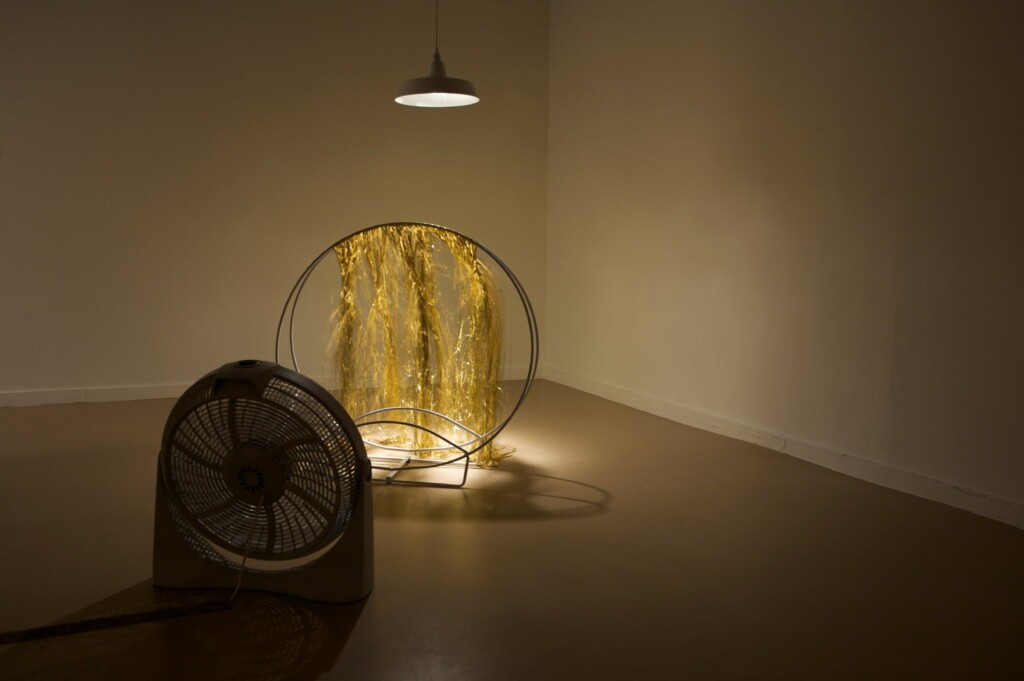
Installation view, A Closer Look 7, 2008, Spruance Gallery
About the Artists and Guest Curator
Phillip Adams (b. 1978) received his B.F.A. from the University of Georgia (Athens) in 2002 and his M.F.A. in painting from the University of Pennsylvania in 2006. In Philadelphia, he has exhibited his work at the Galleries at Moore, Tower Gallery, and the ICA’s Open Video Call (2006). A large graphite drawing by Adams was selected by Connie Butler (Museum of Modern Art) for the 2005 “Works on Paper” exhibition. Adams’ work has also been included in exhibitions at the Whole Gallery (Baltimore), Project 4 (Washington, DC), the Healing Arts Centre (Athens, Georgia), and Greenhouse Gallery, San Antonio, Texas. His works are included in the permanent collections of the Art Bank, DC Commission on the Arts and Humanities, Washing ton DC and the Lydon House Arts Center, Athens, Georgia. Adams lives and works in Philadelphia.
James Johnson (born 1976) received his M.F.A. from the Rochester Institute of Technology in 2002 and his B.F.A. from Marywood University in 1999. He has exhibited his work at exhibited in Philadelphia at Vox Populi Gallery, Moore College of Art & Design, the Samuel S. Fleisher Art Memorial, and the Center for Emerging Visual Artists. His work was selected by Connie Butler for the 2005 “Works on Paper” exhibition at Arcadia and purchased for the school’s permanent collection. Johson has exhibited his work nationally at the University at Buffalo Art Gallery, Samek Art Gallery at Bucknell University (Lewisburg, Pennsylvania), the Firehouse Gallery (Burlington, Vermont) and at Publico (Cincinnati, Ohio). He recently completed a residency at the Bemis Center for Contemporary Arts and received a Pennsylvania Council on the Arts Fellowship in 2007. Johnson currently lives and works in Philadelphia where he is a member of Vox Populi Gallery and chairs the Photography and Digital Arts major at Moore College of Art and Design.
Kocot and Hatton have been collaborating since 1979. They have exhibited their works in solo shows at regional venues such as the Levy Gallery at Moore College of Art and Design (1988), the Delaware Center of Contemporary Art (2003), and Tufts University Art Gallery in Medford, Massachusetts (2004). In addition to showing their work in Fukuya Gallery, Hiroshima, Japan and national venues, the have also exhibited their work regionally in group exhibitions regionally at ICA, Philadelphia (University of Pennsylvania), and Arcadia University where their works have been featured in five “Works on Paper” exhibitions. Their paintings and drawings are included in the permanent collections of the Philadelphia Museum of Art, the Sharjah Arts Museum, United Arabs Emirates, and the Delaware Art Museum. In 1999 they were commissioned by Andy Warhol Museum to create a photography project. They are recipients of fellowships and grants from the Pennsylvania Council and the National Endowment for the Arts. Upcoming exhibitions include the Bjorn Ressle Gallery (New York) and Larry Becker Contemporary Art, Philadelphia. The artists live and work in Philadelphia.
Lucy Pullen (born 1971) received her B.F.A. from the Nova Scotia College of Art and Design (Halifax), in 1993 and her M.F.A. from Tyler School of Art, Temple University in 2001. She is currently working toward a Ph.D. in media and communication with the European Graduate School in Saas-Fee, Switzerland. In the United States, Pullen has exhibited her work in group exhibitions at the following venues: Platform (Seattle), Murray Guy (New York), Yerba Buena Center for the Arts (San Francisco), the Luckman Gallery (University of Southern California), and as well as other venues. In 2001 her work was selected by Thelma Golden, (then curator at the Studio Museum, Harlem) for the gallery’s 2001 “Works on Paper exhibition. In Canada, Pullen has exhibited at Republic Gallery, State, and the Contemporary Art Gallery (Vancouver), Ministry of Casual Living (Victoria), Art Metropole (Toronto), Optica (Montreal), St. Mary’s University Art Gallery, Anna Leonowens, and Eye Level (Halifax). In 2009 she will present a solo exhibition with Lawrence Eng (Vancouver) where she is represented. Pullen currently lives and works in Victoria, B.C. Canada.
Linda Yun (born 1976) received her B.S. in Sculpture and Photography from New York University and subsequently attended Tyler School of Art, where she received her M.F.A. in Sculpture in 2001. In addition to her solo Challenge Series exhibition at the Samuel S. Fleisher Art Memorial in 2002, Yun has shown her work in Philadelphia at the Galleries at Moore, the Woodmere Art Museum, the Main Line Center for the Arts, and Vox Populi, where she has been a member since 2004. In addition to participating in Arcadia University Art Gallery’s 2004 exhibition “Open” (part of the ICA’s city-wide “Big Nothing” project), two sculptures of hers were selected by Connie Butler for the 2005 “Works on Paper” exhibition. Yun’s projects has also been included in group exhibitions at Three Walls Gallery (Chicago) and Sara Meltzer Gallery (New York). In 2002, Yun was awarded a Pennsylvania Council of the Arts grant in Sculpture, and in 2006 and 2008 she was a finalist for a Pew Fellowship in the Arts. She currently lives and works in Philadelphia.
Sheryl Conkelton is director of Exhibitions and Public Programs at Tyler School of Art in Philadelphia. She has organized numerous exhibitions, among them Phil Collins: “assume freedom” (2005), “An International Legacy: Selections from the Collection of the Carnegie Museum of Art” (2003), “Uta Barth, In Between Places” (2000), “What It Meant to Be Modern, Seattle Art at Mid Century” (1999), “Coming to Life, the Figure in American Art 1955-1965” (1998), and “Annette Messager” (with Carol Eliel, 1995). Conkelton has published widely, authoring a number of books including Lewis Baltz: Prototypes, Tract Houses and New Industrial Parks near Irvine, California (RAM/Steidl/Whitney Museum of American Art, 2005), Northwest Mythologies, The Interactions of Mark Tobey, Morris Graves, Kenneth Callahan and Guy and Frederick Sommer (Clio Press, 1995), and has contributed to journals, exhibition catalogues and other publications. Conkelton has also held senior curatorial positions at the Henry Art Gallery, Seattle; the Museum of Modern Art, New York; and the Los Angeles County Museum of Art. She has lectured extensively at museums, universities and cultural institutions in North America, Europe and Japan, and taught at the University of Washington, UCLA, and California State University, Los Angeles. She is the recipient of numerous grants, including awards from the National Endowments for the Arts, the Peter Norton Family Foundation, and the Ministry of Foreign Affairs, France.
Daniel Eatock: Extra Medium
September 18 – October 26, 2008
September 18 – October 26, 2008
Senior Thesis Exhibition
April 25 – May 16, 2008
April 25 – May 16, 2008
Air Kissing: An Exhibition of Contemporary Art About the Art World
March 5 – April 20, 2008
March 5 – April 20, 2008
Student Biennial
February 5 – 24, 2008
February 5 – 24, 2008
2007
Sean Duffy: The Grove
November 8 – December 20, 2007
November 8 – December 20, 2007
Other Islands: Recent Video Works by Sharon Hayes and Danielle Mericle
September 13 – October 28, 2007
September 13 – October 28, 2007
Senior Thesis Exhibition
April 27 – May 18, 2007
April 27 – May 18, 2007
Faculty Exhibition
March 22 – April 20, 2007
March 22 – April 20, 2007
"Always Thinking of You" Paintings and Recent Constructions by Gerald Nichols
January 23 - March 11, 2007
January 23 - March 11, 2007
Titled after a phrase from a Victorian carte de visite, this project by Philadelphia-based artist Gerald Nichols provides a comprehensive look at his reverence for a distressed American landscape. Filtered through Nichols’ idiosyncratic, associative systems—a sensibility that merges a concern for formal abstraction and art history with the signification and immediacy of vernacular art—this new project was conceived specifically for the gallery and constitutes the artist’s first solo exhibition in Philadelphia in nearly a decade.
Installation view, Always Thinking of You: Paintings and Recent Constructions” by Gerald Nichols, Arcadia University Art Gallery, Benton Spruance Art Center.
Gerald Nichols (born 1938) received his MFA in painting from the University of Pennsylvania in 1965. A recipient of a fellowship from the Guggenheim Memorial Foundation in 1970, he was awarded grants from the Carnegie Mellon Foundation and the Institute for Art and Urban Resources, New York. Included in the permanent collections of the Philadelphia Museum of Art and the Cleveland Museum of Art, among others, Nichols has presented his installations, public projects, paintings and constructions in group and solo exhibitions across the country. His last solo exhibition, entitled “Birds, Landscapes, Houses, and Insects,” was presented at York College of Art, Jamaica, New York, in 1999. Since 1967 he has taught painting and drawing at the University of the Arts (Philadelphia), has recently served as Chair of Fine Arts, and has been a lead studio faculty in Painting in the University’s Summer MFA program since its inception in 1995.
Installation view, Always Thinking of You: Paintings and Recent Constructions” by Gerald Nichols, Arcadia University Art Gallery, Benton Spruance Art Center.
2006
Paula Winokur: Geological Sites – A Survey of Work in Porcelain
November 1 – December 17, 2006
November 1 – December 17, 2006
Mystic River
September 8 – October 22, 2006
September 8 – October 22, 2006
Senior Thesis Exhibition
April 28 – May 19, 2006
April 28 – May 19, 2006
Works on Paper
March 28 – April 25, 2006
March 28 – April 25, 2006
Student Biennial
February 2 – March 5, 2006
February 2 – March 5, 2006
2005
Moscow Plastic Arts
November 10 – December 18, 2005
November 10 – December 18, 2005
Very Early Pictures
September 6 – October 30, 2005
September 6 – October 30, 2005
A Closer Look 6
March 1 – April 24, 2005
March 1 – April 24, 2005
Guest Curator: Claudia Gould, Director, Institute of Contemporary Art, University of Pennsylvania, Philadelphia, Pennsylvania
Participating Artists
Carl Fudge, M. Ho, Bruce Pollock, Anne Skoogfors
March 15, 2005
A conversation between guest curator Claudia Gould and the participating artists: 6:30 p.m., Stiteler Auditorium, Murphy Hall.
Reception immediately following panel discussion in the Art Gallery.
“A Closer Look 6” continues a biennial series that presents in greater depth the recent work of artists that have previously exhibited in the gallery’s biennial, juried “Works on Paper” shows. The exhibition examines affinities between the works of the participating artists, all of whom address issues pertaining to the tension between natural and formal order.
Press
Faculty Exhibition
January 20 – February 20, 2005
January 20 – February 20, 2005
2004
Olafur Eliasson: Your colour memory
September 1, 2004 – January 9, 2005
September 1, 2004 – January 9, 2005
Open
June 9 – July 30, 2004
June 9 – July 30, 2004
Senior Thesis Exhibition
April 23 – May 14, 2004
April 23 – May 14, 2004
Faculty Choice
April 1 – April 20, 2004
April 1 – April 20, 2004
Works on Paper
January 16 – March 28, 2004
January 16 – March 28, 2004
2003
Benton Spruance: World of One’s Own
November 12 – December 17, 2003
November 12 – December 17, 2003
Dave Allen: The Mirrored Catalogue D'Oiseaux
August 28 – October 26, 2003
August 28 – October 26, 2003
Senior Thesis Exhibition
April 25 – May 16, 2003
April 25 – May 16, 2003
Beat Streuli: Sydney, Tokyo, Birmingham, New York
March 24 – April 20, 2003
March 24 – April 20, 2003
Oxydationen (1970-1985)
February 11 – March 16, 2003
February 11 – March 16, 2003
Gold & Iron: Faculty Exhibition
January 10 – February 5, 2003
January 10 – February 5, 2003
2002
A Given Circumstance (gestures in situ): Jim Hinz, Jennifer MacDonald, and Kate Moran
November 14 – December 20, 2002
November 14 – December 20, 2002
A Closer Look 5: Jim Hinz, Jennifer MacDonald, and Kate Moran
September 6 – October 31, 2002
September 6 – October 31, 2002
Transformation: The act of changing in form, shape, or appearance; a person or thing transformed. Specifically, transformation achieved through a narrative process—and the "relation of narrative to its objects"—marks the curatorial underpinning of this exhibition of new work by Jennifer Macdonald, Kate Moran, and Jim Hinz. At different points in their careers and possessing distinct sensibilities, all three artists share concerns with emotional ambiguity and intimacy, a fascination with the miniature, and an interest in mythologies of nature and culture. Moreover, each artist’s talent for the well-crafted and well-loved object deliberately shapes the form and content of their art.
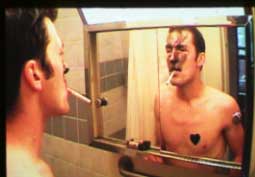
Jim Hinz, video still from Dark Head, 2002, nine minutes and fifty-seven seconds, courtesy of the artist.
The Secret Life of Things
For nursery magic is very strange and wonderful, and only those playthings that are old and wise and experienced…understand all about it….
--Margery Williams, The Velveteen Rabbit
In the seven paintings and one animation featured in "A Closer Look 5," Jennifer Macdonald explores her preoccupation with decorative objects and beloved toys from her youth. Her collector’s mindset and fertile imagination combine to produce reenactments of childhood play transformed by adult behavior. Removing the taint of kitsch that surrounds objects such as stuffed animals, Hummel collectibles, and antique porcelain, for many viewers, Macdonald invests and, in the process, transforms these miniature props — which, for her, embody nostalgia and cliché — with elements of romantic melodrama, melancholy, and humor.
Macdonald describes her images as "investigations of an abbreviated, narrative form," pictorial fragments in which action is suspended between hesitation and decision, the inanimate and the animate. In this context, the toy becomes a narrative device used to relate a fantastic tale, a point of departure for the interface of imagination and memory and, perhaps, a surrogate for the artist herself.
What Macdonald has termed her interest in the "seductiveness of storytelling" reveals itself in miniature vignettes such as It’ll End in Tears and The Reversal with a disjunctive combination of scale, object, and action. In the former, creepy-crawly prey disturb an eighteenth century ménage-a-trois, perhaps as a form of moral retribution. In The Reversal, Macdonald again employs three characters to envision a moment of "sinister betrayal," underlined by a nearby coiled rope.
The drawings are painted on both the front and back of large sheets of frosted mylar with enamel and nail polish. Each work possesses a formal delicacy and lightness of touch and color that in some instances emphasize the narrative’s innocence and naiveté, while in others mask its darker, more cynical motives. With floating figures set in vast expanses of space, the pictures form a frieze-like panorama that anticipates the artist’s experimental move into animation. Macdonald, by introducing real motion into her narratives, accentuates the concept of metamorphosis and transcendence in her works — the toy/fiction comes to life.
Ambivalence and intense attachments are recurrent themes in Brighter Death Now, a one minute and fifteen second animated tale of a lonely boy and bunny that suggests a grown-up version of The Velveteen Rabbit—that classic parable of childhood love, loss, and transformation. In Macdonald’s narrative sequence, the boy meets-, loves-, and loses- bunny theme is disrupted by an act of sudden violence that quickly turns into a tender ritual: the boy’s fetishistic attempt to preserve the spirit of beloved things and friends.
The painstaking, intimate approach the artist brings to her line animation—composed of 283 hand-drawn and colored cards—as well as to her paintings, imbues her imagery with a poignancy that complicates its pop effects. This attention to mood highlights Macdonald’s concern with heightened emotional states grounded in handmade, imaginative worlds.
Dwelling
You should lie down now and remember the forest, for it is disappearing—
no, the truth is it is gone now
and so what details you can bring back
might have a kind of life
--Susan Stewart, The Forest
An artist who moves comfortably between drawing, photography, and sculpture, Kate Moran has produced a number of objects for "A Closer Look 5" that utilize all three modes. Spiraling, literally, around the idea of the forest, in both its actual and metaphoric states, the works reveal a personal lexicon of circular forms that comes together in an investigation of enigmatic and haunted themes.
A deep interest in etymology shapes Moran’s art. For her new body of sylvan imagery, ideas of "clearing" offered a rich point of departure. Through an array of work executed in different media, Moran constructs her own experience of the forest as a place of fairy-tale enchantments, recollected childhood freedoms, and adult anxieties.
In folklore and literature, the woodland is typically the site of transformative events; an otherworldly place that induces fears and dreams in all who cross its threshold. As much as this romantic trope must appeal to Moran’s artistic imagination, it is her concern with the potential disappearance of the forest in our lifetime that gives the work contemporary, even political resonance. Evoking Susan Stewart’s poem, The Forest, Moran asks the viewer to recognize the significance of this world of shadow and silence and to contemplate its role in our lives from the perspectives of both youthful resonance and ecological ruin.
Moran is intrigued by temporal transformations. Using a tangible object either found in the world (a toy truck) or crafted by her (tiny pieces of wood carved and painted to resemble logs, a tree rendered in graphite, steel discs) as a foundation, she employs different visual strategies to contemplate the relationship between space and time. By translating each object’s physical presence into two- and three-dimensional representations — a photograph, a drawing, or a sculpture — Moran alters and complicates the viewer’s perception of the original object and its place in the world. These handcrafted narrative "fragments" suggest the artist’s concern with creative transformation and reveal her interest in symbolic pairings.
Significantly, in these terms, Moran’s photographs deceptively present themselves as drawings. Burning Hemlock, for example, originally began as a sketch of the top of an evergreen tree that the artist then set on fire and photographed. Printed on matt paper, the image acquires a charcoal-like quality and finish. Conversely, a tonal drawing of a monster truck wheel – absurd in its exaggeration — is derived from an earlier photograph of a truck jumping over hemlock.
This formal dialogue suggests how Moran signifies time and intimacy in her work. As she explains, photography arrests the moment while simultaneously suggesting change, "presenting an image of tangible things, only to dematerialize, as in the sensation of life passing by one’s peripheral vision." Drawings, alternatively, indicate time spent with an object.
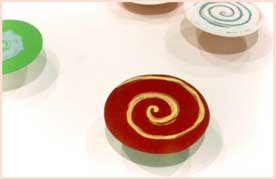
Kate Moran, Clearing (behind and before), 2002, oil on steel, twenty-one discs, courtesy if the artist.
Two recurring motifs in Moran’s art — miniaturization and mechanization — surface in Clearing (behind and before), a forest-like display comprised of twenty-one metal discs, vividly painted with synthetic swirls and slightly elevated above a square platform by metal rods. Referencing both tree rings and a toothless, felling blade, the arrested movement of the spirals produces a tension in which time is magically suspended. The playfulness and artificiality of the piece question the dual life and death cycle of nature, as well as the need for, act of, and consequences of clearing.
The meticulous attention — making, remaking, representing — that the artist brings to her object-driven fictions, parallels what Stewart characterizes as miniature time: "a type of transcendent time which negates change and the flux of lived reality." Moran’s forest is fragmented, reduced, and tamed in an attempt to be understood. In the process, it provides a psychological stage setting for private imaginings, past memories, and future hopes.
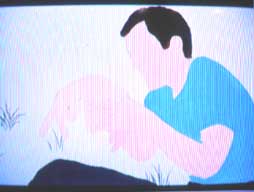
Jennifer Macdonald, video still from A Brighter Death Now, 2002, one minute and fifteen second animation, courtesy of the artist.
Shadows of Love
The day wants you living
And it’s not the last
Time to believe
In more than the past.
Andy with the dark head
Make something new
Keep your eyes open
I’ve shut mine for you
Keep your eyes open
I’ll open mine too
Keep your eyes open
I’m looking for you.
--Jim Hinz, Dark Head
Jim Hinz, in work that is both intimately autobiographical and ironically removed, pays homage to the indie-pop song as an art form in his installation for "A Closer Look 5." Evoking sentiments—humorous and solemn—about the mythology of romance, his extended, reconsidered cliché is articulated through a multimedia offering, loosely built around the concept of smoking.
The installation is composed of handmade objects (a model lung, a cigarette convincingly made from leather and parchment), altered possessions (fragments of favorite shirts transformed into cigarette packets and also used to decorate a grandmother’s craft project) and three "music videos," props from which fill a wall-mounted vitrine. The latter, which represents a new departure in his work, combines a patchwork of comical and affective images with a song-cycle that chronicles in true pop fashion a contemplative state of mind and a relationship’s painful end.
A melancholic, ambient strain runs throughout Hinz’s two instrumentals and three vocal pieces. Structurally simple yet emotionally dense, they range from the lyrical urgency of 17c, a reference to the musical patterns of the seventeenth century as antecedents of contemporary pop, and the creeping effects of a synthesizer in Lope, to the lulling incantation of Dark Head, with its reverberations of longing. The personal address of Dark Head and the a cappella I Am New, delivered by Hinz in a near whisper, lend a particularly intimate, sensual quality to these songs.
Like his handcrafted objects, the artist’s music possesses an endearingly homemade and improvisational feel yet one shaded by somber tones of experience. Archived in a museum-like setting, the videos, sculptures, drawings, props, and crafted artifacts document the artist’s attraction to relics of youth and souvenirs of love. In its entirety, Hinz’s effort resonates with themes of loss, addiction, and obsession.
With the dominating presence of Red Sculpted Carpet — a floor-covering the artist connects to memories of his family home that also evokes a hotel lobby or movie theater — the tension between private and public, emotional and analytical, becomes the feature presentation. The literary scholar Robert Pogue Harrison defines nostalgia as an emotion that "laments the condition of loss, however imaginary or impossible its object of longing." In these terms, nostalgia plays a role in the artist’s acts of tender transformation—from the lovingly made objects and recontextualized family heirloom to the songs themselves.
While Hinz’s "pop canvas" is plaintively humorous, like a classic Smiths song, his visual and verbal expressions reveal archetypal narrative patterns — darkness and light, seeing and knowing, death and devotion — motifs he treats with a deft touch. One might puzzle over the relationship between individual works in Hinz’s installation, but its emotional claim on the viewer is undeniable.
Sylvia Yount
Guest Curator
Notes:
Susan Stewart, On Longing: Narratives of the Miniature, the Gigantic, the Souvenir, the Collection (Durham and London: Duke University Press, 1993), ix.
Ibid., 56.
In addition to Stewart’s poem, Moran was inspired by Robert Pogue Harrison’s examination of the roles the forest has played in the Western imagination; see Forests: The Shadow of Civilization (Chicago and London: The University of Chicago Press, 1992).
For example, the forest is the place where the Velveteen Rabbit is made real.
Stewart, On Longing, 65.
Harrison, Forests, 155.
Andy Partridge used the term "pop canvas" to describe the "delightfully miserable" music he wrote for his band XTC. See Barry Singer, "Adventurous Punk of a Troubled Past," New York Times, Arts and Leisure (June 9, 2002): 28.
Back Time: Video Projections by William Larson
March 23 – April 24, 2002
March 23 – April 24, 2002
This exhibition is the first one-person show in the region since 1985 for Philadelphia-based veteran photographer William Larson. The show introduces three works in video, a medium he only began investigating in 1998 after thirty years of exploring the temporal possibilities of the still image. Each of the three pieces demonstrates a concern for depicting time in static space while consciously using one medium to comment on another. The artist’s preoccupation with root technology, cultural framing, and self-reflexive storytelling is echoed in the exhibition’s title, an allusion to the “back story” or subtext behind the primary intention of film narrative.
Mallare (2000) is a silent, single-channel piece projected onto a suspended screen. It is comprised of the computerized text of Ben Hecht’s 1922 novel Mallare being completely deleted, one word at a time. The process proceeds backwards from the final sentences (“Pity me. This is the cross.”) to the first (“Fantazius Mallare considered himself mad…). Following the cursor are three emblematic sentences Larson selected from the novel that continually rewrite themselves as the piece progresses. These sentences function like a buffer between the text of the novel and a field of constantly changing digits (the protagonist’s obsession) that overtake the text. The contradictory flow of the manuscript being erased as the video moves forward becomes analogous to the narrative of this gothic tale of madness and self-destruction. By allowing the viewer to drift backwards through the text, the artist provides another way to experience the story while revealing a new, generative grammar in the process. Larson conceived this work as one of several text based performances in which the deletion process, something he refers to as “one of the exquisite native programs on the computer,” acts as interface between mathematics and language.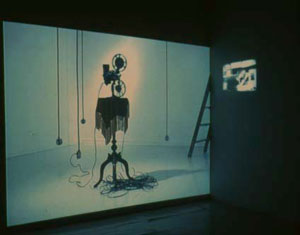
NOTime, 2000, video projection onto perpendicular walls, color image: 9’ x 12’; black and white image: 20” x 28”, 12.5 minutes.
NOTime (2000) is a two-channel work projected on perpendicular walls. A large-scale, color video image depicts an antiquated movie projector on a Victorian table, its reels scrolling the projected film into an inevitable pile on the floor. This projector appears to be the source of a second, smaller, black and white image of looping footage excerpted from a 1923 documentary showing a pair of busy bricklayers in an obviously redundant activity. The illusory relationship between the image of the movie projector and that of the bricklayers gives way to further realizations regarding the historic interplay between the early film technology depicted and the contemporary video equipment actually generating the projections in the gallery. Despite these casual relationships, the two images form their own independent, machine-like rhythm as they grind toward an unresolved yet seemingly deterministic outcome.
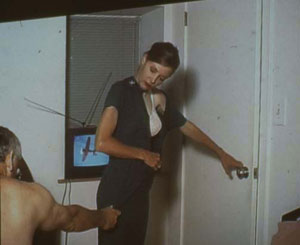
STILL and yet, 1999-2000, video projection, image: 6’ x 8’, 60 minutes.
STILL and yet (1999-2000) projects a series of what appear to be nine “snapshots” of the same image repeated and enlarged to six feet by ten feet, separated by a simulated strobe flash. Tension mounts as each impromptu, family tableaux is suspended in real time for as long as eight minutes or more. Close scrutiny of a group of seemingly identical images, for instance a half-clothed women reaching for a doorknob, reveals slight variations in the background between frames – in this example the image on the Television monitor is constantly changing.
Trained as a painter, Larson has been a significant figure in the field of fine art photography since the early 1970s. His initial experiments with sequential imagery demonstrated a filmmaker’s attitude toward depicting time and space while other projects evinced an interest in synthesizing images through high and low technology. Fire Flies (1976) – one of the first artworks to employ fax technology – documents Larson’s inventive use of early teleprinters as a means to combine photographs, sound, music, text, and voice to create a form of electronic collage. Tucson Gardens (1983), a suite of shadowless images documenting the backyards at the edge of the Sororan Desert in a bleached-out palette of primary colors, carefully references “garden magazine” style picture-making. Articulating Larson’s own wry sense of formal order, the series is regarded as one of the era’s landmarks of color photography, a mode generally disparaged until that time.
Larson’s work has been included in solo exhibitions at the International Museum of Photography (Rochester, New York, 2000), the Center for Creative Photography (Tucson, 1993) and the Institute for Contemporary Art (Philadelphia, 1985), as well as important group exhibitions at the J. Paul Getty Museum (2000), the Whitney Museum of American Art (Biennial, 1981), and the Museum of Modern Art (New York, 1978), where his work is included in the permanent collection. The Los Angeles County Museum of Art, the Atlanta Museum of Art, the Getty, and the Philadelphia Museum of Art also own his photographs. Among his awards and honors are a Pew Fellowship in the Arts (2001), a Guggenheim Fellowship (1982), four fellowships from the National Endowment for the Arts (1971, 1979, 1986, 1992), and a grant from Polaroid Corporation (1979). Larson received his B.S. from SUNY Buffalo and his M.S. from the Illinois Institute of Technology, Institute of Design in Chicago. He is currently the Director of Graduate Photography and Digital Imaging at the Maryland Institute College of Art.
Cary Leibowitz: Stop Copying Me, Stop Copying Me – Recent Paintings and Trash Cans
February 7 – March 14, 2002
February 7 – March 14, 2002
The Arcadia University Art Gallery is pleased to present “Stop Copying Me Stop Copying Me,” an exhibition of recent paintings and multiples by New York-based artist Cary Leibowitz. The exhibition includes a series of twelve text-based paintings on wood panels and a stack of over 200 trash cans/umbrella stands piled high in the center of the gallery.
Since emerging in the late 1980s using the alias “Candyass,” (which he dropped in 1996) Leibowitz has developed a reputation for what he refers to as “late 20th-century gay Dada.” His paintings and multiples (such as pennants that read “Go Fags!” and “Misery Rules!”) use self-deprecating humor to critique our narcissistic fantasies of ambition and appearance. While the work in this exhibition makes self-conscious references to his identity as a gay, Jewish artist, Leibowitz’s most recent pieces comment wryly on more universal questions germane to the exhausted discourse around painting and contemporary practice that have also been his stock in trade. (A series of banners from 1989 included works with titles such as “I Love Sherrie Levine,” and “I Love Tom of Finland.”) More than a decade later, “Stop Copying Me Stop Copying Me” demonstrates how the persistence of Leibowitz’s dandified, sad-sack whining allows him to claim the nominal “failure” of his career as potent content for his work.
For this exhibition Leibowitz employs a more minimal, monochromatic style compared to chattier, previous efforts. Each of the new pictures is painted in his signature, candy-colored palette on thick, wood panels. Labeled in Leibowitz’s faux-naive scrawl and hung from their top edges on exaggerated nails, they resemble a cross between old fashioned shop signs and 3-D cartoons.
The majority of the works are visual puns. Painting with Something Missing (2001) is a purple field with a square cut into its center. Painting with a Way Out (2001) offers a door knob. Painting with Hindsight (2002) has a rear-view mirror attached to it. Many of these multiple panel works use text to address each other as well as the viewer. In “Hi Fatty…HI,” (2001) a “slim” painting taunts a “fat” one. In another, a pink square with red lettering implores eleven others to “stop copying” it. Confident in their awkward physicality and impudent formalism, Leibowitz’s deadpan one-liners take material literalism to a hyperbolic, bratty extreme.
In the center of the gallery Leibowitz has installed a mountain of garbage cans/umbrella stands, each printed with a snapshot of the artist on the occasion of his Bar Mitzvah, circa 1976. “The cans with the picture of Fatso,” he explains, “ also have the text GAIN! WAIT! NOW!, which is very much in keeping with my longstanding history of wanting/needing/hoping/praying for things to improve in my own impatient way.” The garbage cans are $50 and the umbrella stands are $52, the only difference being their price.
Leibowitz’s penchant for producing inexpensive multiples in flagrantly large editions is extended in the 6 x 9” announcement card he conceived expressly for the exhibition at Arcadia University Art Gallery. Based on the aforementioned painting Stop Copying Me Stop Copying Me, this multiple was printed in an edition of 12,000 and was bulk-mailed not once but twice to every address on the gallery’s mailing list.
Leibowitz (38) received his MFA in painting from the University of Kansas in 1987 after studying interior design at the Fashion Institute of Technology (1983-84) and architecture at Pratt Institute, New York (1981-83). Since his first one-person show in New York (at Stux Gallery in 1988), he has exhibited internationally, including important group shows such as “Bad Girls,” at The New Museum of Contemporary Art (1994); “In a Different Light” at the University Art Museum, Berkeley, California; and “Two Jewish? Challenging Traditional Identities,” at the Jewish Museum, New York (1996). He is the recipient of an Award in the Visual Arts Fellowship (1991) and a grant from Art Matters (1994). A resident of Harlem (where he has lived since 1999), he is a print specialist at Christie’s New York auction house. In October of 2001, the interior of his town house (“decorated to within an inch of its life”) was featured in a cover story of the New York Times Magazine’s “Home Design”section.
Writing about Leibowitz’s paintings on view in a recent exhibition at the Andrew Kreps Gallery–his first one-person exhibition in new York since 1996, New York Times critic Holland Cotter remarked: Mr. Leibowitz takes a passive aggressive jab at a whole range of art-world non-issues in work that is post-beauty, post-theory, post-cool, post mature, and possibly–this has been Leibowtiz’s consuming worry for over a decade–post success. But he needn’t fear failure. He never “arrived” on the scene in any conventional sense, so he has never left it either. Being perpetually out of step is a career move that makes him an artist for all seasons.
After the exhibition opens on February 7, “Stop Copying Me Stop Copying Me” will remain on view until March 14. The show will be introduced by a lecture by Leibowitz starting at 6:30 PM on February 7 in Stiteler Auditorium, Murphy Hall. The opening reception will follow immediately afterwards in the art gallery. Both are free and open to the public.
Faculty Choice
January 14 – February 3, 2002
January 14 – February 3, 2002
2001
Desire Admire Acquire
November 9 – December 18, 2001
November 9 – December 18, 2001
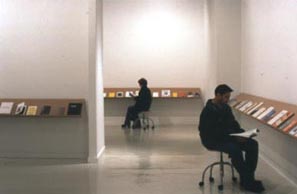
A survey of artists’ books and publications from the 1960s to the present, for browsing and sale, selected from Printed Matter, Inc., New York.
Partial list of featured artists: Marina Abramovic, John Baldessari, Barbara Bloom, Mel Bochner, Christian Boltanski, Angela Bulloch, David Bunn, Daniel Buren, David Byrne, John Cage, Maurizio Cattelan, Larry Clark, Tacita Dean, Helen Douglas, Peter Downsbrough, Jimmy Durham, Olafur Eliasson, Tracey Emin, Hans-Peter Feldman, Ian Hamilton Finlay, Karen Finley, Hamish Fulton, Gilbert & George, Liam Gillick, Robert Gober, Rodney Graham, Renée Green, Simon Grennan & Christopher Sperandio, Joseph Grigley, Paul Heimbach, Dick Higgins, Susan Hiller, Hirsch Farm Project, Thomas Hirschorn, Nancy Holt, Jenny Holzer, Douglas Huebler, Daniel Jewsberry, Allan Kaprow, Emma Kay, Ellsworth Kelly, Mike Kelley, Martin Kippinberger, Alison Knowles, Jeff Koons, Richard Kostelanetz, Sean Landers, Les Levine, Sol LeWitt, Richard Long, Ken Lum, M.M. Lum, Anita M-28, Antonio Muntadas, Peter Nadin, Paul Noble, Richard Nonas, Yoko Ono, Kevin Osborn, Dan Perjovschi, Raymond Pettibon, Elizabeth Peyton, Tom Phillips, Jack Pierson, Adrian Piper, Stephan Prina, Richard Prince, Allen Ruppersberg, Ed Ruscha, Joe Scanlan, David Shrigley, Daniel Spoerri, Telfer Stokes, Michelle Stuart, Wolfgang Tillmans, Richard Tuttle, Lawrence Weiner, Marther Wilson, Phil Zimmerman.
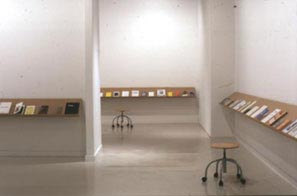
Works on Paper
September 25 – October 31, 2001
September 25 – October 31, 2001
Juror: Thelma Golden, Chief Curator, The Studio Museum, Harlem, New York City, New York.
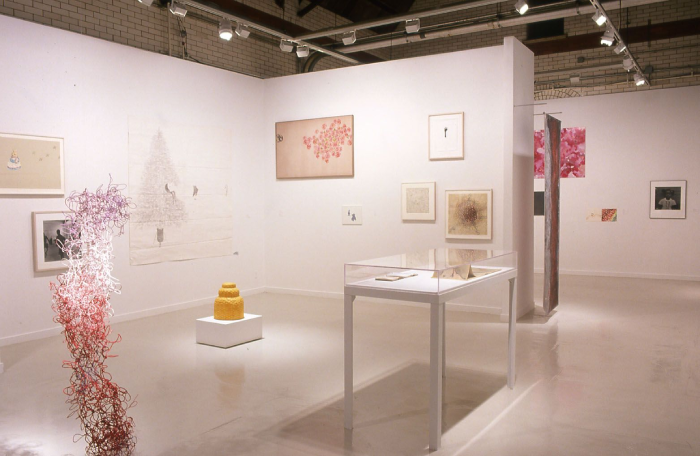
Installation view, “Works on Paper,” Arcadia University Art Gallery.
Participating Artists
Amy Adams, Randy Bolton, Charles Burwell, Yane Calovski, Tom Carey, Nick Cassaway, Stephen Cartwright, Dominic Episcopo, Joy Feasely, Carson Fox, Sara Gallo, Sherif Habashi, E. Sherman Hayman, Raquel Higgins, Mei-Ling Hom, Joseph Hu, Jeremiah Johnson, Yukie Kobayshi, Nancy Lewis, Bill Lohre, Tristin Lowe, Hau C. Ly, Danica Maier, Virgil Marti, Jennifer McDonald, Quentin Morris, Arthur Parker, Lucy Pullen, Steve Riedell, James Rosenthal, Lawrence Salzmann, Olivia Schreiner, Francie Shaw, Gordon Smith, Tony Ward, and Jeremy Wineberg
Senior Thesis Exhibition
April 27 – May 20, 2001
April 27 – May 20, 2001
Freestanding
April 2 – 26, 2001
April 2 – 26, 2001
Snapshot
February 15 – March 25, 2001
February 15 – March 25, 2001
The Beaver College Art Gallery is pleased to present a traveling exhibition (organized by the Contemporary Museum, Baltimore), which features over 1000 snapshots solicited from internationally recognized artists as well as amateur and untrained photographers at every level of experience. Submissions came from 24 countries around the globe, the only requirement for inclusion being that the entries be no larger than 4” x 6” and a suggestion they hold some personal significance for those responding. The show features 800 snapshots originally submitted to the Contemporary Museum (where the exhibition was on view from November 2, 2000 through February 4, 2001) as well as approximately 200 images solicited from area artists, fine art photographers, and residents of the immediate communities within and surrounding Beaver College.
Hung floor-to-ceiling in alphabetical order, each snapshot is labeled with the name, birthyear, and city of residence of the person who submitted it, as well as a title ascribed by this individual to the image. While vastly outnumbered by unknown photographers, some of the more internationally recognized contemporary artists participating in the project include: Luis Cruz Azaceta, Polly Apfelbaum, Ken Aptekar, John Baldessari, Jennifer Bornestein, Emily Cheng, Petah Coyne, James Elaine, Louise Fishman, Rainer Ganahl, Douglas Gordon, Harmony Hammond, Holly Hughs, Connie Imboden, Koo Jeong-a, Isaac Julien, Sejla Kameric, Jerry Kearns, Mary Kelly, William Kentridge, Elke Krystufek, Justine Kurland, Pepon Osorio, Fabian Marcaccio, Jonathan Monk Sam Samore, Andres Serrano, Mira Schor, Kiki Smith, Buzz Spector, Jessica Stockholder, John Waters, Randy Wray, Rob Wynne, and Allan Wexler.
“We’re trying to explore the relationship between fine art and non-art imagery and the relationship between things of personal value and images that would be aesthetically valuable in a public context,” said Adam Lerner, associate curator at the Contemporary Museum and exhibition co-curator. As such, the show explores contemporary techniques of popular folk imagery and family documentation as well issues regarding the impact of photographers on their subjects and indeterminate meanings that have always tempered the presentation of snapshots. Other issues raised include the relationship between accidents and deliberate intention, naturalness and theater, and the effects of captions and titles on photographic images.
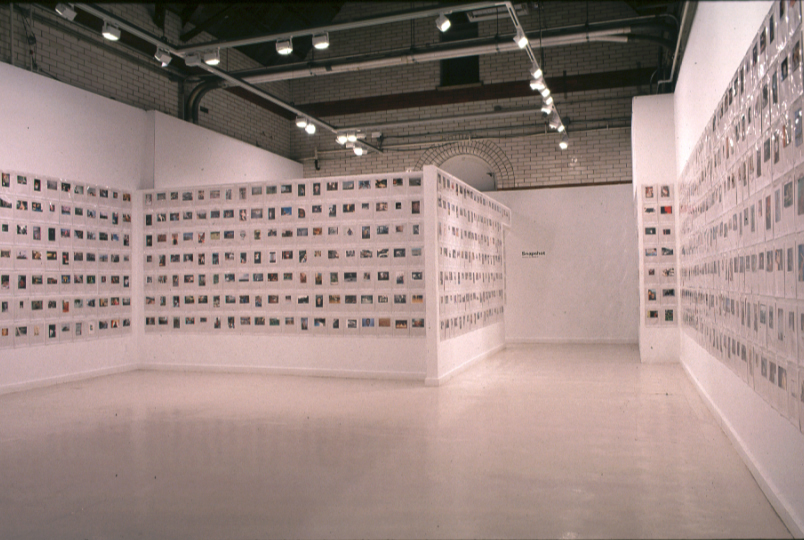
Installation view, “Snapshot,” Beaver College Art Gallery
“Snapshot” is accompanied by a CD-ROM catalog (of the original exhibition only) and three special events, each scheduled to begin at 6:30 PM in Stiteler Auditorium, Murphy Hall, a short walk from the gallery.
On Thursday, February 22, exhibition curator Adam Lerner will deliver a lecture entitled “Puppy Porn to Debbie Harry: A Curator’s Perspective on the Snapshot Exhibition,” during which he will discuss the process of organizing and realizing the exhibition in Baltimore as well as addressing the many issues and interpretative possibilities yielded by this unusual project.
On Thursday evening, March 1, the gallery will screen Pecker, the 1998 film by participating artist John Waters. This rags-to-riches pastiche of the contemporary artworldstars Edward Furlong as a Baltimore-based youngster whose idiosyncratic photographs of working-class Baltimore life transform him into an art star. But Pecker’s success turns to misery back home as family and friends are dragged from their everyday lives into the spotlight, becoming the subjects of political and cultural debates in the media.
On Thursday evening, March 8, Mia Fineman, curator of this past summer’s Metropolitan Museum of Art exhibition “Other Pictures: Vernacular Photographs from the Thomas Walther Collection,” will present a lecture entitled “Try Harder, Fail Better: The Accidental Art of the Snapshot.” Fineman will discuss nearly 100 black & white images that comprised the exhibition. Never intended for public display, all of these anonymous photos were made between 1900 and 1960 by amateur photographers and hobbyists during an era that saw the emergence of the camera as a nearly ubiquitous accessory of modern life. Chronicling the spirit of their time in refreshing and often unexpected ways, the images were selected exclusively from the collection of Thomas Walther, one of the finest private photo archives in the world.
The opening reception will take place in the gallery on Thursday evening, February 22, directly following Adam Lerner’s lecture (at approximately 7:30 PM).
“Snapshot” is a traveling exhibition organized by the Contemporary Museum, Baltimore; Curators: Gary Sangster, Executive Director; Adam Lerner, Associate Curator; Sarah Vezina, Program Assistant, The Contemporary Museum, Baltimore. Eight-hundred of the initial 1325 images presented at the Contemporary Museum (gathered since 1999) are supplemented at the Beaver College Art Gallery with additional snapshots submitted from the immediate neighborhoods surrounding the gallery and the Philadelphia artistic community including photographs from Phoebe Adams, Astrid Bowlby, Susan Fenton, Kevin Finklea, Ap. Gorny, David Graham, Jim Hinz, Sharon Horvath, Howard Hussey, Catherine Jansen, Maurie Kerrigan, Sarah McEneany, Eileen Neff, Gabriel Martinez, Stuart Netsky, Staurt Rome, Maurie Kerrigan, Peter Miraglia, Jennie Shanker, Merle Spandorfer, Sandy Sorlien, Sarah Van Keuren, and Bob and Paula Winokur (list in formation).
The exhibition is funded by the Pennsylvania State Council on the Arts and the Friends and Advisory Board of the Beaver College Art Gallery.
2000
The Big G Stands for Goodness: Corita Kent’s 1960s Pop
November 16 – December 20, 2000
November 16 – December 20, 2000
The Beaver College Art Gallery is pleased to present “The Big G Stands for Goodness: Corita Kent’s 1960s Pop,” curated by Los Angeles-based critic Michael Duncan. On view from November 16 through December 20, 2000, the show opens with a lecture by Duncan on Thursday evening, November 16, at 6:30 PM in Stiteler Auditorium followed immediately by a reception. Admission is free.
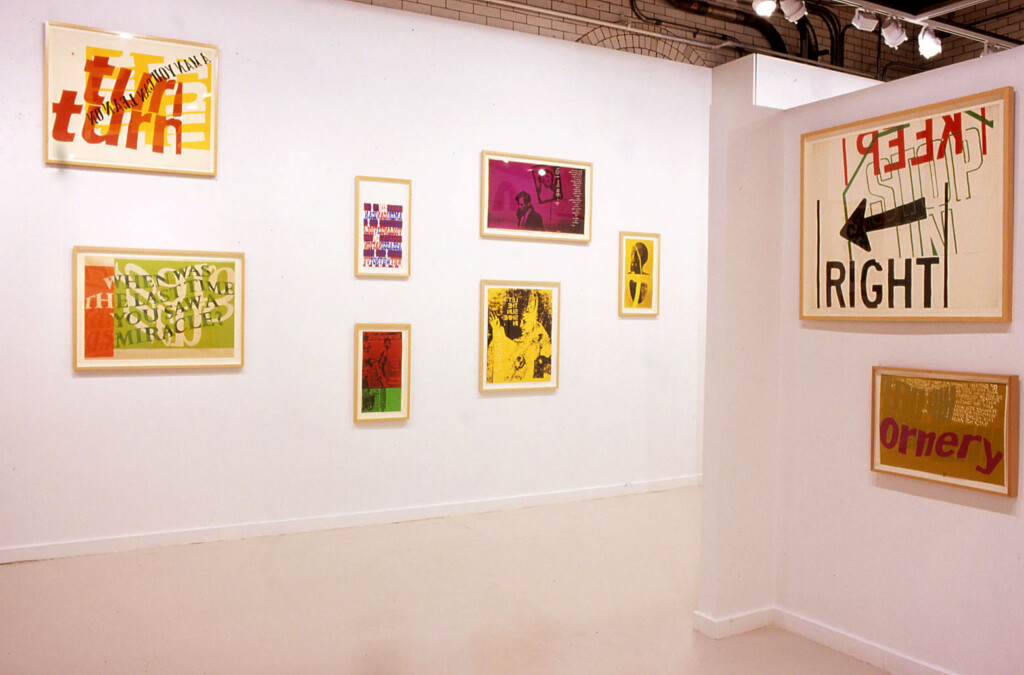
Installation view, “The Big G Stands for Goodness: Corita Kent’s 1960s Pop,” Beaver College Art Gallery
“The Big G Stands for Goodness: Corita Kent’s 1960s Pop” features 50 works surveying the disarmingly engaging, formally inventive silkscreen prints from the 1960s by Sister Mary Corita Kent (1918-1986). Juxtaposed with these works will be pieces by 17 contemporary Los Angeles artists who use a similar approach to popular culture and formal experimentation with the visual display of texts. As well as pointing to the extraordinary sophistication of Corita’s 1960s work, the contemporary portion of the exhibition serves as a mini-survey of contemporary Los Angeles art that has utilized text in visually inventive ways.
A teacher at Immaculate Heart College in Los Angeles, and a civil rights-, feminist-, and anti-war- activist, Corita (she resigned her religious order in 1968) was one of the most popular American graphic artists of the 1960s and 1970s, making hundreds of prints espousing her humanist causes. Creating her own liberal Catholic version of Pop in the early 1960s, Sr. Corita mixed swatches of bright, saturated color with fragments of graphics and type appropriated from supermarket items. With a deadpan literalism and an ear for language rivaling that of her contemporary Angelino, Ed Ruscha, Corita’s prints confirm her upbeat theology by sampling and morphing the well-known advertising phrases of her time, such as The big G stands for Goodness (General Mills) and Put a tiger in your tank (Esso gasoline). Logos and slogans promoting “Wonder” bread, “Humble” oil, “Sunkist” lemons, “Safeway” supermarkets, and even “Lark” cigarettes become visual and verbal puns endorsing her all-embracing humanitarianism. Interrupting our subliminal responses to familiar slogans, her graphic transformations borrow promises that the marketplace cannot deliver. A true subversive, Corita de-objectifies advertising, usurping its appeals for her own moral concerns.
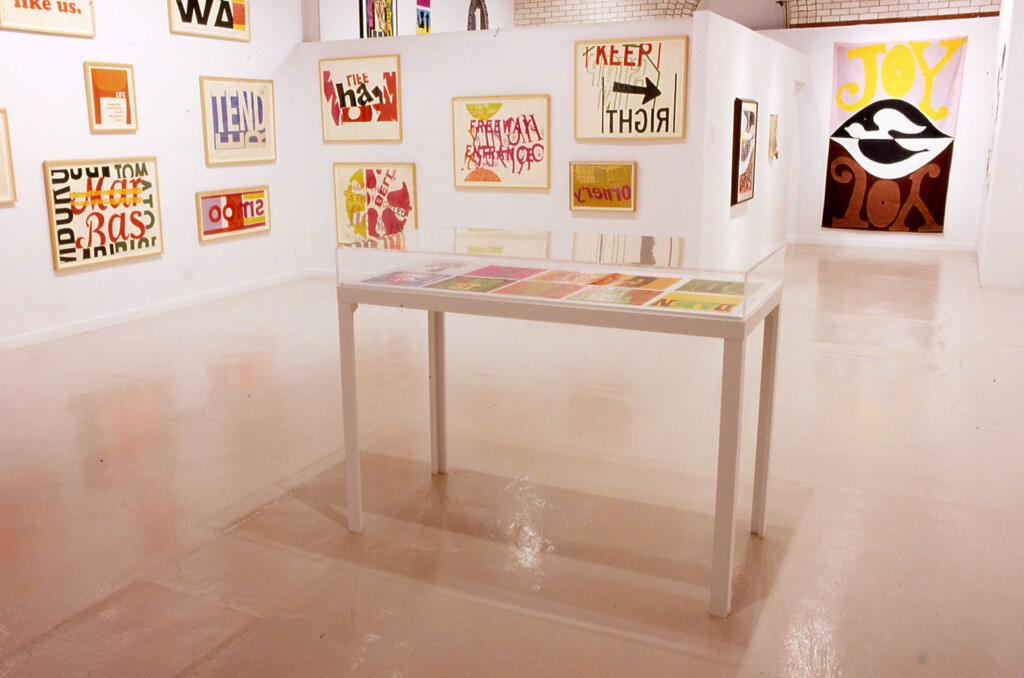
Installation view, “The Big G Stands for Goodness: Corita Kent’s 1960s Pop,” Beaver College Art Gallery
Works by several contemporary Los Angeles Artists in the exhibition share auspicious affinities with Corita’s prints. Her playful application of block letters, word fragments, mirrored writing, and warped texts diversely parallel those of Larry Johnson, Karen Carson, and Lari Pittman. Passages from texts by Gertrude Stein, Samuel Beckett, Camus, e.e. Cummings, John Lennon, and Ugo Betti are often scrawled across Corita’s works in a style that prefigures that of Raymond Pettibon. Moreover, Mike Kelley’s felt banners from the late 1980s (one of which is included in the show), were directly spun off her work, offering their own twisted celebration of the abject.
“The Big G Stands for Goodness: Corita Kent’s 1960s Pop” is curated by Michael Duncan, independent curator and writer whose recent exhibitions include “Love Flight of a Pink Candy Heart: A Compliment to Florine Stettheimer” at Holly Solomon Gallery in New York (1995), and “Pavel Tchelitchew: Interior Landscapes” at the Katonah Museum of Art in New York (1998). Duncan is currently Corresponding Editor for Art in America magazine, and has also written for the magazines Buzz, L.A. Weekly, Frieze, New Art Examiner, Art issues, and Flash Art, among others.
“The Big G Stands for Goodness: Corita Kent’s 1960s Pop” originated at the Luckman Fine Arts Gallery at California State University, Los Angeles in January, 2000. It has since traveled to the Nora Eccles Harrison Museum of Art, Utah State University, Logan, Utah; the Donna Beam Fine Art Gallery at the University of Nevada, Las Vegas; and the Art Gallery at the University of Texas, San Antonio. Due to the large scale of the exhibition, part of the show will be presented in the Atwood Gallery on the ground floor of Beaver College’s Atwood Library, a short walk from the Beaver College Art Gallery. The presentation of this touring exhibition in Glenside is funded by the Pennsylvania Council on the Arts and the Advisory Board and Friends of Beaver College Art Gallery.
A Closer Look 4
September 20 – October 31, 2000
September 20 – October 31, 2000
The Beaver College Art Gallery is pleased to present “A Closer Look: 4,” the fourth in a biennial series of exhibitions that presents in greater depth works by area artists previously included in the gallery’s juried “Works on Paper” exhibitions. Curated by Alex Baker, former associate curator of the Institute of Contemporary Art, Philadelphia, the exhibition features recent projects by Susan Arthur, Aaron Igler, Nancy Lewis, and Matthew Wine. On view from September 20 through October 31, 2000, the show opens with a public conversation between Baker and the participating artists in Stiteler Auditorium at 6:30 PM on Wednesday, September 20, followed immediately by the opening reception in the art gallery. All of the artists selected for “A Closer Look: 4” share an affinity for both oblique narrative and a deceptively capricious formalism. Whether personal, fictional, whimsical, or disturbing – the storytelling employed is frequently deferred and indirect. Lightness in attitude, composition, and even subject matter provide points of entry into often more complicated ways of representing the world and the self.
Susan Arthur’s recent color photographs depict marshmallow “peeps” (candy chicks, ghosts, jack-o-lanterns, and snowmen that she places in natural, outdoor settings to create fanciful, diorama-like compositions that are also reminiscent of still-lifes. Although “peeps” may be perceived as cute, harmless, inanimate confections, a poignant anthropomorphism and loneliness haunts these vibrant pictures. Arthur received her M.A. in art history from the University of Texas, Austin before becoming director of the Houk Friedman and Edwynn Houk Galleries in New York. “A Closer Look: 4” is her first major exhibition since she returned to Philadelphia last year when her work was included in “Works on Paper” (1999), selected by James Elaine, then curator of The Drawing Center, New York.
Nancy Lewis’s paintings, drawings, and prints employ a vocabulary that includes fireworks, flames, diamonds and other archetypal symbols that she revisits to convey her emotional state at the time each work was created. For “A Closer Look: 4,” she will present her first site-specific work, a 16-ft. image of a roller coaster. Rendered in pencil on the gallery wall, Lewis uses this undulating motif both as an emotional trope and as a reflexive exercise to explore the process of drawing itself. She will also be represented by a selection of computer prints and a large-scale canvas depicting a vast sea of fire. Lewis received her B.A. from San Francisco State University and her M.F.A. from the Pennsylvania Academy of Fine Arts and is currently a member of Vox Populi. She was selected for “Works on Paper” (1996) by Bill Arning–then director of White Columns, New York.
Matthew Wine will present a series of new works made from foam carpet-backing, a speckled, multicolored material that he manipulates into a surprising variety of eccentric, three-dimensional volumes. Resembling otherworldly creatures familiar from science fiction narratives, these biomorphic abstractions also reference the sick or expelling body. Wine cites Eva Hesse and Lynda Benglis – and their attention to the materiality of form – as influences on this work. A recipient of a B.F.A. from Virginia Commonwealth University, Wine graduated with an M.F.A. from Tyler School of Art last spring. He was included in the “Works on Paper” (1999) juried by James Elaine.
Aaron Igler is a photographer, video artist, and musician who is interested in the chance intersection of images and sounds. For his video projection, Models for the Floatable Delay of Light (2000), a pair of video loops depicting light reflected from rotating, prism-like surfaces joins a third image of an illuminated object darting across a South Philadelphia sky. The three loops are accompanied by a dense audio-track of synthesized sound accessed via headphones plugged into a custom seating unit. The repetition of visual and aural stimuli creates a hypnotic environment that offers viewers the opportunity to create an individualized interior space while constructing their own associative narratives. Igler attended Munson Williams Proctor Institute (Utica, New York) before receiving his B.F.A. in photography from the University of the Arts, Philadelphia. He was included in “Works on Paper” (1996), selected by Bill Arning. Until June of this year, guest curator Alex Baker was associate curator of the ICA, Philadelphia, a position he’d held since 1996. During his tenure there he developed numerous exhibitions featuring the work of international as well as area artists – including “Biographies: Philadelphia Narratives,” which he co-curated with Judith Tannenbaum. Baker also conceived and organized the wildly popular “Sticker Shock” (1998) and this spring’s “Indelible Market” (part of the exhibition “Wall Power”). Now an independent curator, Baker is currently completing his doctorate in Cultural Anthropology at Temple University. He will return to the ICA in May, 2000, as a guest curator of “East Meets West: ‘Folk’ and Fantasy from the Coasts,” an exhibition featuring three Philadelphia artists and three San Franciscans.
“A Closer Look” was initiated in 1995 as a biennial series to present more comprehensively the work of artists who have been included in the gallery’s juried “Works on Paper” shows. The series provides an opportunity to consider an expanding roster of Philadelphia-based artists in the context of small group shows underscoring relationships among the exhibited works. Funded by a grant from the Pennsylvania Council on the Arts and the Friends and Advisory Board of the Beaver College Art Gallery.
Nine Artists / Five Decades: Works by Beaver College Alumni
June 2 – 27, 2000
June 2 – 27, 2000
Senior Thesis Exhibition
April 28, 2000
April 28, 2000
The Sea & The Sky
February 17 – April 25, 2000
February 17 – April 25, 2000
“The Sea and the Sky” focuses on the ocean, atmosphere, and cosmos as subjects for contemporary works by twenty-four American, European, and Asian artists who employ celestial and watery imagery to reflect on the existential and sublime.
Co-presented by the Beaver College Art Gallery and the Royal Hibernian Academy, Dublin, Ireland and curated by Patrick T. Murphy and Richard Torchia.
A 47-page catalogue accompanies this exhibition with an essay by Susan Stewart and a published conversation between the curators.
“In works of art representing the sea or the sky, there is always an infinite reach or recession—behind the heavens is the unending vastness of space; behind the breakers, the extent of the main; under the surface, the depths; behind the clouds, the stars; behind the stars, more stars; and behind our conscious ness of these views, a vast, inarticulate, and untranslatable consciousness. Every gesture indicating surface and depth in these works is an index to the profundity of profundity itself. As watchers of the sea and heavens—at least from Amerigo Vespucci onward—gathered their observations in notebooks and bound manuscripts, they speak to our need to find some legible and encompassing form for such vastness. Meville’s Ishmael described the laborious transmutation of the whale into “Bible leaves! Bible leaves!” Marcel Proust watched the sea reflected in the glass of a bookcase. To frame enormity within the covers of a book, to register the infinite through a series of patient, exacting, marks on sheets of paper, brings the scale of such phenomena back to hand and eye and thought—the vehicles of human intelligibility.”
— Excerpt from “What Thought is Like” by Susan Stewart from the Sea and the Sky catalogue.
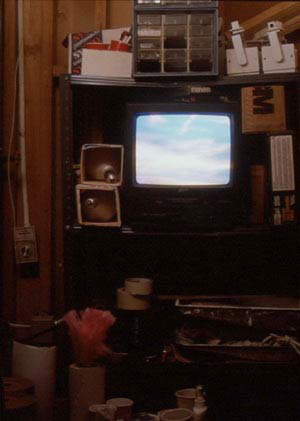
Robert Nesbit, Setting Sun, 2000 (installation detail), light-blocked gallery utility closet illuminated by monitor playing 90-minute videotape, altered doorway.
Robert Nesbit’s Setting Sun is a videotape documenting an entire sunset filmed in real-time from his north-Philadelphia rooftop. Placed on a shelf in the gallery’s functioning utility closet—like another can of paint or a waiting spotlight—the T.V. monitor is the only source of illumination in the intimate space. The work becomes a tragic comment on our capacity to appreciate both natural and aesthetic occurrences, however mediated and displaced.
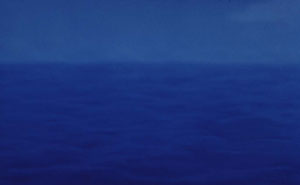
Karen Butler, Scene 8, from the series Anywhere but Here, 2000, C-print mounted on Plexiglass, 48” x 72.”
For her ongoing series Anywhere but Here, begun in 1997, Karen Butler uses acetate, vacuum-formed plastic, colored lights, and a variety of commercially printed “sky” backdrops to create tabletop dioramas of nearly featureless seascapes. She then photographs these fabrications with a macro lens and prints them as large-scale Cibachromes. Mounted behind sheets of Plexiglass, her saturated views invite reverie within an ambiguous space confused by the uncertainty of subject matter. Is the viewer made witness to the mind-boggling, colorful splendors of nature or presented with equally intense images based on simulation and Technicolor dreaminess?
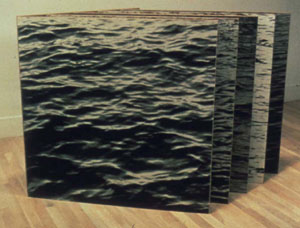
Eileen Neff, Five, for Example, 1990, black and white silverprints on board, 36” x 60” x 37 1/2.”
Each of the photographs that comprise Eileen Neff’s Five, for Example depicts a cropped view of a different body of water. Configured into an oversize “book” whose freestanding panels play on the illusory verticality of water surfaces viewed obliquely, the work’s real subject becomes the nature of representation itself. Despite the implication of a countless procession of waves, the work’s sculptural physicality and its inevitable limitations, by contrast, remind us of how cerebral our concepts of distance, mutability, and infinity can be.
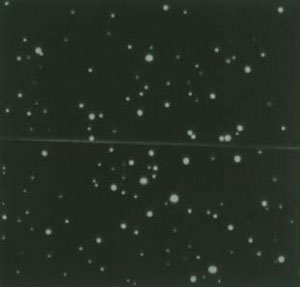
Vija Celmins, From China, 1982, graphite on acrylic ground on paper, 21” x 21.”
Like most of her work, Vija Celmins’ From China is based on a photograph—in this case a magazine clipping about one and a half inches square. Dense layers of graphite, applied with extremely soft pencils brought back from China to the artist as a gift, build up this dark field of the image while the stars are formed by the isolation of the white acrylic ground. What might be a comet trail, created by the aggressive drag of a pencil point that tears the fabric of the paper, divides the composition horizontally.
Faculty Choice
January 18 – February 6, 2000
January 18 – February 6, 2000