February 23 – April 23, 2023
Spruance Gallery
Arcadia Exhibitions is pleased to present “The Highwaymen: Fast Painting the American Dream,” on view from February 23 to April 23, 2023. The exhibition features sixteen tropical landscape paintings produced between the 1960s to the early 1990s by eight core members of a loosely affiliated group of 26 African American artists (25 men and one woman) based in Central Florida.
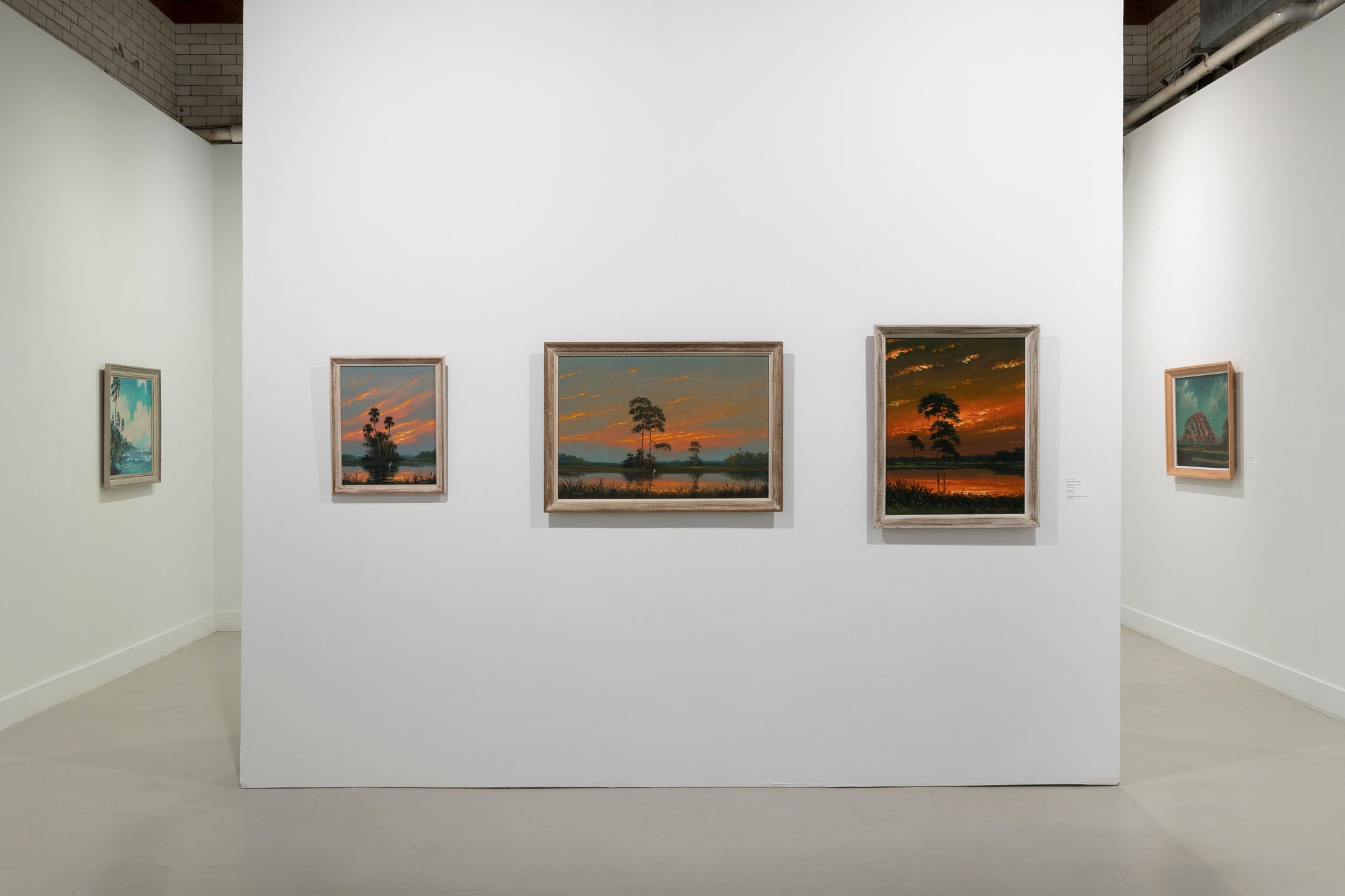
Installation view “The Highwaymen: Fast Painting the American Dream,” Spruance Gallery, Benton Spruance Art Center. Photo: Sam Fritch.
Largely untrained as artists, this informal cohort of young painters was rediscovered in the mid-1990s when they were retrospectively named the Highwaymen to refer to their innovation of an entrepreneurial strategy that harnessed landscape painting as a vehicle to bypass low-paying work in the state’s citrus groves. Shut out of the museum and the gallery system by racial segregation and Florida’s Jim Crow laws, the artists traveled the recently completed interstate roads and highways of Florida’s east coast, selling their paintings at reasonable prices “door-to door and store-to-store” from the trunks of their cars. Their mostly white patrons included a growing population of new homeowners as well as hotels, restaurants and doctor’s offices looking for affordable décor during the post-war boom period. In the process, the Highwaymen engendered a unique iteration of romantic regionalism that helped cultivate the iconography of Florida that nurtured the myth of the Sunshine State.
The sixteen paintings on view depict idyllic back-country marshes, windswept beaches, and conditions of light and weather that the artists knew first-hand, all executed in a range of “fast painting” processes. These include the use of “wet-on-wet” techniques, palette knives loaded with paint, and assembly-line methods that could yield up to 20 examples a day. Primarily rendered in oil on Upson board (an inexpensive roofing material) cut in standard sizes from 4 ft by 8 ft. sheets, the paintings were framed by the artists with off-the-shelf crown moldings that facilitated stacked storage and transport that allowed the works to sold while still wet often on the day they were made.
This collaborative enterprise, which some historians estimate yielded more than 200,000 paintings during its heyday from the late 1950s to early 1980s, can now be regarded as a hybrid practice that merged the classical traditions of the Hudson River School with folk art by way of Warhol’s Factory. Described by Artforum critic Zack Hatfield, as “brazenly formulaic but fringed with fantasy, these paintings parade a wonderfully unprecious attitude about living with, and making one’s living from, art.”

Installation view “The Highwaymen: Fast Painting the American Dream,” Spruance Gallery, Benton Spruance Art Center. Photo: Sam Fritch.
In addition to serving as a compelling example of overcoming systemic racism and economic oppression, the phenomenon of the Highwaymen is also a story of formal invention via emulation and subversion. The work was inspired by the success of A.E. “Bean” Backus (1906 -1990), the white mentor of the group known as “the dean of Florida Landscape painting” based in Fort Pierce, Florida. In 1954, Backus formally trained the 19-year-old Harold Newton, convincing him to abandon his focus on religious subjects. The following year, 14-year-old Alfred Hair began attending Backus’s Saturday-morning classes and came to realize, as Highwaymen historian Gary Monroe states, “that as an African American artist he could not attain the same level of success as his white mentor unless he sold scores of paintings at much lower prices.”
Hair’s solution included developing myriad forms of accelerating the painting production, including contracting friends to prepare boards, build frames, and peddle his paintings on the road. Monroe adds that Hair “didn’t know that by working away to build inventory he would inadvertently strip away artifice to reveal archetypes, imagery that was as sublime as it was descriptive.” His efforts exposed a market for painted fantasies of the region and his success motivated others in his circle to follow his lead. Newton, who is represented in the exhibition by four examples, is now recognized for his technical expertise while Hair is regarded as the group’s driving force and catalyst.
The exhibition includes works by Al Black (b. 1940), Mary Ann Carroll (1940-2019), Willie Daniels (b. 1950-2021), James Gibson (1938-2017), Alfred Hair (1942-1970), Roy McClendon (b.1932), Harold Newton (1934-1994), and Livingston Roberts (1942-2004).
Their paintings are included in the A.E. Backus Museum (Fort Pierce, Florida) the collection of the Smithsonian’s National Museum of African American History and Culture (Washington, D.C.), and the Florida Artists Hall of Fame (Tallahassee, Florida).
On Tuesday, March 28, Gary Monroe, Professor of Visual Art, Daytona Beach Community College and author of five books about the Highwaymen (four published by University Press of Florida), will lecture about the group and their work. Monroe’s talk will take place in the Great Room, University Commons and begin at 6:30 PM.
All works included in the exhibition are on loan courtesy The Walker Collection of Florida Self-Taught Art.
Special thanks to Lance Walker, Dorothy Hussey, and Gary Monroe with additional gratitude to Nina Johnson, Alex Baker, and John Ollman.

Installation view “The Highwaymen: Fast Painting the American Dream,” Spruance Gallery, Benton Spruance Art Center. Photo: Sam Fritch.