1999
Post Millennial Fizzy (Addressing the Possibility of the Future)
November 3 – December 19, 1999
November 3 – December 19, 1999
The Beaver College Art Gallery is pleased to present “Post Millennial Fizzy (Addressing the Possibility of the Future),” a group exhibition considering utopia, dystopia, and 21st-century culture. Co-curated by painter Adam Ross and Julie Joyce, director of the Luckman Fine Arts Gallery at California State University, Los Angeles, the exhibition features multimedia works by eleven Los Angeles-based artists, most of whom are presenting their work on the east coast for the first time. The exhibition opens November 3, 1999 with a reception for the artists starting at 7:30 PM preceded by a slide lecture by exhibition curators Ross and Joyce starting at 6:30 PM in Stiteler Auditorium, Murphy Hall, adjacent to the Art Gallery. “Post Millennial Fizzy” remains on view through December 19, 1999.
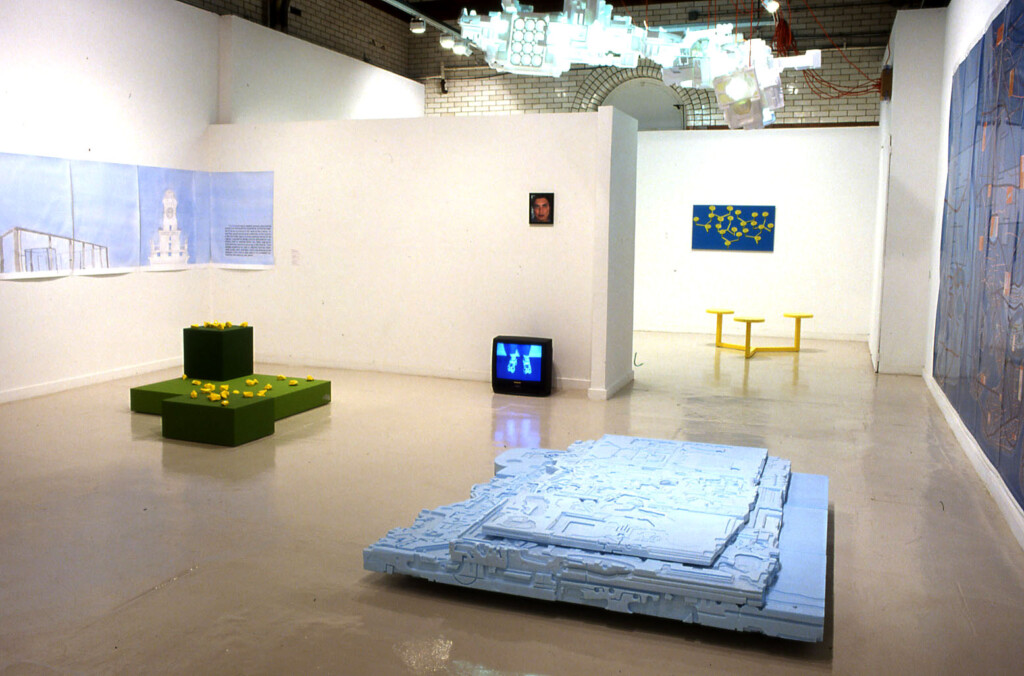
Installation view, “Post Millennial Fizzy (Addressing the Possibility of the Future),” Beaver College Art Gallery
The exhibition takes its name from a fictional soft drink consumed in a novel about post-Y2K America by acclaimed author David Foster Wallace entitled Infinite Jest (1995). In his 1073-page epic, Wallace describes an entertainment-obsessed society addicted to a movie so engaging that anyone who watches it loses all desire to do anything else. Focusing on concepts related to the future, rather than a futuristic aesthetic per se, the works in the exhibition become platforms for speculation whose ends are as resourceful, critical, inspiring, or as preposterous as those found in Wallace’s novel. While many of the artists included employ some form of technology, just as many eschew it for materials that are pointedly handmade. Whether cynical or utopian in their projections, most of the artists emulate advanced ideas regarding marketing, design and lifestyle.
“Post Millennial Fizzy” was first presented at the Luckman Fine Arts Gallery, Los Angeles, a city – due in part to the industries and attitudes that rise from it – is often associated with the manufacture of the future. The show’s presentation in Glenside is funded by grants from the Pennsylvania Council on the Arts and the Friends and Advisory Board of the Beaver College Art Gallery.
Works on Paper
September 9 – October 24, 1999
September 9 – October 24, 1999
The Beaver College Art Gallery is pleased to present its biennial “Works on Paper” exhibition, a juried show this year featuring 31 area artists, from September 9 through October 24, 1999. This year’s exhibition was selected by James Elaine, Artist and Curator of Contemporary Projects, UCLA Hammer Museum, (formerly Curator of Contemporary Exhibitions/Viewing Program Coordinator, The Drawing Center, New York).
The exhibition opens with a reception on Tuesday, September 14 at 6:30 PM beginning with a lecture by Museum of Modern Art Department of Drawing Curator Laura Hoptman to be presented at Beaver’s Stiteler Auditorium, directly adjacent to the gallery.
Elaine chose 34 works from 710 entries submitted by a record total of 371 regional artists. The artists–both emerging and established–are Susan Arthur, Joe Begonia, Matt Bergen, Randy Bolton, Marina Borker, Astrid Bowlby, Mark Campbell, Geoffrey DeMasi, Kevin Finklea, Alan Goldstein, Richard Harrod, Joseph Ives, Leroy Johnson, Brad Kalin (North Wales), David Kettner (Melrose Park), Deborah Kogan (Wyndmoor), Rodger LaPelle, Joanne Maynard (Doylestown), Jeremiah Misfeldt, Joseph Moser (Oreland), Steve Riedell, Scott Rigby, Paco Rodriguez, Judith Taylor, Geri Tuckett, Buy Shaver, Nancy Sophy, Kevin Strickland, Anne Seidman, Matt Wine (Melrose Park), Barbara Woodall and Base Kamp–a collaborative, not-for-profit studio/gallery run by David Dempewolf, Justine Matherly, Scott Rigby. (Unless otherwise indicated, all the artists listed reside in Philadelphia.)
Beaver’s “Works on Paper” exhibition remains one of the few juried shows in the area selected from actual artworks, as opposed to 35mm slides. This year’s show, while presenting a range of media–including photography, collage, and text-based conceptual projects–celebrates the formal economy of drawing and the virtues of paper as material support. Examples of interest include David Kettner’s graphic analysis of a child’s depiction of his father, spectral abstractions in oilstick and walnut oil by Alan Goldstein and Nancy Sophy, Steve Riedell’s spiralling discs of collaged song lyrics, and Joe Begonia’s graphite abstractions inspired by loudspeaker designs. A nocturnal,
suburban malaise emerges as the theme of works by Susan Arthur, Matt Bergen, and Mark Campbell. Base Kamp’s Failed Attempt at Shameless Self Promotion is a topical exercise documenting the artists’ ironic and exploitative encounters with Vito Acconci, Kiki Smith, and Sol LeWitt at recent Philadelphia receptions for these “famous artists.”
Laura Hoptman’s lecture will place Beaver’s “Works on Paper” show in a broader, contemporary context. Scheduled to begin at 6:30 PM on September 14th in Stiteler Auditorium, it is entitled “Drawing is a Noun: Working on Paper Today” and will address those factors Hoptman believes distinguish current drawing from work made as recently as 15 years ago. Hoptman’s curatorial endeavors at MoMA include “Sight Gags: Grotesque, Caricature, and Wit in Modern and Contemporary Drawing,” “Drawing on Chance,” and highly acclaimed shows for MoMA’s “Projects” series featuring Maurizio Cattelan, John Currin, Elizabeth Peyton, and Luc Tuymans.
A public reception for the participating artists will commence in the gallery immediately following the lecture.
Over the course of the exhibition, over $1,200 in cash will be awarded to five participating artists, including the Mildred Bougher Award ($500) and the Beaver College purchase award ($300). In addition, the Philadelphia Museum of Art will select a work for consideration for its permanent collection. All exhibiting artists also become eligible for inclusion in the gallery’s biennial “Closer Look” series. These group shows–each selected by an independent regional curator–feature 3 to 5 artists in greater depth while highlighting thematic relationships among their works.
The 1999 “Works on Paper” exhibition is supported by grants from the Samuel S. Fels Fund, the Pennsylvania Council on the Arts, and the Friends and Advisory Board of Beaver College Art Gallery.
Faculty Exhibition
March 25 – April 22, 1999
March 25 – April 22, 1999
Painting Pictures: Rendering the [Photo] Real
February 20 – March 21, 1999
February 20 – March 21, 1999
Beaver College Art Gallery is pleased to present “Painting Pictures–rendering the [photo]real,” a group exhibition of works by Matthew Antezzo, Judie Bamber, Peter Cain, Marilyn Minter, Mary Murphy, Richard Phillips, Paul Winstanley, and Kevin Wolff. Exploring the use of photographs as subjects for contemporary paintings, the exhibition will be on view from February 20 through March 21, 1999. Educational events include a gallery talk by exhibition curator, Richard Torchia, scheduled for Thursday, February 25 at 12:15 PM in the art gallery, and a lecture by participating artist, Indianapolis-based painter Kevin Wolff on Thursday March 4, at 6:30 PM in the Stiteler Auditorium, Murphy Hall. Wolff’s lecture will be followed immediately by a public reception in the Art Gallery.
“Painting Pictures” presents fourteen paintings on canvas, aluminum, wood, and paper that consciously employ photographs as their subjects in the literal, often labor-intensive manner of “photorealism” but with a range of intentions, procedures, and effects that would have been unlikely in 1970 when this term was first used to name the work of painters Richard Estes, Robert Bechtle and others. The practice of realistically transcribing photographs into paint on canvas, sometimes disparaged as a conservative derivation of pop art driven by a numbing technique, has nevertheless persisted into the 1990s. Spurred, perhaps, by the current reconsideration of seventies culture, in the past five years the word “photorealist” has been difficult to suppress as an effective term to describe the work of numerous critically acclaimed painters.
The exhibition serves as a way to mark the current impact of photography on painting, as well as to index critical shifts in both practices over the past thirty years. Works by Peter Cain (1959-1998), Kevin Wolff (Indianapolis) and Paul Winstanley (Great Britain) demonstrate photography’s new role as a highly adaptable source of both verisimilitude and abstraction. Mary Murphy (Philadelphia) and Judie Bamber (Los Angeles), use photos as a way to make an almost tactile, visceral contact with the recent past or as a method of mitigating personal loss. In the work of New York-based artist Matthew Antezzo, the material transformation from print to paint unleashes ideological and psychological content only latent in the original photographs. Other works in the exhibition demonstrate the lessons of 1980s appropriation art (Richard Phillips) the contemporary resurgence of figuration (Marilyn Minter), and the cultural primacy of painting despite the ubiquitous presence of photography within the mass media.
The exhibition is funded by grants from the Arcadia Foundation, the Pennsylvania Council on the Arts, and the Advisory Board and Friends of the Beaver College Art Gallery.
Since 1993 Matthew Antezzo has been basing his large-scale, grisaille paintings on photographs documenting performances and installations from the late 1960s and early 1970s. He selects works such Maggie Lowe’s Explosion (in which the artist detonated a pair of Hostess “Snoballs”) and whose existence is entirely dependent on its having been published in an art magazine (in this case, Art in America., Jan-Feb 1971, also the title of the work). While Antezzo’s translation of Lowe’s convention-challenging performance into an heroically scaled oil painting is not without its irony, his canvas strives to rescue an ephemeral gesture from certain cultural amnesia. Antezzo’s work can thus be read as an act of affection, if not for Lowe’s work in particular, for the epoch of radical experimentation for which it is emblematic.
Photographs from 1960s/70s publications also provide the sources for the recent paintings of Richard Phillips. These large-scale canvases, several of which were included in 1997 Whitney Biennial, typically depict the close-cropped faces of fashion models rendered at billboard scale and in a manner that equates the sensuous reality of oil paint on linen with the artifice of cosmetic beauty. In Transfixed, the model’s head is enveloped in a shadow of deep purple pierced by a vignetted spotlight that transforms her face into a blank mask blinded by glamour.
Phillips’ indulgence in the surface of painting as analog for the superficial allure perpetrated by the fashion industry becomes the target of works by Marilyn Minter. The two enamel paintings on aluminum eschew her signature, Ab-Ex “drips” in an effort to exploit the fetishism of what Minter recently referred to as “photo-shop realism.” Based on photos she scans into a computer, digitally alters, and then transcribes into shiny paintings on metal panels, often applying the enamel with her own fingertips, works such as Finger Toes Study expose forms of horror that can lie beneath glamour’s thin veil. In this tightly cropped collage, Minter seamlessly joins a hyper-real image of a glossy fingernail with a similarly cropped detail of a frosted toenail, suggesting that model’s hand has been monstrously deformed.
Judie Bamber employs her technical virtuosity to both ideological and personal ends. Her Untitled #1 is a life sized, tightly cropped close-up of female genitals. Scrupulously painted in oil on a piece of wood 6” x 1 3/4” x 2”, the work has an object-like (even phallic) presence that reverses Freudian readings of “female lack.” Based on a photograph, its extended sense of time and focused looking transcend the limits of camera vision and subvert taboos in viewers male and female, gay and straight. Bamber is also represented by two 10” x 14” watercolors of meticulously rendered photographs of her father (who died as a young man while she was still a child). A sunstruck black and white beach portrait (from 1966) and a flash-filled side-view of her father typing (based on a photo taken three years later and printed after his death) stubbornly record every nuance of the faded, original prints. Despite their fidelity to the snapshots, Bamber’s watercolors possess an elusive clumsiness that sidesteps sentimentality while subtly asserting her felt presence.
Mary Murphy has also cultivated a crafted approach to transcribing family photographs into psychologically charged paintings. Recognized in Philadelphia for her abstract paintings of interwoven, painted bands, in recent years Murphy has applied her fascination with the grid as image to the grid as an instrument of depiction. Mom, Dad, Maureen and Me translates a detail of a group portrait into a mosaic of 1200 one inch square gray tones, each loosely brushed and smudged into the next. The resulting distortion of detail accentuates facial features and anomalies, while alluding to the struggle of preserving identity within the often unspoken and repressive structures of family dynamics.
Indianapolis based artist Kevin Wolff is represented by two canvases that relate directly to his series of paintings of reflections exhibited in the 1993 Whitney Biennial. In Wall, False Hole, Mirror, Wolff depicts a photograph he took of a circle of black paper affixed to a mirror (unfocused) and a found photograph of an interior (beyond the mirror) into which a real hole has been cut. Mourning Picture represents a clipping (from a Spanish rock magazine) of two young men attached to a mirror tilted at an angle beyond which an inverted bouquet of roses hangs. One of the men, flattened and distorted by foreshortening, directs his eyes at the other, whose head has been cut out in a flower-shaped flap that hinges forward, parallel to the picture plane, his face and the scalloped edges that frame it sharply in focus. Both paintings’ play of gazes, reflections, and multiple methods of representing space suggest the baroque reflexivity of Valesquez’ Las Meninas, a work critic Hal Foster has suggested as a paradigm of photorealist practice.
Engaging cerebral puzzles are also posed by a pair of Los Angeles streetscapes by Peter Cain. Mobil and Glendale Boulevard might suggest the obsessive chaos of Richard Estes’ urban views were it not for Cain’s looser brushwork and suppression of all the usual commercial signage from these images of a gas station and convenience store. Devoid of the text and logos they would normally support, the blank display panels and banners assume an air of eerie expectation as they become more perfectly “new” again–as if they were models of themselves, uncompromised by actual application in the real world. Cain’s cityscapes participate in an unexpected dialogue not only with Edward Hopper but with Hans Hoffman and late Mondrian. Vacant of figures,they suggest a world customized for cars–the subjects of Cain’s earlier paintings (exhibited at the 1993 and 1995 Whitney Biennials) that earned him a cult following before his untimely death of a cerebral hemorrhage in 1997 at the age 37.
The deadpan depiction of cars, trucks, commercial graphics, and urban textures–glossy or gritty–attracted many of the original photorealists. This preoccupation with surfaces had more to do with the formal, pictorial, and illusionistic possibilities inherent in the appearance of these subjects than with any impulse toward critique or transformation. In a pair of 1989 paintings depicting the walls of a graffiti emblazoned underpass, London-based painter PAUL WINSTANELY demonstrates how the same, grungy urban subjects might be redeemed by the similar techniques. Rendered in foreshortened perspective, the cropped details of opposing walls, certain details obliterated by a blinding light at the terminus just past the frame, the uninflected pristine surfaces of these canvases imitate the texture of air brush–the very medium depicted in the painted image. The quotidian is rendered as a shimmering passage to the infinite.
Funded by the Arcadia Foundation, the Pennsylvania Council on the Arts, and the Advisory Board and Friends of the Beaver College Art Gallery.
A Closer Look 3
January 12 – February 14, 1999
January 12 – February 14, 1999
“Map me no maps, sir, my head is a map, a map of the whole world”
Henry Fielding (1707-1754)
We humans have long charted, plotted, and diagramed the world around us. The oldest existing map—a small clay tablet from Sumeria portraying an estate—was made late in the third millennium B.C. This universal process of mapmaking, of measuring and systemizing space, transforms one set of visual information into another. I had been preoccupied for some time by the artful manifestations of mapping in contemporary art when Beaver College Art Gallery Director asked me to curate “A Closer Look 3.” After sifting through nearly one-hundred dossiers, I created a short list of twelve artists. I then determined that the nucleus of the group would be Perry Steindel, an artist who has been making imaginary maps for the last thirty years. His art led me to other artists who puzzle over the conceptual terrain of thought and language. The group of seven I eventually selected employ both serious and comic strategies to address the ways people, animals, and plants make and stake the landscape.
“Maps are the vocabulary of passion that I speak,” Perry Steindel wrote in 1992. Steindel supports himself as a night staffer in a bank. On occasion he is obliged to wait for a long printout to be cranked out by a large printer. In those moments he may grab a piece of scrap computer paper he’s stowed away for the purpose and start a drawing of an imaginary coastline. To Steindel, creating these delicate, lyrical markings is a privately spiritual endeavor, as he takes the blank page and transforms it into a small, graceful drawing. His usual tool is a ballpoint pen refill, which is quite light in the hand; “like taking hold of a feather, or flying in a dream,” he says. Later he often salvages a part of the spontaneous image and works on it until he’s satisfied that it is complete. In general, maps serve as intermediaries between their maker, their users, and the environment. Steindel’s cartographic notations invite us to follow him into the territory of the mind’s eye.
The intimate, rebuslike paintings of Sharon Horvath explore the interpretive richness of diagrammatic markings. Horvath is as much inspired by the layered density of primitive archeological sites as she is by modern metro maps. In Heaven and Sea (1998), which appears to reference an electronic circuit as well as a body of water, Horvath frames her central form with a zig-zagged edging made by pinking shears. While Chronicle Paternal (1998) evokes a target or radar screen, Emerald Necklace (1996) suggests a forest from a bird’s-eye view. Regarding the role of maps in her work, Horvath recently stated: “My paintings are maplike suggestions of the physical and psychological energies that we call the self, and at the same time, they are attempts at portraying a world always shifting borders between inner and outer by which we recognize our world and our selves.” One work on view, a humorous etching and watercolor entitled Walking Map (1995), contains images resembling a tall shoe and peg leg. It evokes the “Walking Purchase,” an ignoble moment in Pennsylvania history when, in 1737, the sons of William Penn used a forged treaty to acquire territory from the Delaware Indians. They chose an exceptionally fit man to establish land boundaries loosely described as extending “as far as a man can go in a day and a half.”
In English language, we talk about “reading” a map as well as reading text. How is reading different from looking? Sue Patterson charts the territory of language through her linen cutwork lexicon mazes. Reflecting her current focus on the written word, she creates Scrabble boardlike formations of her own poems in the two works on view. In several instances, these texts refer back to their own form and to our awareness of the process of reading: “persons awaiting discovery may be lost forever…take the time for smaller problems.” Snaking around each rectilinear configuration of the machine-stitched text is a loose, gestural track of stitches, worked by hand in thread that glows in the dark. These patterns take the form of Porteus mazes, named after the early twentieth-century Australian educator who developed them as an educational testing tool. Each pattern documents a given individual’s series of “choice points” at important times of transition. Patterson awakens us to the notion of the maze as a map, recalling the way Ariadne helped Theseus escape the labyrinth by laying down a thread to serve as his guide.
In three distinct but related works, Yane Calovski employs aerial views and elevations to symbolically deconstruct his family’s house, designed and built by his parents. Starting with accurate architectural information, he maps the home and property, exploring different aspects of looking by showing us the house plan in different views and formats, including a masonite relief and two drawings—one on adjoined sheets of rice paper and the other on both sides of a bar of plexiglass. Precisely rendered, they not only suggest the propositional attitude of blueprints and models, but also register the structure as built, observed, inhabited, and adjusted. To the artist, these works “represent the ephemeral nature of remembering.” The specific dwelling, both documented and recollected, becomes “the active monument of our lives.” The text that inspired these works is a poem entitled The house and its imperfections by his father, the Macedonian poet and essayist Todor Calovski. Regarding his own sculpture, Calovski has said: “There is nothing perfect or absolute about any of these works; although they derive from a specific source, they have become self-referential by speaking of their own imperfections and transformations.” Airplanes and their shadows appear in two of the pieces, as does a small car that appears to exit the large rice paper drawing. Mimicking the narrative of travel, these elements animate the works and confirm the actuality of the house in relation to the world.
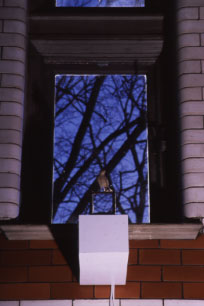
Bill Scanga, Singing Bird, 1999, mixed media with motorized, mounted specimen and audio, 16” x 12 1/2” x 16”, courtesy of the artist.
Bill Scanga is represented by three works that question context, including a miniature, well-appointed living room inhabited by a mounted frog. Are we to understand that the creature is in his own space, or is he an intruder? And what do we make of the other frog in the tableau. Scanga’s droll sculpture leaves us with as many questions as answers. The croaking sounds emerging from the loud speakers are a link to the creature’s natural habitat, where sound is a way of marking territory. High in the rafters of the gallery, beneath the sill of a small elevated window, Scanga has carefully sited another mounted specimen – a bird rocking suggestively back and forth on his perch. These seemingly auto-erotic motions are not accompanied by birdsong but by a vintage recording of tunes whistled by the legendary virtuoso Fred Lowery. Scanga is not afraid of making his audience laugh with his surreal juxtapositions of animal life and human appurtenances. In another work, Ant (1997), his amusing seven-minute videotape inspired by other “pioneering” animals as they intersect with the manmade, Scanga documents the successful space flight of a live insect traveling in a toy rocket.
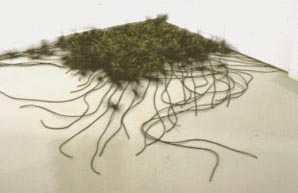
Susan Crowder, Ground Cover, 1998, electronic cable, plastic mesh, coated wire, 7” x 108” x 108”, courtesy of the artist
Like Scanga, outdoor sculptor Susan Crowder evokes grave questions about the opposing territorial imperatives of different species. Indigenous information often dictates the form of Crowder’s undertakings. Her favored materials are black rubber hose, coated wire, and plastic netting used to protect plants from grazing animals. When she employs conventional materials for works on paper, Crowder enjoys delineating a dense, central image, the edges of which she then fans or “smudges” into progressively lighter tonal passages. She was delighted to discover that when she cut and bundled, the plastic netting allows her to replicate in her sculpture the visual effect of her drawings. Ground Cover (1998) is a dark horticultural surrogate animated with the sinister will of hearty, invasive aliens. It expresses the random growth of plant life as it literally blankets the floor. Glenside (1998), the column-based sculpture situated outside the gallery, is surmounted by a bird’s nest. Crowder translates its classic forms back into the raw materials of trees. As such, it becomes a canny time capsule, using the language of architecture as interpreted in the late-eighteenth century, when people were interested in the origins of the classical orders and took pleasure in the rustication of forms. Primex (1998), a large, ersatz hanging planter, takes its name from the large garden supply store in Glenside.
The quasi-abstract canvases of Gerald Nichols reveal his interest in mapmaking as a primary—but not the sole—tool for capturing a “sense of place.” In Nichols’ semi-autobiographical work, The Nighthawks, for example, we can discern the meandering course of the Susquehanna River as it appears and disappears from view. Nichols’ use of geometry relates to what he refers to as “the conceit of controlling the shape of the world” as seen by his visual references to schema—for instance the configuration of the Big Dipper or a stylized leaf designed by a nineteenth-century American quilter. Institute for the Investigation of Winter (1997), the tongue-in-cheek title of one of Nichols’ three paintings on view, speaks to this unrealistic desire to quantify nature. Nichols highlights a vintage Airstream trailer making its way across the compositional circuitry. He succeeds masterfully here in conveying the buttery potential of paint while humorously referencing the archetypal green and red of the holiday season.
In his ancient volume Lives, the Greek biographer Plutarch described the work of geographers who “crowd into the edges of their maps part of the world which they do not know about, adding notes in the margin to the effect that beyond this lies nothing but sandy deserts full of wild beasts and unapproachable bogs.” Like Plutarchian geographers, the seven artists exhibiting in “A Closer Look 3” pay homage both to what can and cannot be seen. For most of us, it is a balance that is continually shifting.
Judith Stein, January 1999
1998
Paul Ramirez-Jonas: "Not the old, not the new, but the necessary" sculpture, photographs, video
November 11 – December 17, 1998
November 11 – December 17, 1998
The Beaver College Art Gallery is pleased to present “Not the old, not the new, but the necessary,” an exhibition of sculpture, photographs and video by artist Paul Ramírez-Jonas on view from November 11 through December 17, 1998. Titled after a 1920 revolutionary slogan crafted by Russian constructivist Vladimir Tatlin, the show is a compact survey of works by this New York-based Latin American sculptor and chronicles his nostalgia for technological failures and utopian ideals brought down to earth and into the light of the everyday. Among the earliest works included are examples from Heavier Than Air (1993-95).
For this project Ramírez Jonas used white cotton fabric and wood slats to construct replicas of late-19th century “flying machines” developed by inventors such as Alexander Graham Bell, Lawrence Hargrave, Walter Brooks and others – all of whom were left in the dust by the Wright Brothers. Ramírez-Jonas equipped each of these kites with disposable cameras (triggered by mechanical alarm clocks), which, when flown off New York’s Robert Moses beach, snapped aerial views of the shore. Each of the resulting prints depicts a length of colored string stretching from the base of the airborne kite (just out of the picture frame) to a tiny figure below – Ramírez-Jonas clutching the other end of the tether. Objective proof of the flight of each craft, these dizzying, vertiginous images also capture the romance of invention despite the artist’s patent awareness of the impossibility of recreating history. This sense of exploration at a commonplace frontier is especially apparent in a projected videotape from 1997 entitled A Longer Day. Charged with the Einsteinian possibility of using speed to stretch time, this deceptively straightforward work is driven by a mind-over-matter aesthetic and the myth of “westward expansion.”
Leaving his New York studio at sunrise with his video camera pointing directly out his windshield, Ramírez-Jonas drove due west with the express purpose of taping the sunset (midway through Indiana), which he prolonged and repeated by traveling slightly faster than the speed limit. This optimistic work is paired with Red Ball (1997), a 73”-diameter slice of the top of what would be a 40-foot diameter rubber sphere. Standing on this silicon mound, we are reminded of the curvature of the earth. This natural fact – effectively camouflaged by the scale of our planet – is responsible for a host of persistent phenomena that form the core of many of the artist’s projects, A Longer Day notwithstanding.
The most recent work in the exhibition, “Not the old, not the new, but the necessary” (1998), is a reinterpretation of Tatlin’s 1919 Monument to the Third International. This triptych of color photographs depicts three views of a Babel-like tower of studio paraphernalia – a sculpture stand, various chairs, an LP of salsa music, an electric fan, plastic buckets, a text on Proust, a jar of water, etc., illuminated only by the headlight of a toy locomotive speeding up and down the pile on a moebius-like track. Taken with 20-minute exposures, these photographs render the circuit of the train as a perfect double spiral, a form whose mathematical precision contrasts sharply with the quotidian chaos of the ad hoc structure that supports it. The work becomes a reminder of the paradoxes that distinguish Tatlin’s Monument, a tower whose technological idealism guaranteed its practical failure but ensured its potency as a symbol of international socialism. Ramírez-Jonas’ pragmatic reiteration, like all of the artist’s works, is fueled by a lucid, do-it-your-selfer’s sense of purpose and immediacy. Writing about the pieces he has selected for this exhibition, the artist remarks that the works look both forward and backward in time with a sense of wonder and joy that embraces the constancy of the physical world. The pieces also suggest that human endeavors are part of that constancy as well. They offer a utopian vision not of a better tomorrow, but simply of a present that will always have a tomorrow and a yesterday. Ramírez-Jonas was born in Los Angeles in 1965, and was raised in Honduras. He moved back to the United States in 1985 to attend Brown University. He received his MFA from the Rhode Island School of Design in 1989 and moved to New York later the same year. In addition to three solo exhibitions at Postmasters Gallery in New York (in 1994, ‘96, and ‘97), and London’s White Cube (1994), his recent efforts include projects at Rojer Björkholmen Galleri (Stokholm, Sweden), and Studio Guenzani (Milan). He is currently preparing a large-scale clockwork performance for the city of Utrecht, Holland that premiers this spring.
The exhibition will be accompanied by “Anything but the Present,” an illustrated conversation between the artist and Kirby Gookin (art historian, critic and curator) scheduled directly prior to the opening reception on Wednesday, November 11 at 6:30 PM in Stiteler Auditorium, Murphy Hall, on the Beaver College Campus.
The exhibition and lecture are funded by the Arcadia Foundation, the Pennsylvania Council on the Arts, and the Friends and Advisory Board of the Beaver College Art Gallery.
Period Room: A Project by Amy Hauft
August 18 – November 1, 1998
August 18 – November 1, 1998
The Beaver College Art Gallery is pleased to present New York based artist Amy Hauft, whose sculpture practice involves interventions into galleries, museums, and non-traditional sites that in the words of the Los Angeles Museum of Contemporary Art Curator, Connie Butler, have contributed to “the dissolve of the category that is installation art.” Hauft’s pieces often employ expansive planes of light-porous materials (theatre netting, organza, tracing paper) applied elegantly but pragmatically in response to the architecture of a given site to provide viewers with a refreshing awareness of the body in contact with a specific setting.
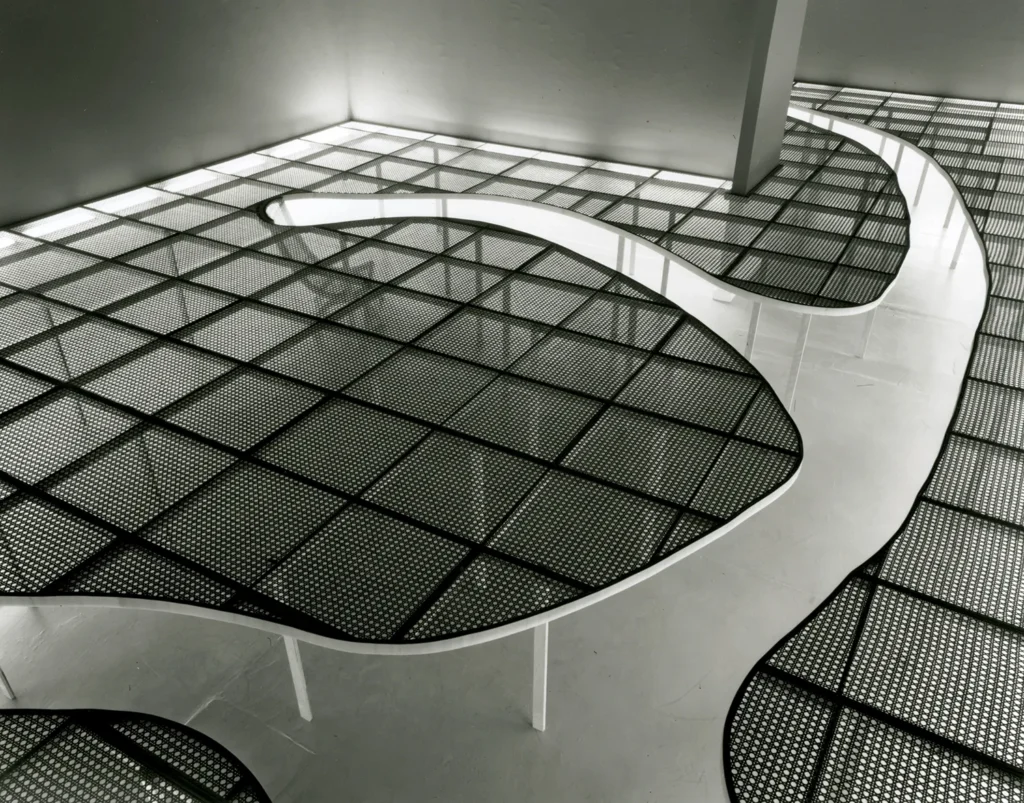
Installation view, “Period Room: A Project by Amy Hauft,” Beaver College Art Gallery
For her project at Beaver College Art Gallery, Hauft constructed a horizontal plane of caned plywood frames suspended at waist-level, wall-to-wall, throughout the 1200-square foot space. Three paths cut into this straw-colored, flood-like barrier led visitors to chaises designed and hand-caned by the artist. By integrating pathway, floor, and furniture at an exuberant scale, the installation both enveloped and supported the body, offering viewers the sensation of “wearing” space as if it were a garment. Lit from beneath by fluorescent fixtures and from above by natural light, the plane became transparent or opaque depending on the viewer’s position in the room.
Visitors were encouraged to recline in Hauft’s chairs, each of which offered ideal vantage points from which to view the 30-foot high, gabled ceiling and proto-modernist web of steel trusses that distinguish the 1893 structure that houses the gallery. Formerly a power station, the building was designed by Horace Trumbauer (1868-1938), a member of the team that drafted the plans for the Philadelphia Museum of Art (1911-28), whose many period rooms supply inspiration for Hauft’s project.
Hauft’s unprecedented application of caning—which we generally see in only discrete amounts of usually no more than one square foot at a time—is expanded from her installation at Beaver by the presentation of six historic cane chairs in area collections. These chairs were selected by the artist and designated at each venue by a free multiple—a printed cardboard disc that illustrated the chosen chair on one side and reproduced Hauft’s own hand caning on the other. Three of the chairs Hauft chose were determined as much for their sites as for the intrinsic beauty and history of the chairs. These venues included the second story Oval Parlor at Lemmon Hill (a federal mansion in Fairmount park), the Conservatory at Wyck (one of the oldest houses in Germantown), and the gallery at the Athenaeum of Philadelphia (a museum and library of decorative arts on Washington Square whose Reading Room is furnished with over 30 caned armchairs and stools).
The Heywood Brothers’ Recamier Settee (c. 1885-90) and Mies van der Rohe’s 1927 cantilever chair were presented on platforms at the Philadelphia Museum of Art in niches far from their original settings to provide viewers with a different perspective of the role these pieces play in the history of design. At the American Philosophical Society, one of a set of 34 popular chairs was placed in the lobby outside the Society’s famous library, which holds among other significant papers, all the historic records of Wyck.
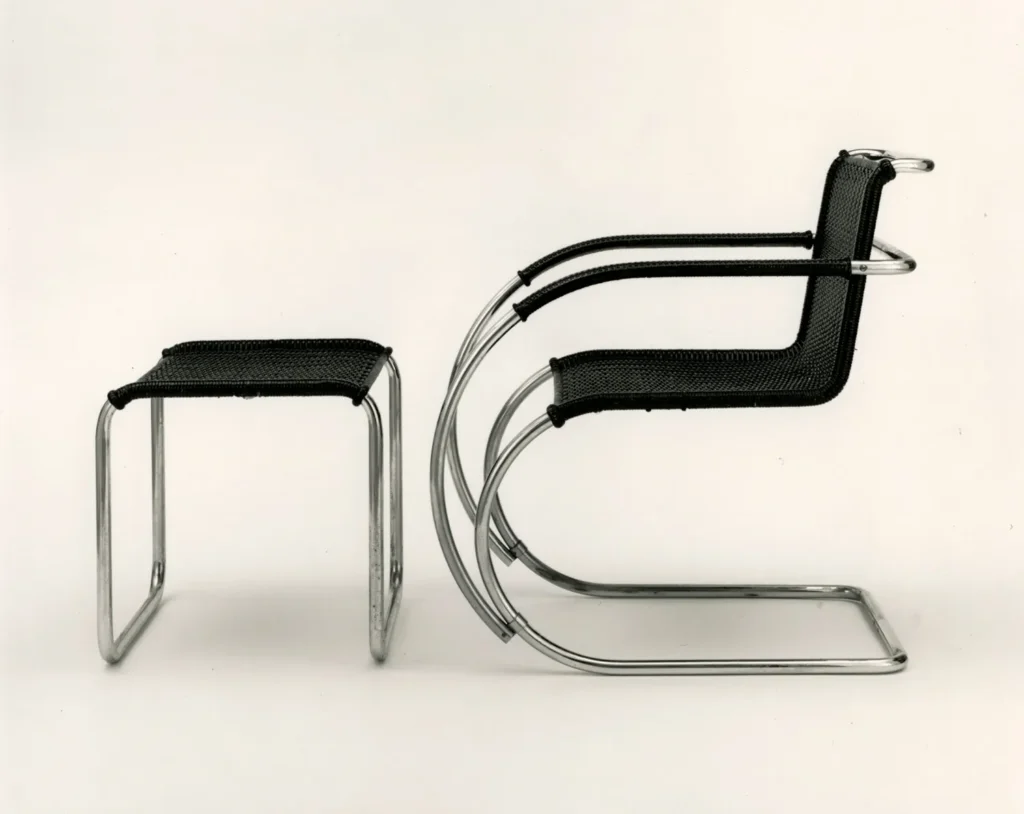
Installation view, “Period Room: A Project by Amy Hauft,” Beaver College Art Gallery
Caning satisfies Hauft’s fascination for labor-intensive process and the deployment of spacious planes that restrain bodily passages yet can be seen through. Caning is also a potent cultural form rich in world history. A caned day-bed, for example, was among the treasures found in Tutankhamen’s tomb, although it is Indian craftsmen who are credited for developing the use of woven rattan reeds for the seats and backs of chairs. More resilient and durable than European alternatives, caned chairs were portable and ideal for use in warm weather. Despite their lightness and comfort, however, they were initially frowned upon because of their cheapness. Demonstrating an example of upward social mobility in furniture, caned chairs eventually found their way into the grandest and most splendid interiors of England. It was during the 1890s (during the construction of the power station that now houses the gallery) that the rage for caned seats in the United States reached its peak—a fashion imported from Great Britain prompted by interest in Oriental products. A century earlier, Philadelphia was the primary American port for receiving rolled cane from China—a form of mass-produced, pre-fabricated caning still in demand today and which Hauft matches deftly with her own hand-woven cane work. Her unique approach to craft embraces these and other historical references to create the compelling experience offered by her installation and the cultural matrix provided by the project as a whole.
“Hauft’s chosen material for her horizontal plane—rattan caning—evokes a 19th century milieu of crafts, natural substances, handmade furniture, and, in her terms, ‘Yankee ingenuity.’ Inspiring the work is her own memory while growing up in Philadelphia, of going to various museums and seeing period rooms—all those exquisitely ordered chambers filled with perfectly preserved chairs and sensible commodes, dining room tables and wall-hugging dressers, generated by a culture that, while prone to visionary utopianism, has equally prized a can-do utilitarianism. In teaching herself the craft of caning, Hauft developed not only a hands-on relationship to the labor-intensive technique but also a hands-on engagement with the whole lengthy order of pioneering, do-it yourself individualism, especially as revealed through well-crafted but eminently useful domestic objects.”
— Excerpt from the essay “The Exact and the Vast” by Gregory Volk in Period Room and Other Projects.
“Sitting in one of the chairs, a visitor is placed at eye level with the vast datum of cane. With head cast back, the eye races across the surface and then wanders to behold the volume of space overhead. A respite from the constricted passages, the chairs afford some observation of the imponderables of an architecture that began as a power house and now exists for the contemplation of art. But there is an irresistible temptation to see how things work—to discern the engineering of this illusory force. This great floating, illuminated plane is not some chimerical incident. It is dutifully held in place by wooden legs with a banister of fluorescent lights to sustain a consistent luminosity with the changing sunlight. To sit in the chair is both an acceptance and a defiance of gravity. Viewers can sense the visceral facts of the structure, but feel mysteriously suspended, nevertheless.”
— Excerpt from the essay “Period Room: The Topography of Transience” by Patricia C. Phillips in Period Room and Other Projects.
Senior Thesis Exhibition
May 1 – 22, 1998
May 1 – 22, 1998
Works on Paper
April 1 – 26, 1998
April 1 – 26, 1998
Juror: Mark Rosenthal, Curator, The Solomon R. Guggenheim Museum, New York City, New York.
Participating Artists
Anthe, Jennifer Baker, Pay Boyer, Charles Burwell, Yane Calovski, Mark Campbell, Pete Checchia, Susan Crowder, Susan Deseyn, William Drake, Sandra Eliot, Tom Ferris, Hyunsoo Han, Marilyn Holsing, Judith Jacobson, Jeanne Jaffe, Kocot and Hatton, Anna Kuo, Shelly Inez Lependorf, Benjamin Long, Virgil Marti, Quentin Morris, Suzanne Okamoto, Sue Patterson, Stuart Rome, Lynca Schmid, Rita Siemienski Smith, Concha de la Serna, and Joseph Sweeny.
Kay Rosen: ABC (At Beaver College) Works Employing Alphabetical Sequences
February 16 – March 17, 1998
February 16 – March 17, 1998
The Beaver College Art Gallery is pleased to present “Kay Rosen: ABC (At Beaver College)” an exhibition of murals, paintings and drawings employing alphabetical sequences, on view from February 16 through March 17, 1998. The opening reception will take place on Monday evening, February 16, from 6:30 to 8:00 PM beginning with a lecture on Rosen’s work by Tom Sokolowski, Director of The Andy Warhol Museum, in the Stiteler Auditorium of Beaver’s Murphy Hall.
“ABC” provides an unusual opportunity to examine a series of integrally related pieces by an artist recognized for her innovations in the exploration of text as image. Each of the eight works in the exhibition draws on the deeply embedded, universal order of the English alphabet to reveal what Rosen refers to as “unofficial and coincidental encounters between structure and meaning.” In these characteristically bold and deceptively simple pieces (ranging from 1988 to the present,) Rosen mines the alphabet for examples of “pictorial onomatopoeia,” unearthing startling relationships between letter sequences as they are written, spoken, and named.
Rosen’s hair splitting attention to typestyle, color, cropping, and titles invests these unassuming samples of the alphabet with the ability to act in ways that conventional language rarely has a chance to. She creates conditions under which, instead of simply recognizing letters and words, as we do when we read standard texts, we can witness the release of dormant and unexpected meanings. The sequence D E F, for example, rendered with sign paint on canvas, speaks the title of Rosen’s painting, Deaf, a word in which we cannot hear the letter “a.” The addition of a period following the “v” in U Versus W (1995) transforms this three-letter sequence into a debate (U v. W) as well as a formal, typographical analysis. In addition to knowing the names of Rosen’s works, saying them aloud offers clues to their content. The puzzle behind the painted equation xy = z remains unsolved until its title, Xylophone is voiced by the viewer.
Other pieces in the exhibition are generated by Rosen’s nuanced disturbance of alphabetical progressions. The Beginning of a Byzantine Plot (1997), for example, continues the pattern of symmetrical inversion found in the first four letters of the word BYZAntine. The resulting narrative becomes too elaborate to follow, despite the rigor with which it is pursued. For The River (1988), the letters S T Y X are stacked between the banks of P Q R (above) and W V U (below). Reversing and backing up their natural flow, Rosen creates a verbal proxy of a mythological landscape.
Unlike the more declamatory voices used in the text-based work of artists such as Barbara Kruger and Jenny Holzer, Rosen opts for neutrality, even as she exposes the symbolic, patriarchal order represented by the alphabet –arguably one of the most influential instruments of control ever devised. The works included in “ABC,” with their persuasive, often humorous demonstrations of alternative readings of the alphabet, celebrate uncanny – yet seemingly inevitable – occurrences within this highly utilitarian tool.
Rosen’s manipulations, with their emphasis on the pictorial, tautological, and systemic possibilities of text, could be described as concrete poems and/or conceptual works, were they not so physically present as paintings, drawings, and environments. The two murals that feature prominently in the exhibition are cited specifically in response to a 34-foot long wall tinted sky – blue on one side of a shorter bisecting wall, and black on the other. Hand– painted in white against the blue are the first nine letters of the alphabet, the last two of which (colored yellow) spell the sunny American greeting of Rosen’s HI (1997 – 98). The alphabetical sequence continues on the other side of the wall from J to Q. The central letters of this group, LMNO (also painted yellow), comprise Rosen’s code for the Middle of a Film Noir (1990/97), a work that transforms the back gallery into a movie theater. Rosen’s linking of these two murals in the space echoes the way the word “alphabet” itself neatly fuses the first Greek letter, alpha to beta, the second.
Earlier this year, two billboard versions of HI were sited on Routes 15 and 144 in Lewisburg and Centre Hall, Pennsylvania, as part of a collaboration with Bucknell University’s Center Gallery. These two public works, presented anonymously, will remain on view through February 28, 1998.
Rosen, who will be on hand for the reception on February 16th, was born in Corpus Christi, Texas, and lives and works in Gary, Indiana. She received a B.A. from Tulane University and her M.A. in linguistics from Northwestern University. A recipient of three NEA Visual Arts Grants (in 1987, 1989, and 1995) and an Awards in the Visual Arts Fellowship (1990), she has presented her work in solo and group shows internationally since the early 1980s. In 1995 she was included in the group exhibition “Word for Word” (curated by Paula Marincola) at the Beaver College Art Gallery, where she presented a wall painting of her work Leak. Early next year, she will be the subject of a mid-career survey organized jointly by the Los Angeles Museum of Contemporary Art and the Otis College of Art and Design.
“ABC” will be introduced with a lecture by Tom Sokolowski on Monday evening, February 16th at 6:30 pm in the Stiteler Auditorium. Prior to his appointment as director of the Andy Warhol Museum, Sokolowski was, for twelve years, director of New York University’s Gray Art Gallery and Study Center.
Faculty Choice Student Juried Exhibition
January 27 – February 8, 1998
January 27 – February 8, 1998
1997
Michael Lucero: Confounding Artifacts
November 10 – December 16, 1997
November 10 – December 16, 1997
The Beaver College Art Gallery is pleased to present fourteen pieces from Michael Lucero’s “Reclamation Series,” the artist’s most recent and ongoing body of work begun in 1994. The seven sculptural works on view incorporate Lucero’s signature glazed vessels attached to dismembered garden statuary, broken African sculpture, and other distressed objects rescued from vintage thrift stores and antique fairs. (The damaged condition of the original artifacts is requisite to Lucero’s process and critical to the content of the finished pieces.) The seven gouache drawings included were executed on found pencil sketches from the 1940s, 50s, and 60s, similarly acquired and “restored.” Together, the drawings and sculpture epitomize a form of “iconographic pluralism” that “interprets culture as an aggregate, formed over time by exposure, improvisation, and adaptation.” 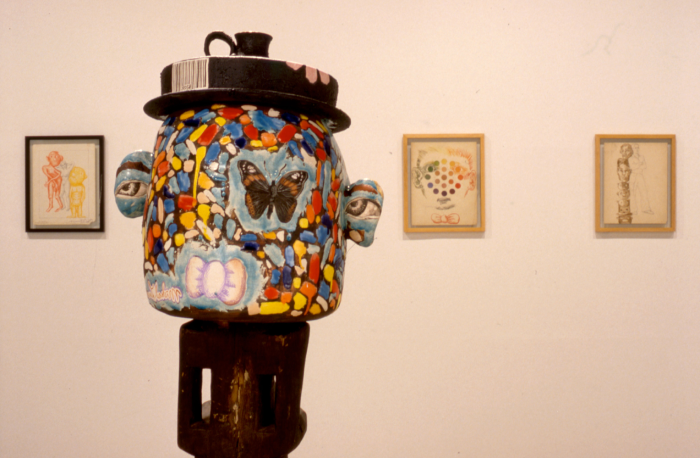
Installation view, “Michael Lucero: Confounding Artifacts,” Beaver College Art Gallery
White Poodle (1996) perhaps best exemplifies Lucero’s punning, syncretic approach. A metal armature inserted into the neck of a headless lawn ornament supports three glazed vessels. The one in the center, deftly painted with the sullen face of a dog to exploit the curved volumes of the pot, replaces the animal’s missing head. Near the folds in the long-necked vessel to the right, painted fingers pinch the clay, pointing to Lucero’s practice of altering pots wheel-thrown by an assistant. The floating “bubbles” on the third vessel and the metal rings, clamps, and stands (obtained from a chemistry set) suggest laboratory activity, confirming a kinship to “Frankenstein’s monster” and other creatures assembled from incongruous fragments. Lucero’s aesthetic prosthesis, however, not only re-animates and updates the broken garden toy, but refreshes our interest in it, creating a bold new breed of ceramic sculpture in the process.
Pink Nude (1995) resurrects a Latino santo figure, Knight (1995) recovers a dyed plaster “conquistador,” Luba Carolina (1995) repairs a cracked wood African sculpture, and Horse (1996) recuperates a decapitated equestrian statue. Treasure (1995) christens a drab miniature ceramic house with a sparkling coat of yellow “paint” dripping from a teapot. A tree once used as a theatre prop (Cedar, 1996) is put into service as a “bottle rack.” (Thinking of Duchamp’s “assisted ready-mades” here is apt, but ultimately limiting.) In each case, the cast-off object has been “reclaimed” by vessels potent with references to vernacular traditions such as the Native American totem pole, the bottle tree, and “face jugs”crafted by plantation slaves, as well as the eccentric vessels of Mississippi potter George Ohr, and other indigenous genres.
Lucero’s embrace of such explicit ceramic traditions is complicated by his conscious detachment from conventional attitudes toward clay, for example, his unapologetic use of commercial glazes and his adoption of “appropriationist” strategies developed by sculptors such as Haim Steinbach in the 1980s, who left his consumer goods and artifacts intact, but ideologically transformed by their presentation. Lucero uses pots to perform similar shifts in context and meaning, capitalizing on the medium’s fluid sculptural and cultural connotations. “In Lucero,” writes critic John Perreault, “everything, including ‘ceramics,’ is in ‘quotes.’ ”
Translated into two dimensions using found drawings, Lucero’s “reclamation” strategy operates more surreptitiously, but with no less invention. Exploring the pictorial possibilities presented by the negative spaces enveloping these earnest amateur figures, Lucero inscribes comic faces, strutting limbs, and third-world imagery to camouflage authorship while honoring difference. Each re-finished drawing becomes an unwitting collaboration that is all the more haunting upon the discovery, in some cases, of original dates and signatures.
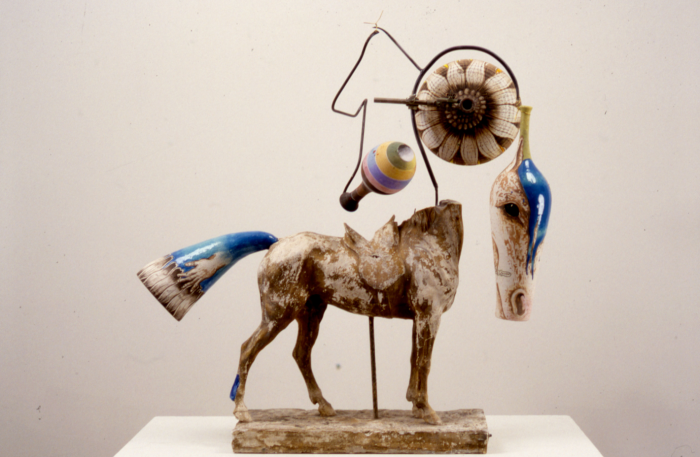
Installation view, “Michael Lucero: Confounding Artifacts,” Beaver College Art Gallery
Both the drawings and sculptural works are hybrid, quasi-surreal, history-sacking, boundary-busting, cross-cultural creations that defy the simple polemics of the machine vs. the handmade, high vs. low, and crafts vs. fine arts. Although Lucero’s approach could be regarded as irreverent, the net effect is celebratory. Restoring the vitality and aesthetic utility of these forlorn artifacts and sketches, he conveys what curator Barbara Bloemink has called “the ultimate triumph of visual cultures over anonymity, geographic displacement, and reigns of cultural conformism.”
Lucero’s exhibition continues the gallery’s interest in exhibiting innovative ceramic sculpture established by its shows for Daisy Youngblood in 1992 and Ken Price in 1995. With its focus on works from the “Reclamation Series,” this exhibition complements the artist’s traveling mid-career survey on view at the Renwick Gallery (National Museum of American Art) through January 4, 1998.
Currently a resident of New York’s East Village, where he has lived since the early 1980s, Lucero was born in Tracy, California in 1953. He received his B.A. from Humboldt State University before studying at Seattle’s University of Washington. Initially identified as a painter inspired by bay-area funk, Lucero chose instead to pursue ceramics because he was fascinated by the possibilities of using glazes as a way to paint on three dimensional forms. Early acclaim came with his large hanging figures assembled from clay shards and his “Dreamers” of the mid-1980s, sleeping heads glazed with visionary landscapes. The recipient of a Ford Foundation Fellowship and three Individual Artists Grants from the National Endowment for the Arts, he is included in public museum collections across the country, in Mexico and Korea. His retrospective, organized by The Mint Museum of Art (Charlotte, North Carolina), concludes it’s tour this spring at the Carnegie Museum of Art, Pittsburgh. Lucero’s work is represented in New York by the David Beitzel Gallery.
“Michael Lucero: Confounding Artifacts” is funded by grants from the Arcadia Foundation, The Pennsylvania Council on the Arts, and the Advisory Board and Friends of the Beaver College Art Gallery.
Donald Moffett Blue (NY)
September 17 – October 29, 1997
September 17 – October 29, 1997
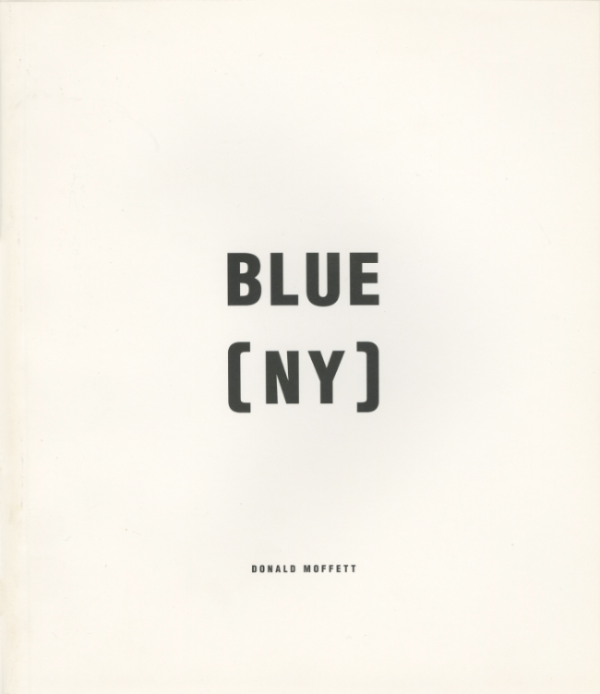
This exhibition is accompanied by a publication, Blue [NY]. For more details, inquire at gallery@arcadia.edu.
PRESS RELEASE
The Beaver College Art Gallery is pleased to present “Blue (NY)” a selection of new photographs by artist Donald Moffett on view from September 17 through October 29, 1997. The opening reception will take place on Wednesday evening, September 17, from 6:00 to 7:30 p.m. in the gallery.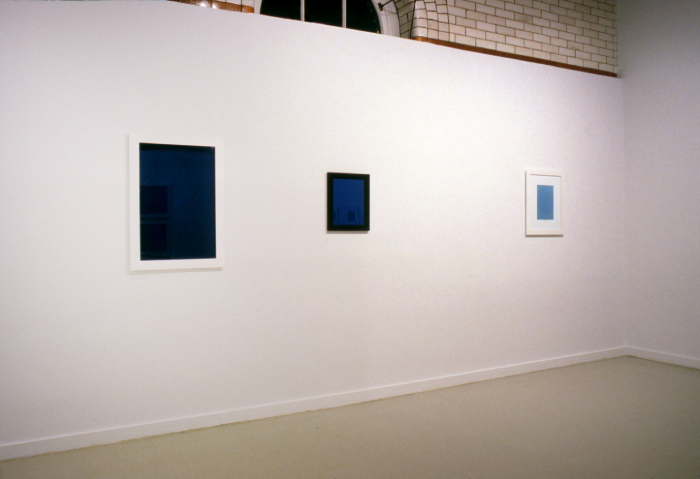
Installation view of “Blue (NY): Photographs by Donald Moffett,” 1997, Beaver College Art Gallery.
Moffett’s exhibition at Beaver College–his first significant exposure in the Philadelphia area–introduces a new body of work that represents a departure in both method and attitude from his previous projects. Those earlier works, executed in a variety of media, consistently fused the detached elegance of minimal and conceptual strategies with an unmistakable political punch. The photographic prints that comprise “Blue (NY)” are distinguished by their (baffling) simplicity. Depicting cloudless expanses of sky above Manhattan, they range in hue from a seemingly improbable navy to a drained baby blue. Printed at various scales, presented both as vertical and horizontal rectangles, glazed and bordered by white frames, the pictures paradoxically appear flat and opaque (even object-like), yet convey a latent depth and translucency.
“Blue (NY)” distills traditional codes of abstraction and representation, painting and photography, sculpture and poetry to achieve a kind of historical inevitability. With the utmost economy, Moffett links the Modernist legacy of the monochrome (from its Suprematist inception, its re-mergence in the 1950s, and its numerous contemporary manifestations) via Steiglitz’s Equivalents, to render the blue sky as both concrete record and abstract symbol of a persistent longing for the “ideal.”
Lacking any traces of scale and devoid of any physical subject–save daylight itself ricocheting within the atmosphere–the pictures are potent with interpretive possibilities. Open and generous, they quietly extend Moffett’s long exploration of the dangers and complexities of being queer in America, planting these concerns firmly beneath what he thinks of as the “shared canopy of blue.” The pictures, in effect, locate a safe haven, fine weather, and ultimately, the promise of hope for a population the artist describes as “beleaguered by more than a decade of catastrophe and assault.”
Moffett was born in San Antonio, Texas, where he attended Trinity University, receiving degrees in art and biology before moving to New York in the late 1970s. He began exhibiting his work in numerous group shows and one-person exhibitions at the Wessel O’Connor Gallery and Simon Watson. Last year he presented a “report on painting” (six small canvases) at Jay Gorney Modern Art. In addition to participating in exhibitions across the country, in Canada, and in Europe, his work was included in the (now infamous) 1993 Whitney Biennial and at New York’s New Museum of Contemporary Art, The Museum of Fine Arts (Boston), and M.I.T’s List Visual Arts Center. Moffett was a founding member of the AIDS activist collective Gran Fury.
“Blue (NY)” is funded by the Pennsylvania Council on the Arts and the Friends and Advisory Board of the Beaver College Art Gallery.
Blue [NY]
Richard Torchia
1997
“In the fall of 1997, the Beaver College Art Gallery [now Arcadia Exhibitions] introduced Blue (NY a series of photographs by Donald Moffett depicting cloudless expanses of sky above Manhattan. Presented in diverse formats (glazed and unglazed, with and without mats, bordered in black or white frames, or laminated to aluminum and mounted flush to the wall), the work was distinguished by its multiplicity of interpretations” (Richard Torchia, Curator.) Includes photographs of the artist’s work as well as an essay by Torchia.
Senior Thesis Exhibition
April 25 – May 16, 1997
April 25 – May 16, 1997
Yukinori Yanagi
March 27 – April 20, 1997
March 27 – April 20, 1997
Faculty Exhibition
February 20 – March 16, 1997
February 20 – March 16, 1997
The Beaver College Art Gallery is pleased to present its biennial Fine Arts Department Faculty Exhibition. This show, featuring work by both full and part time faculty members in the department, will be on view from February 20–March 16, 1997. An opening reception in honor of the faculty will be held on Wednesday, February 26 from 4:30–6:00 PM in the Art Gallery. The public is cordially invited to attend.
Exhibiting faculty members in this year’s exhibition include: Alma Alabilikian; Betsey Batchelor; Nancy Brandt; Celeste Callaghan; Anda Dubinskis; Robert Mauro; Karen Misher; Todd Noe; Scott Noel; Scott Rawlins; Carol Saraullo; Cynthia Swanson; Jas Szygiel; Judith Taylor, and Paula Winokur. The work on view spans a broad range of practices and activities including painting, sculpture, graphic design, printmaking, medical illustration, drawing, and interior design. Such a diversity of disciplines indicates the breadth of professional training available in the Fine Arts Department.
“We are proud of our faculty’s achievements and look forward to this biennial presentation of their work to the community,” notes Gallery Director Paula Marincola. “We know the exhibition will have special significance to students; alumni, and the Beaver College audience.”
A Closer Look 2
January 16 – February 14, 1997
January 16 – February 14, 1997
The Beaver College Art Gallery is pleased to present “A Closer Look 2,” the second in a biennial series that focuses upon area artists. “A Closer Look 2” has been organized by guest curator Richard Torchia, and will include work by Drew Dominick, Deborah Margo, Steve Riedell, Susan Tiger, and Alan Wiener; it will be on view from January 16 through February 14, 1997. A conversation between Torchia and artist/art critic Eileen Neff, with material contributed by the exhibiting artists, will be presented on Tuesday, January 28, at 6:30 PM in Stiteler Auditorium, followed immediately by a reception in the Art Gallery in honor of the artists. Both events are free and open to the public.
 Installation view, “A Closer Look 2,” Beaver College Art Gallery
“A Closer Look” was initiated in 1995 in order to present in greater depth the work of selected area artists who have previously exhibited in the gallery’s “Works on Paper” show, and whose achievements warrant greater attention. It also has been designed to point out significant relationships among artists working in this community.
Torchia has a unique expertise with regard to local artists. From 1987-95 he was curator at the Levy Gallery for the Arts in Philadelphia, Moore College of Art and Design, where he organized over 24 exhibitions for area artists, as well as wrote a number of scholarly essays to accompany gallery publications. Torchia is also a practicing artist, who has exhibited his work at the Center for Creative Photography, Tucson, the Institute of Contemporary Art, Philadelphia, the University of the Arts, Schmidt/Dean Gallery, Nexus; the Pennsylvania Academy of Fine Arts; the State Museum of Pennsylvania, Harrisburg, and the Carnegie-Mellon University Gallery, Pittsburgh, among many other institutions. He is also a recipient of a PEW Fellowship in the Arts.
1996
Patterns of Excess
November 7 – December 20, 1996
November 7 – December 20, 1996
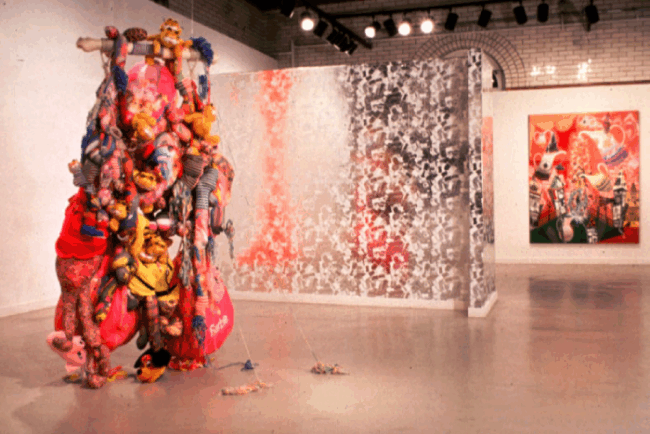
The Beaver College Art Gallery is pleased to present “Patterns of Excess,” a thematic exhibition for artists who embrace an aesthetic of visual complexity, from November 7 to December 20 in the Spruance Fine Arts Center on the campus.
Installation view, “Patterns of Excess,” Beaver College Art Gallery
Ingrid Schaffner, a well known New York critic, author, and independent curator, will present a lecture about the exhibition on Tuesday, November 19 at 6:30 PM in The Little Theater. A reception in the Art Gallery in honor of the speaker and exhibiting artists will immediately follow. Both events are free and open to the public..
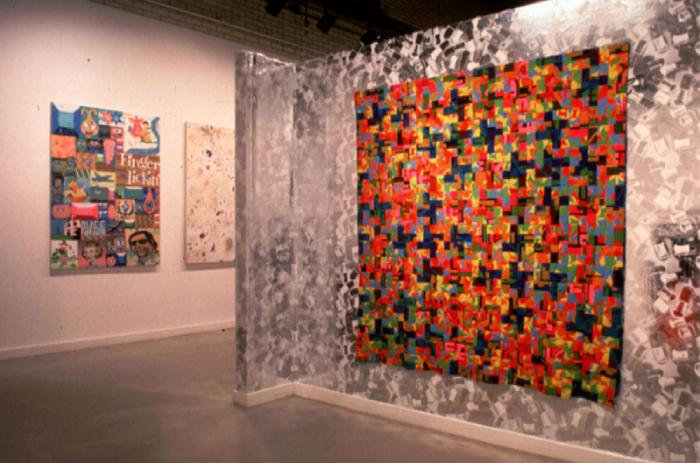
“Patterns of Excess” includes painting and sculpture by ten artists: Carole Caroompas, Jim Isermann, Larry Mantello, Virgil Marti, Stuart Netsky, Lari Pittman, Christian Schumann, Jessica Stockholder, Lily van der Stokker, and Fred Tomaselli. The “patterns” invoked by the show’s title refer not merely to repetitive motifs, but to means of construction that privilege additive processes such as accumulation, layering, and juxtaposition. Highly wrought, this work emphasizes its own physicality and is marked by intense color, surface density and compression, and the incorporation of “low” materials, with a predilection for glitz, kitsch, and references to consumer culture.
Often conjoining abstract and figurative elements, the work in this exhibition sets up a tension between representation and figuration. It is based in a transmuted decorative impulse, also indebted to Pop and Op art, that centralizes visual pleasure’s aesthetic and polemical value. It consciously pushes beyond simple formal and conceptual notions of the decorative, however, to deliver unexpected messages. For example, these works address the politics of sexuality, including gay survival and feminism (Caroompas, Netsky, Pittman); draw upon the realms of domestic craft and decor to parody prescribed forms of taste (Isermann, Marti); celebrate modes of juvenilia as icons of beauty and sentiment (Mantello, Schumann, van der Stokker); undermine pieties about the conflation of art and social life through poetically allusive assemblages (Stockholder), and allude to a liberated state still possible within the context of visual art (Tomaselli). The conscious extravagance of such work, its deliberate “impurity,” functions in effect and intent as a declaration against repressive aesthetic and socio-cultural practices, while always engaging and rewarding the viewer on a sensory level.
Installation view, “Patterns of Excess,” Beaver College Art Gallery
Caroompas, Isermann, and Pittman live in California; Mantello, Schumann, Stockholder, and Tomaselli live in New York; Marti and Netsky are from Philadelphia, and van der Stokker lives in Amsterdam. “This geographical diversity,” notes Gallery Director Paula Marincola, “attests to the widespread interest on artists’ part in this energetic and dynamic approach to artmaking. Such work compely a timely investigation.”
Ingrid Schaffner, who will lecture about the exhibition’s concept and artists, will also contribute an essay to its forthcoming catalogue. Schaffner has written extensively about contemporary art for Artforum, Art in America, Sculpture, Parkett, and Art & Antiques magazines. She has contributed essays to exhibition catalogues for several institutions including the Carnegie Museum in Pittsburgh, and the Solomon R. Guggenheim Museum in New York City. She recently wrote the catalogue essay for the Philadelphia Institute of Contemporary Art’s Jeanne Silverthorne show. Schaffner also has curated exhibitions such as “Richard Artschwager, Photo/Works 1945-1996,” “Like Young: Twelve New York Painters,” and received particular attention for “The Return of the Cadavre Exquis,” a show that involved contemporary artists in the collaborative surrealist drawing game of Exquisite Corpose, which originated at the Drawing Center in New York and traveled around the country. “Patterns of Excess” has been funded by the National Endowment for the Arts, a federal agency,the Pennsylvania Council on the Arts, and the Advisory Board and Friends of Beaver College Art Gallery.
Laughter Ten Years After
September 16 – October 27, 1996
September 16 – October 27, 1996
Senior Thesis Exhibition
April 26 – May 17, 1996
April 26 – May 17, 1996
Works on Paper
March 28 – April 21, 1996
March 28 – April 21, 1996
Endurance: The Information
January 17 – February 11, 1996
January 17 – February 11, 1996
1995
Ken Price: A Selected Survey (1960-1995)
November 9 – December 20, 1995
November 9 – December 20, 1995
The Beaver College Art Gallery is pleased to present “Ken Price: A Selected Survey” November 9 through December 20, 1995, located in the Spruance Art Center on the campus. Price will present a public lecture in conjunction with the exhibition on Tuesday, November 28, at 7 PM, in Stiteler Auditorium, followed by a reception in his honor in the Art Gallery. Both events are free and open to the public.
Ken Price is one of the most important ceramic sculptors to have emerged in California since 1945. Using glazed and painted ceramic as his primary medium, Price is renowned for producing forms of startling beauty, color, and mystery. While often small in scale, his variations on traditional forms such as the cup and the vase, and his free-form biomorphic sculptures, are surprisingly powerful with large frames of formal references. These works play out in clay aspects of both surrealism and geometric abstraction. Eluding easy characterization, his work forcefully spans the divide between fine art and crafts, occupying a unique position and demanding recognition as the oeuvre of a mature and major talent.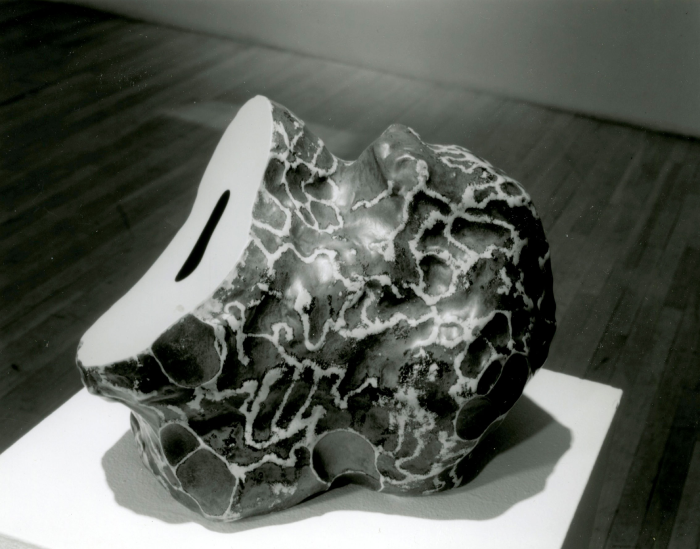
Installation view, “Ken Price: A Selected Survey (1960-1995),” Beaver College Art Gallery
Price’s exhibition at Beaver College will include examples of work from the late sixties to the present. “We are honored to present the sculpture of such an important American artist as Ken Price in our gallery,” notes Gallery Director Paula Marincola. “That he does not often visit the East Coast and so infrequently speaks publicly about his work makes this lecture an especially significant event in our community.”
Price, who was born in 1935 in Los Angeles, received a B.F.A. from the University of Southern California in 1956. From 1955 to 1956, he studied with Peter Voulkos, and it was during this time that he came into contact with other artists of the nascent sixties’ Los Angeles art scene. In 1958, Price received his M.F.A. from the New York State College of Ceramics at Alfred. He has exhibited his work extensively around the world. In 1992, the Menil Collection in Houston, organized a major retrospective of his work that also traveled to the Walker Art Center in Minneapolis. Price is represented in New York by Franklin Parrasch Gallery; he currently lives in Venice, California.
“Ken Price: A Selected Survey” has been funded by The Arcadia Foundation, the Pennsylvania Council on the Arts, and the Friends of Beaver College Art Gallery. The artist’s lecture is funded in part by a grant from The Montgomery County Foundation and the Forum Committee. A catalogue documenting the exhibition with an essay by prominent New York art critic Carter Ratcliff is forthcoming. Beaver College Art Gallery wishes to acknowledge the cooperation and assistance of Franklin Parrasch Art Gallery, New York, in realizing this exhibition.
Word for Word
September 14 – October 25, 1995
September 14 – October 25, 1995
Glenn Ligon and Gary Simmons: Selected Works
March 23 – April 24, 1995
March 23 – April 24, 1995
Faculty Exhibition
February 22 – March 15, 1995
February 22 – March 15, 1995
A Closer Look
January 18 – February 15, 1995
January 18 – February 15, 1995
The Beaver College Art Gallery is pleased to inaugurate “A Closer Look,” a new biennial series that will focus on area artists. The first exhibition in the series will include work by Carolyn Healy, Michael Macfeat, Quentin Morris and Anne Seidman, and will be on view from January 18 through February 15, 1995. An exhibiting artists’ roundtable discussion, moderated by artist and art critic Mary Murphy, will be presented on Wednesday, January 15, at 6:30 PM in Stiteler Auditorium. The opening reception in honor of the artists will take place in the Art Gallery immediately following the roundtable discussion. The discussion, exhibition and reception are free and open to the public.
“A Closer Look,” which will alternate years with the Art Gallery’s long-running “Works on Paper” juried show, has been initiated in order to present in greater depth the work of selected area artists who have previously exhibited in the “Works on Paper” show and whose achievements warrant greater attention. It will also point out significant relationships among artists working in this community. This year’s exhibition has been curated by Gallery Director Paula Marincola; guest curators will be invited to participate in the selection process in future years.
“We wanted to find more ways to serve the needs of the many talented artists working in our area,” notes Marincola, “and we believe this new biennial series will allow us to present deserving artists’ work in greater depth as we diversify our program.”
This years’ “A Closer Look” includes painting, sculpture and drawing, and opens a comparative dialogue between abstraction and assemblage as articulated in the work of the four exhibiting artists. Healy, for example, constructs objects from found materials in improvisatory ways that are sometimes toy-like and whimsical; sometimes poetic and moving. Macfeat’s spare sculptures are indebted to a post-minimalist emphasis on materiality. His unexpected placements and juxtapositions of materials often have a deliberately flatfooted kind of visual humor. Morris’ enigmatic, large circular abstractions, exclusively black monochromes, plumb the inventive possibilities that can be derived from deliberately limited means. His works are imbued with spirituality, but the socio-economic connotations of the color black – Morris is African-American – are also components of the paintings’ overall meaning. The repertoire of forms in Seidman’s gestural drawings are arrived at through both intuition and computer generated arrangements. Their combinations and relationships activate pure white fields and, while remaining completely abstract, evoke references to natural and man-made forms and objects.
All of the artists included in “A Closer Look” have exhibited frequently in the Philadelphia area at the Institute of Contemporary Art, University of the Arts, the S.S. White Building, Vox Populi and various commercial spaces, as well as in venues outside the city. Morris and Seidman are represented by Larry Becker Contemporary Art, Philadelphia; Healy and Macfeat are currently independent agents although both have formerly been affiliated with area galleries.
“A Closer Look” has been funded by The Arcadia Foundation, the Pennsylvania Council on the Arts and the Friends of Beaver College Art Gallery. The roundtable discussion has been funded by The Montgomery County Foundation.
1994
The Social Fabric
November 9 – December 20, 1994
November 9 – December 20, 1994
The Beaver College Art Gallery is pleased to present “The Social Fabric,” a thematic exhibition that includes emerging and established artists who have made substantial bodies of work using cloth as both a medium and metaphor for the complex interweaving of objects and values in our society, November 9 through December 20. The exhibition is free and open to the public.
 Installation view, “The Social Fabric,” Beaver College Art Gallery
Stuart Netsky, one of the featured artists in “The Social Fabric,” will present a new performance titled “Fake Fur” on Wednesday, November 9 at 6:30 PM in Beaver College’s Little Theater. Members of the community are invited to attend the performance and a reception immediately following “Fake Fur” in the Art Gallery. Admission is free.
Netsky combines the worlds of interior decoration, domestic handicrafts, high fashion and art in a work that is simultaneously camp, gorgeous and touching, and often bends or crosses gender lines. Netsky recently had a one-person exhibition at the Institute of Contemporary Art and has been included in numerous shows in New York, Boston and Philadelphia.
Artists featured in “The Social Fabric” often incorporate the fabrics and techniques associated with handicrafts and the domestic arts such as knitting, sewing, embroidery within the realm of fine art. They do so not to glorify “craft” but to use its vocabulary as a vehicle to address larger cultural issues as well as historical and social themes. Participating artists include Polly Apfelbaum, Renee Green, Michael Jenkins, Donald Moffet, Lois Nesbitt, Elaine Reichek, David Robbins and Meyer Vaisman, all of New York; David Hammond, of Italy; Mike Kelley, of Los Angeles; Stuart Netsky, of Philadelphia; Jana Sterbak, of Montreal; and Rosemarie Trockel, of Germany.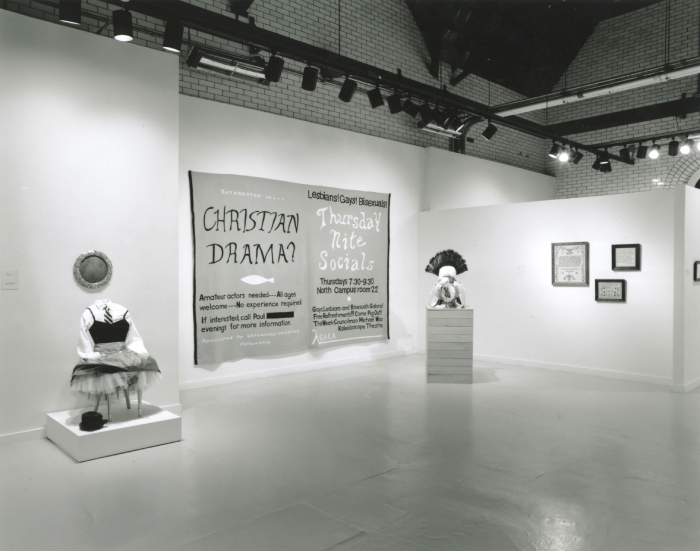 Installation view, “The Social Fabric,” Beaver College Art Gallery
Indebted to arte povera, conceptualism and feminine discourse, the two and three dimensional objects in “The Social Fabric,” such as samplers, banners, pillows, costumes, blankets, and a stuffed turkey, challenge the traditional heroic notions of the medium usually of fine art. Of equal significance, this kind of ephemeral fragile work is made as much by male as by female artists. For women, such efforts both elevate and subvert traditional ideas of “women’s work.” For men, this shows a deliberate crossing of the border of assigned gender roles. For both genders, these works draw upon the commonality of social experience expressed by cloth, as they straddle the gap between high and low, fine and applied art, and home and the world.
“This kind of work is strongly indicative of our moment’s social and artistic struggles,” notes Gallery Director Paula Marincola, “and such warrants examination and analysis. In addition, further suggesting the timeliness and relevance of our show.”
A catalog will be forthcoming documenting “The Social Fabric.” The catalog and exhibition have both been funded by the Arcadia Foundation, the National Endowment for the Arts in Washington D.C., a public agency, the Pennsylvania Council on the Arts and the Friends of the Beaver College Art Gallery.
Mary Heilman: Paintings, Drawings, Ceramics
September 13 – October 28, 1994
September 13 – October 28, 1994
This exhibition presents a selected overview of Heilmann’s paintings, drawings, and ceramics (tiles, functional pieces, and sculptures) from 1979 to 1994. Trained as a ceramicist under Peter Voulkos in San Francisco, Heilmann has been active since the 1960s. She is primarily known for her paintings characterized by a strong modernist sensibility that combines the geometric vocabulary of artists such as Mondrian and Malevich with a robust gestural quality associated with the Abstract Expressionists. The eccentric, softened shapes and intense colors employed by Heilmann, however, conjure up images of synthetic domestic décors and the pervasive lights of Las Vegas and Times Square. This frenetic vibe situates Heilmann’s paintings and ceramics within the brightly lit environments and quick pace of contemporary life.
Works on Paper
March 30 – April 24, 1994
March 30 – April 24, 1994
Felix Gonzalez-Torres
February 14 – March 14, 1994
February 14 – March 14, 1994
An exhibition of work by New York artist Felix Gonzalez-Torres will be on view at Beaver College Art Gallery, 450 S. Easton Road, Feb. 14 through March 14.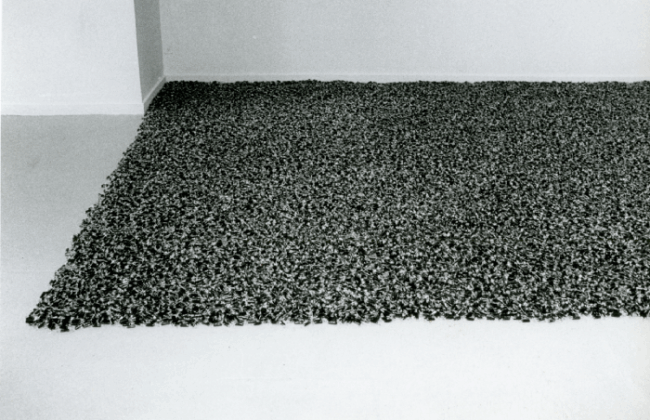
Installation view Felix Gonzalez-Torres, Beaver College Art Gallery, 1994. Photo: Larry Salese.
Press Release
GLENSIDE, Pa. – An exhibition of work by New York artist Felix Gonzalez-Torres will be on view at Beaver College Art Gallery, 450 S. Easton Road, Reb. 14 through March 14.
Born in Cuba in 1957, Gonzalez-Torres manipulates and combines characteristics of sculpture, photography, printmaking and performance in his work. He is perhaps best known for his installations of immense quantities of individually wrapped candy heaped in the corners of a room or spread out on the floor.
The Beaver College Art Gallery is located in the Spruance Art Center on the campus at Church and Easton Roads. The gallery is open to the public Monday through Friday 10 a.m. to 3 p.m., Sunday 1 to 4 p.m. and by appointment. Admission is free.
Noted artist Tim Rollins, who recently published a book-length interview with Gonzalez-Torres, will discuss Gonzalez-Torres’ art at a free lecture Thursday, Feb. 24 at 6:30 p.m. at the Little Theater, also located on the Beaver College campus.
Gonzalez-Torres employs a spare aesthetic that is indebted to post-minimalism and conceptualism and is infused with emotional and socio-political content. Themes of loss and love are predominate in his work, along with critical examinations of power and virility.
Los Angeles Times art critic David Pagel noted, “Gonzalez-Torres’ ‘Minimalism’ scrutinizes neither the facts of perception nor the reality of arts materials, but the social forces that hold us together and tear us apart.”
His well-known candy piles recall the corner works of Robert Smithson and the scatter pieces of Robert Morris. They exhibit abundant formal beauty while embodying the notion of a work of art as an object of consumption and gratification. He often invites viewers to take a piece of candy away with them, to undermine the idea of exclusive ownership and alter the elevated status of the art object.
Three Gonzalez-Torres works will be presented at Beaver College Art Gallery, including Untitled (Public Opinion), which is comprised of 900 pounds of foil-wrapped black licorice rods. This work, part of the permanent collection of the Guggenheim Museum, was created during the Gulf War and alludes to the manner in which public opinion was manipulated by the government and the media during that conflict.
Gonzalez-Torres also will exhibit several of his photostat “Date” works and a collage at Beaver College Art Gallery.
A variety of other kinds of works, including draperies, mirrors, lights and another candy pile will be exhibited at a concurrent show at The Fabric Workshop in Philadelphia Feb. 14 from 5 to 7 p.m. at The Fabric Workshop, 1315 Cherry St. Admission is free.
Gonzalez-Torres has had his work exhibited internationally with solo shows in Paris, Stockholm, Vienna, and Milan. He has been involved in numerous group exhibitions, including the 1991 Whitney Biennial and a current three-person exhibition at the Camden Arts Centre in London. The Philadelphia Museum of Art recently acquired and installed one of his works.
Gonzalez-Torres is the recipient of two artists’ fellowships from the National Endowment for the Arts, a Polock Krasner grant and a DAAD Artist-in-Residence grant. His exhibition at Beaver College Art Gallery. Tim Rollins’ lecture on the artist is funded in part by a grant from the Montgomery County Foundation.
Beaver College is a co-educational, independent, comprehensive college in suburban Philadelphia, offering undergraduate and graduate study to more than 2,300 students annually. The Beaver College Center for Education Abroad, one of the largest campus-based study abroad programs in the country, serves an additional 1,200 students each year from nearly 200 American colleges and universities.
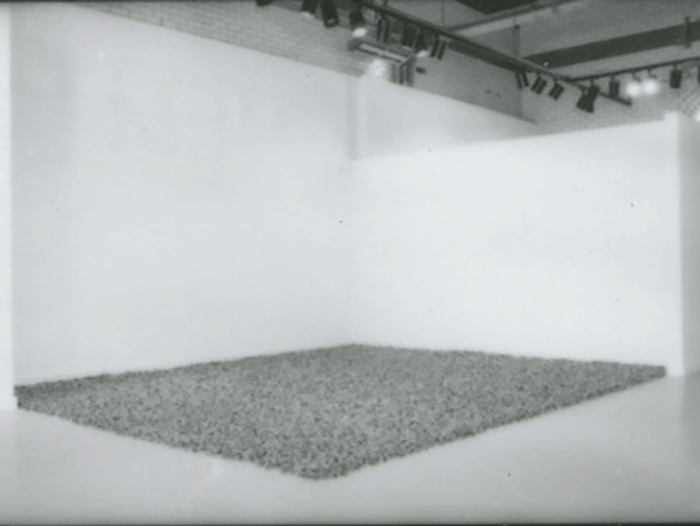
Installation view Felix Gonzalez-Torres, Beaver College Art Gallery, 1994. Photo: Larry Salese.
Faculty Choice: An Exhibition of Student Work Selected by the Fine Arts Faculty
January 19 – February 4, 1994
January 19 – February 4, 1994
1993
Ap Gorny: If You Only Knew
November 9 – December 19, 1993
November 9 – December 19, 1993
Text taken from original press release
Glenside, Pa. – “If You Only Knew,” a mid-career retrospective installation by Philadelphia artist A.P. Gorny, will be on view from November 9 through December 19 at the Beaver College Art Gallery. The Gallery is located in the Spruance Art Center on the campus located at Church and Easton Roads. November 9 will also feature a discussion between the artist and Judith Tannenbaum, associate director of the Institute of Contemporary Art, Philadelphia, beginning at 6 p.m. in Stiteler Auditorium. A reception in Gorny’s honor will follow in the Gallery. These events are free and open to the public.
Gorny has a considerable reputation in the Philadelphia community as a printmaker, photographer, installation and performance artist, and teacher. The installation at Beaver College represents an effort by the artist to summarize and survey his career to date. As is typical of Gorny, the work will be dense with complex, sometimes hermetic symbolism, informed by the artist’s voluminous reading and intensely personal, idiosyncratic approach.
“If You Only Knew” borrows its title from a poem about unacknowledged passion addressed to a mysterious loved one by the French Surrealist poet Robert Desnos. In the front of the Gallery, a chambered wall will be papered with images of bouquets taken by the artist over the course of 20 years. Each bouquet will enclose, within its foliage, a hidden lens through which the viewer peeps inside the wall at upside-down images of various “objects” of the artist’s desire. The acronymic title of this part of the exhibition, H.W.N.C.N.B.M. alludes to the ineffable, inexpressible nature of love.
The rear of the Gallery will be enclosed with entry possible only through a small portal. This room, entitled “Mise-en-abyme,” will be entirely papered in gold. Inside, at its far end, will stand a rectangular reflecting-pool/altar/sepulchre. Mounted above the water, an old cast iron stove will spout three jets of fire.From the ceiling an overhead cupola will reflect a chain of burnt-in images in the pool below.
Outside of the gallery, a conical pile of the artist’s old prints and drawings tied in bundles with black ribbons will await their ritual burning on a wooden pyre. The portion of the exhibition, designated as the “Auto-da-fe” and planned to take place during the exhibition’s opening, will be marked by a stone cairn that will remain outside the Gallery during the entire exhibition.
“A.P. Gorny is one of Philadelphia’s most interesting and prolific artists,” notes Gallery Director Paula Marincola. “And since part of our mission is to recognize and foster the efforts of artists in our own community, we are gratified to be able to offer him this opportunity to create an ambitious work especially for the Beaver College Art Gallery.”
Gorny, represented in Philadelphia by Locks Gallery, received his MFA from Yale University. He has taught at Tyler School of Art, Bryn Mawr College and Samuel S. Fleisher Art Memorial, and is currently a full-time faculty member at the University of the Arts. Exhibited nationally, his work is in the collection of the Guggenheim Museum of Art and the National Gallery, Washington, D.C., among others. Marincola will document the exhibit in a forthcoming publication. The exhibition and catalogue have been funded by the Dietrich Foundation; Arcadia Foundation; the Pennsylvania Council of the Arts and the Friends of Beaver College Art Gallery.
Kenneth Goldsmith: 73 Poems – A Series of 80 Drawings
September 14 – October 21, 1993
September 14 – October 21, 1993
Fred Wilson
March 30 – April 20, 1993
March 30 – April 20, 1993
Works on Paper
February 22 – March 21, 1993
February 22 – March 21, 1993
Faculty Exhibition
January 11 – February 7, 1993
January 11 – February 7, 1993
1992
Boys and Girls Together: Recent Photography
November 10 – December 18, 1992
November 10 – December 18, 1992
Richard Prince: Joke Paintings and Protest Paintings
September 15 – October 25, 1992
September 15 – October 25, 1992
Senior Thesis Exhibition
April 24, 1992
April 24, 1992
Works on Paper
April 2 – 22, 1992
April 2 – 22, 1992
Juror: Robert Storr, Curator, Department of Painting and Sculpture, Museum of Modern Art, New York City, New York.
Participating Artists
Betsey Batchelor, Joseph Begonia, Nicholas Coviello, Lynnette Detweiler, Drew Dominick, Kevin Finklea, Christopher Giglio, Barry Goldberg, A. P. Gorny, Neysa Grassi, Carolyn Healy, Mei-Ling Hom, Lydia Hunn, Hank Jaffe, Virgil Marti, Quentin Morris, Mary Murphy, Stuart Netsky, Gerald Nichols, Darwin Nix, Kevin O’Neill, William Jude Rumley, and Anne Seidman.
1992 Press Release
“…The Beaver College Art Gallery opens its annual, juried ‘Works on Paper’ exhibition Thursday, April 2, with a public reception, 7 to 8:30 p.m., in the gallery on campus at Church and Easton roads.
“Supported in part by a grant from the Pennsylvania Council on the Arts, the show includes 26 works by 23 area artists. In conjunction with the exhibition, exhibiting artists will present informal gallery talks on Wednesday, April 8 at noon in the Beaver college Art Gallery. The exhibition and gallery talks are free and open to the public.
“Robert Storr, curator of Painting and Sculpture, Museum of Modern Art, New York, served as juror for this year’s exhibition, selecting the participants from 509 submissions by 307 artists. Works selected include photographs, drawings on paper and wood, mixed media collages, a digitized video and relief print, woodcuts, lithographs, a performing object-sound drawing and work on paper composed with Valium and AZT.
“The majority of the artists in the exhibition are from Philadelphia and include Betsey Batchelor (19119), Joseph Begonia (19128), Nicholas Coviello (19118), Lynnette Detweiler (19146), Drew Dominick (19122), Kevin Finklea (19123), Christopher Giglio (19143), Barry Goldberg (19106), A. P. Gorny (19106), Carolyn Healy (19143), Mei-Ling Hom (19146), Lydia Hunn (19147), Virgil Marti (19106), Quentin Morris (19146), Mary Murphy (19106), Stuart Netsky (19103), Gerald Nichols (19104), Darwin Nix (19106), William Jude Rumley (19144), and Anne Seidman (19147).
“Other artists selected include: Neysa Grassi of Ardmore; Hank Jaffe of Jenkintown and Kevin O’Neill of Norristown.
“‘We continue to be gratified by both the high number of submissions t this exhibition and the excellent quality of the work. This year the competition was especially keen,’ noted Beaver College Gallery Director Paula Marincola. Prizes and awards will be announced within the next two weeks and these include: The Philadelphia Museum of Art Award; the Beaver College Purchase Award; the Mildred Bougher Award; the Director’s Prize and the Friends of the Beaver College Art Gallery awards for emerging artists.
“The ‘Works on Paper’ exhibit runs from April 2 through 22. Gallery hours are 10;30 a.m. to 3:30 p.m. Monday through Friday and 1 to 4 p.m. Sunday. For more information, please cal (215) 572-2131.”
Daisy Youngblood: Sculpture 1980-1991
February 24 – March 20, 1992
February 24 – March 20, 1992
Student Juried Show
January 27 – February 14, 1992
January 27 – February 14, 1992
1991
Residue Politics
November 14 – December 20, 1991
November 14 – December 20, 1991
The Beaver College Art Gallery is pleased to present “Residue Politics,” a thematic exhibition with artists Nayland Blake, Jennifer Bolande, Greg Colson, David Hammons, Mike Kelley, Christian Marclay, Karen Kilimnik and Christy Rupp, on view from November 14 through December 20.
There will be a public lecture by Germano Celant, curator for contemporary art, Solomon R. Guggenheim Museum, New York City, on Thursday, November 21, 6:00 PM in Stiteler Auditorium, followed by a reception in the art gallery. Both events are free and open to the public.
“Residue Politics” focuses on a new generation of American assemblage artists, indebted to Arte Povera, process art and conceptualism. Each of these eight artists restructures found and/or left over, discarded or otherwise marginal materials for both aesthetic power and a larger connection to and reflection of the social order, touching on a continuum of socio-political themes. For example, they comment upon the domestication of political corruption (Blake); caricature the sentimentalization of childhood (Kelley); configure tableaux torn from the American landscape of social and domestic violence (Kilimnik); memorialize the relics of popular culture as they examine their underlying sexual and economic ideologies (Marclay); reconstruct the complex layering of black culture and identity (Hammons); investigate our troubled relationship with nature (Rupp); and crate metaphors for the dislocated experience of late 20th Century culture (Bolande, Colson). Marclay and Kilimnik each created new installations especially for this exhibition.
“’Residue Politics’ attempts to direct attention to the substantive issues underlying a stylistic phenomenon,” notes Gallery Director Paula Marincola. “In drawing our attention to that which has been overlooked and often suppressed, the works in this show speak in a variety of compelling voices to a realm of shared information and experience.”
Of the artists in the exhibition, Bolande, Hammons, Marclay and Rupp live in New York City. Blake lives in San Francisco, and Kelley and Colson live in Los Angeles. Kilimnik lives in Philadelphia. Blake, Kelley and Marclay were included in the 1991 Whitney Biennial.
Celant, who is a contributing editor at “Artforum” and “Interview” magazines in addition to his duties at the Guggenheim Museum, will lecture Thursday, November 21, 6:00 PM in Stiteler Auditorium on the affinities between European Arte Povera and its “Americanized” version as manifested in the “Residue Politics” exhibition.
Celant is the critic and curator most loosely associated with the Arte Povera movement in Europe and is well known for his critical writing as well as for severa, major museum exhibitions that he has organized for institutions in the U.S. and abroad. He has written books on Joseph Beuys, Piero Manzoni, Jannis Kounellis and Michelangelo Pistoletto, among others. He is currently working on several shows, including a European retrospective to open at the Guggenheim Museum in 1992.
A catalogue will be forthcoming documenting the exhibition with an essay by Celant and an introduction by Beaver College Art Gallery Director Paula Marincola. The catalogue and exhibition both have been funded by the National Endowment for the Arts in Washington D.C., the Pennsylvania Council on the Arts, the Dietrich Foundation, the Friends of Beaver College Art Gallery and the Beaver College Department of Fine Arts.
Thomas Nozkowski: Selected Paintings 1980–1990
September 16 – October 27, 1991
September 16 – October 27, 1991
Senior Thesis Exhibition
April 26 – May 10, 1991
April 26 – May 10, 1991
Works on Paper
April 3 – 21, 1991
April 3 – 21, 1991
Faculty Exhibition
March 8 – 24, 1991
March 8 – 24, 1991
The Beaver College Art Gallery is pleased to present the Department of Fine Arts Faculty biennial exhibition from March 8 to 24 at the Spruance Art Center.
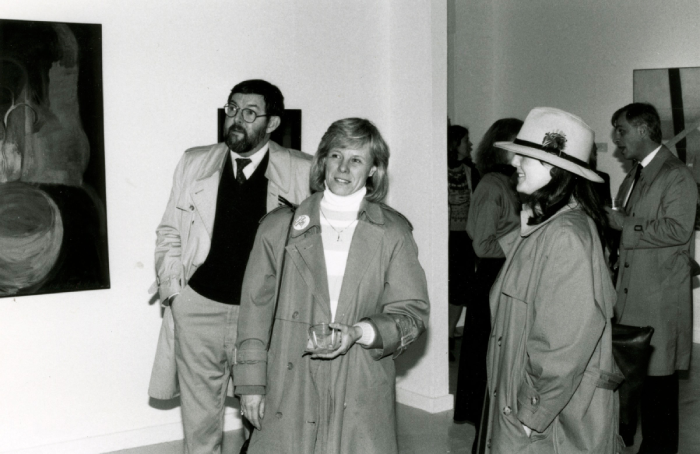
“Faculty Exhibition, 1991,” Beaver College Art Gallery
There will be a public reception in honor of the featured artists on March 13 from 4:30 to 7:00 PM in the Gallery. The reception is open to the public and free of charge.
Faculty members participating in the exhibition include: Alma Alabilikian, Betsey Batchelor, Celeste Callaghan, David Eagan, Holly Goeckler, Judith Heep, Dennis Kuronen, Mary Ella Marra, Robert Mauro, Rebecca Michaels, Karen Ott, Mary Lou Stewart, and Paula Winokur. Their works represent a wide range of disciplines including painting, photography, printmaking, metals, interior design, ceramics, and graphic design.
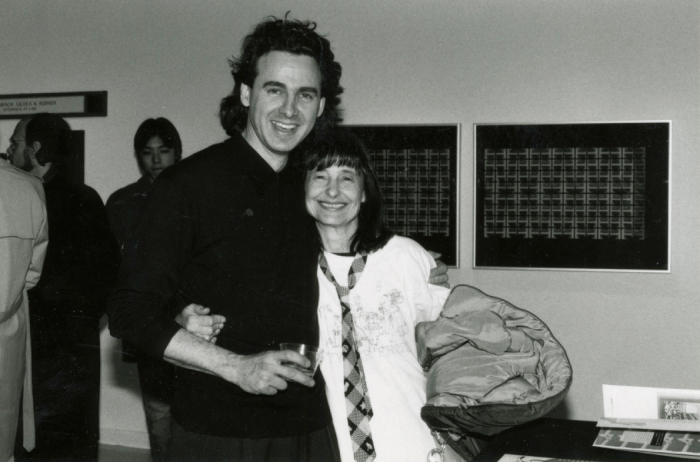
“Faculty Exhibition, 1991,” Beaver College Art Gallery
“We are very proud to have this opportunity to showcase the many talents of our excellent fine arts faculty,” noted Gallery Director Paula Marincola. “The quality and diversity of their achievements warrant recognition both within and outside of their community.”
Rona Pondick: Scrap
February 6 – March 3, 1991
February 6 – March 3, 1991
Beaver College Art Gallery is pleased to present “Scrap” by New York artist Rona Pondick from February 6 to March 3, 1991 at the Beaver College Art Gallery, located in the Spruance Art Center.
There will be an artist’s lecture on Wednesday, February 13, 1991 at 6:00 PM in the Little Theatre, followed by a public reception in the gallery in honor of Pondick. Both events are open to the public and free of charge.
Pondick, described as “one of the most important and original female artists” by Village Voice art critic Elizabeth Hess, is one of a new generation of Arte Povera artists who employ aesthetically potent cast-off and discarded material to create their work. Pondick, who received her MFA from Yale University where she studied with Joel Shapiro, has her roots in minimalism, but her art has been compared in psychological content and use of materials to sculptors such as Louise Bourgeois and Eva Hesse.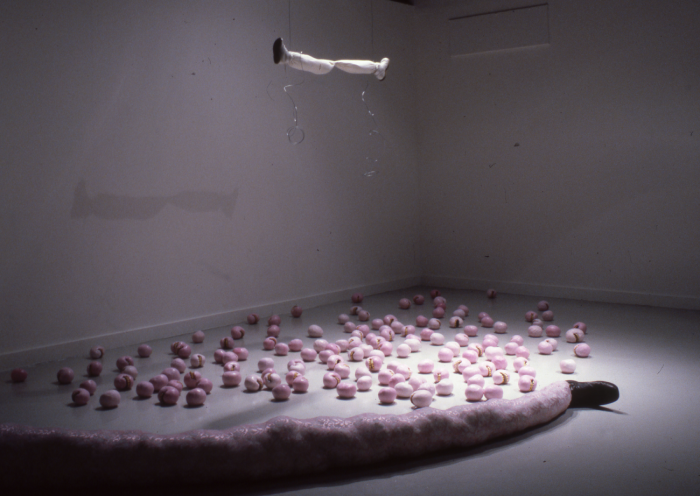
Installation view, “Rona Pondick: Scrap,” Beaver College Art Gallery
Pondick’s ongoing thematic investigations center around the Freudian premise that the life of the psyche is as much a biological story as a social one. Within these parameters, she pays particular attention to the realm of female eroticism and representation. Her fetishistic work, strongly surrealist, utilizes images of the body, its parts, waste products, and intimate accouterments such as beds, bottles, and shoes to direct the viewer’s attention to our culture’s ambivalent fascination with “taboo” subjects such as excrement, mother’s milk, and other body fluids and functions. The psychological ramifications of our most basic fixations and the blurred boundary between sacred and profane in our society are Pondick’s provocative and continuing subjects.
“Scrap,” an installation of works created especially for the Beaver College Art Gallery as part of its “Transformations” series, includes pieces made of shoes, lace, and polyester stuffing; wax, plastic and comic books; baby shoes, picture wire and polyester; and wax, plastic, and rubber teeth. Playing off the possible connotations evoked by its title — discarded objects, a tussle, “scrapmeat” — the exhibit addresses issues of physical fragmentation and sexual ambiguity.
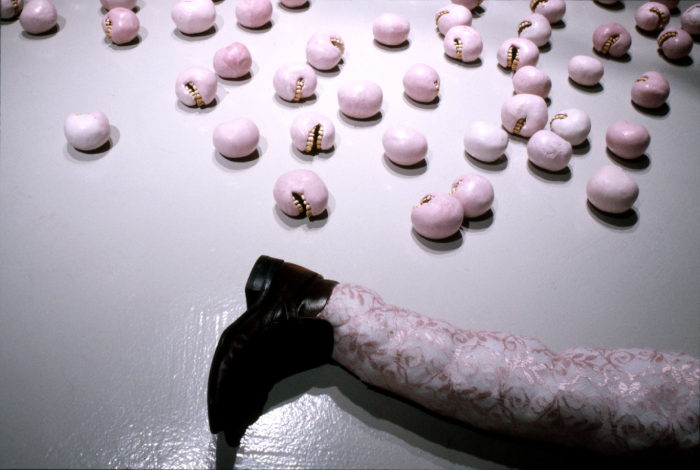
Installation view, “Rona Pondick: Scrap,” Beaver College Art Gallery
Pondick is represented in New York by Fiction / Non-Fiction Gallery where she will have a one person show in April 1991. Other solo exhibitions include those at Asher-Faure Gallery in Los Angeles; The Institute of Contemporary Art, Boston; and The Sculpture Center in New York City.
Pondick’s work will be included in the 1991’s prestigious Whitney Biennial at The Whitney Museum of American Art, New York City. She also has exhibited in several group exhibitions in Paris, Cologne, Los Angeles, Santa Barbara, and New York City.
“Scrap” will be documented in a spring 1991 publication, which will include a text by noted curator and critic Christian Leigh.
“Scrap” has been funded by the National Endowment for the Arts in Washington D.C., the Pennsylvania Council on the Arts, the Friends of Beaver College Art Gallery, and the Beaver College Department of Fine Arts.
1990
Who's Afraid of Red, White and Blue? Works by Donald Lipski
November 9 – December 21, 1990
November 9 – December 21, 1990
The Beaver College Art Gallery is pleased to present “Who’s Afraid of Red, White and Blue?,” simultaneous exhibitions by noted New York sculptor Donald Lipski, in collaboration with The Fabric Workshop and The University of the Arts, on display from November 9 through December 21, 1990. A public reception and opening for all three exhibitions will be held on November 9 from 5:30 PM to 7:30 PM at The University of the Arts. Lipski will discuss the exhibition and his other works in a public lecture at Beaver College on November 11 at 4:30 PM in the Stiteler Auditorium. Both events are open to the public and free of charge.
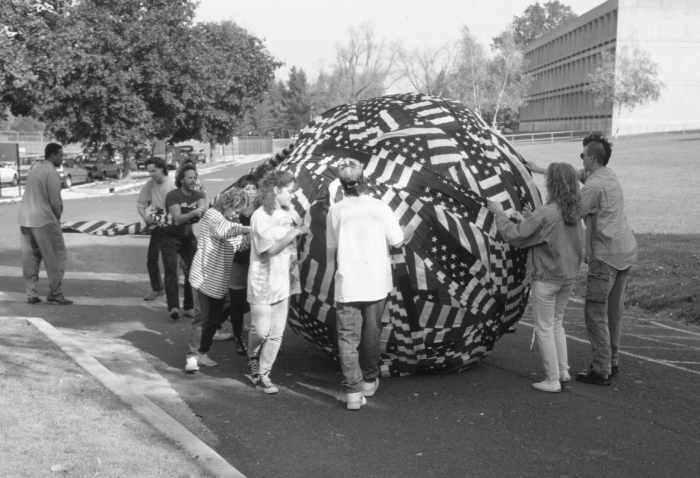
Sphere assembly, “Who’s Afraid of Red, White and Blue? Works by Donald Lipski,” Beaver College Art Gallery
Since the mid-seventies, Lipski has utilized his remarkable formal intelligence to transform the mundane identities of a variety of found and purchased materials ranging from the smallest domestic articles to industrial supplies and hardware. These objects undergo various manipulations — weaving, stacking, wrapping, joining — and are structured within simple configurations that combine the iconic simplicity of a minimalist presence with the unexpected, often revelatory wit of a surrealist sensibility.
In his most recent series, “Who’s Afraid of Red, White, and Blue?,” Lipski applies his familiar creative strategies to a new subject — the American flag. Works from this series will be simultaneously on view at Beaver College Art Gallery, The Fabric Workshop, and The University of the Arts and include several imaginative variations on this new theme. At Beaver College, Lipski will exhibit a large-scale, eight-foot in diameter wrapped flag ball on the campus with a complementary indoor exhibition of smaller-scaled flag balls. Other aspects of this project to be seen at the collaborating institutions include two-dimensional constructed, monochromatic and plaited flags of many different scales and materials. Lipski has been in residence at The Fabric Workshop, and many of these new works were constructed during his residence there. Other aspects of “Who’s Afraid of Red, White, and Blue?” will be seen at the Corcoran Gallery of Art in Washington D.C.
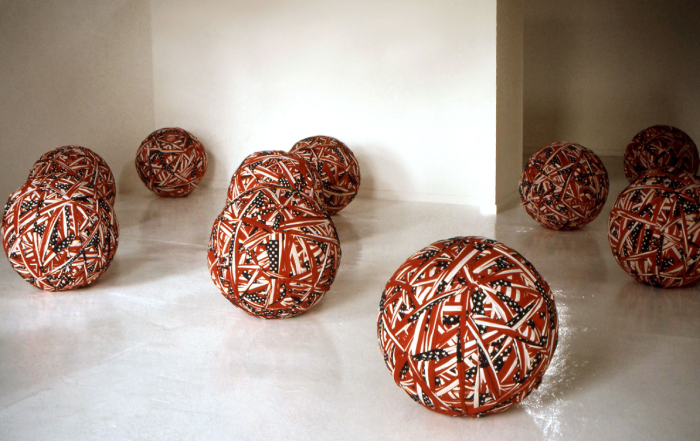
Installation view, “Who’s Afraid of Red, White and Blue? Works by Donald Lipski,” Beaver College Art Gallery
According to Paula Marincola, director of Beaver College Art Gallery, “The Flag as both pop and political symbol has proved a fascinating subject for contemporary artists. Jasper John’s flag paintings of the late fifties and sixties come immediately to mind, but Roy Lichtenstein, Andy Warhol and more recently, Vito Acconci and Robert Longo, among many other artists, have utilized this subject matter in various ways. The impetus for Lipski’s imaginative reconstructions of the flag was partly motivated by his response to recent attempts to legislate its usage.” “Lipski is a strong advocate of artistic freedom of expression and asserts that ‘you can make art out of anything in the work,'” said Marincola.
“But his flag series is also a natural outgrowth of his longtime interest in subjecting found objects to a playful series of structural permutations that expand their metaphorical resonance and interpretive possibilities. He is emphatic that this latest work be viewed primarily in an aesthetic context, and it is from the application of a cool, essentially formalist methodology to the presentation of a highly charged image that this work derives its power.”
Culture in Pieces: Other Social Objects
September 17 – October 24, 1990
September 17 – October 24, 1990
The Beaver College Art Gallery is pleased to open the 1990–91 season on September 17, 1990 with a thematic exhibition entitled “Culture in Pieces: Other Social Objects.”
The exhibition, displayed in the Spruance Art Center on the campus, will continue through October 24, 1990 and includes the work of nine artists: John Armleder, Saint Clair Cemin, Lauren Ewing, Robert Gober, Tishan Hsu, Annette Lemieux, Eileen Neff, Joel Otterson, and Steve Wolfe.
There will be a public reception, Tuesday, September 18, 1990 from 7:00 PM to 9:00 PM. Robert Gober, one of the most discussed sculptors working today, will speak in Beaver’s Little Theatre at 6:00 PM, immediately proceeding the reception. Both events are free.
All of the artists in this exhibition create metaphorical redescriptions of everyday objects, which we interact with in intimate ways. These works, including a lead covered bureau, an attenuated blackboard, a wall-mounted pewter drain, a black velvet bed shaped like the continent of Africa and a silver vinyl diner booth, poignantly or humorously evoke a range of mundane experiences from ordinary social contexts that connect to the larger world of meaning.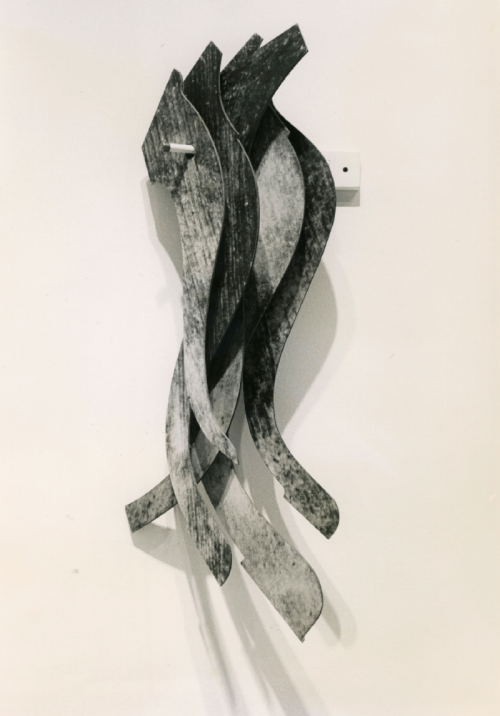
Installation view, “Culture in Pieces: Other Social Objects,” Beaver College Art Gallery
Whether stripped to a spare essence or imaginative hybrids of forms and media, these carefully crafted “pictures,” located at the junction of the symbolic and surreal, informed by minimalism and conceptualism, explore the object as an analogue for the self and an expression of our fragmented culture. Through metaphor they comment upon and reconstitute the social construction of the self through objects outside the self yet personal.
Most of the artists in this exhibition live and work in New York with the exception of Eileen Neff, who works in Philadelphia; John Armleder, who works in Switzerland, and Saint Clair Cemin, who works in Paris and New York City. Many, while relatively young, have achieved international recognition and respect.
A catalogue documenting the exhibition will be forthcoming in winter 1990 with an essay by Trevor Fairbrother, associate curator of Contemporary Art at the Museum of Fine Arts, Boston, and an introduction by Beaver College Art Gallery Director Paula Marincola. The catalogue and exhibition both have been funded by the National Endowment for the Arts in Washington, D. C., the Pennsylvania Council on the Arts, the Friends of Beaver College Art Gallery, and the Department of Fine Arts.
Senior Thesis Exhibition
May 10 – 26, 1990
May 10 – 26, 1990
Works on Paper
April 11 – May 6, 1990
April 11 – May 6, 1990
The Beaver College Art Gallery is pleased to present its annual, juried “Works on Paper” exhibition beginning Wednesday, April 11 through May 6, 1990.
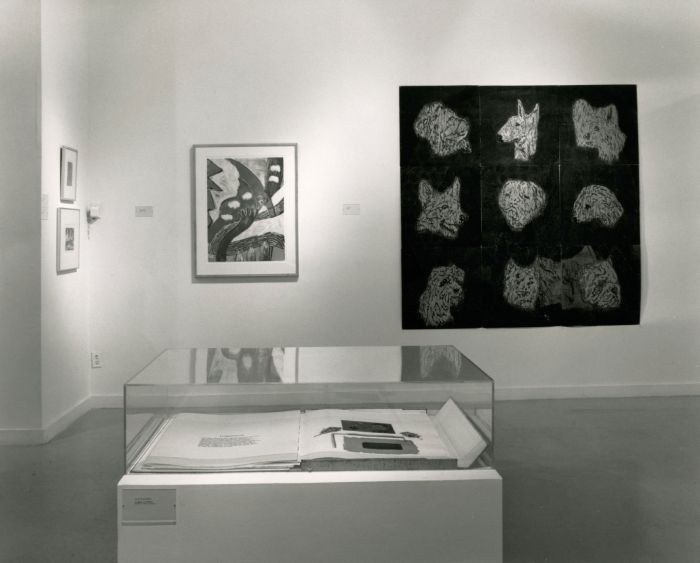
Installation view, “Works on Paper, 1990,” Beaver College Art Gallery
An opening reception will be held on April 11, 1990 from 7:00 to 9:00 PM on the campus at Church and Easton roads. On April 18, 1991 an informal gallery talk with the exhibiting artists will be held at 3:30 PM in the gallery. Both events are free and open to the public.
Supported in part by a grant from the Pennsylvania Council on the Arts, the show includes 34 works by 29 area artists. Robert Smith, art critic for the New York Times served as juror for this year’s exhibition, selecting, according to Paula Marincola, gallery director, “a lively and diverse group of works” from 326 submissions.
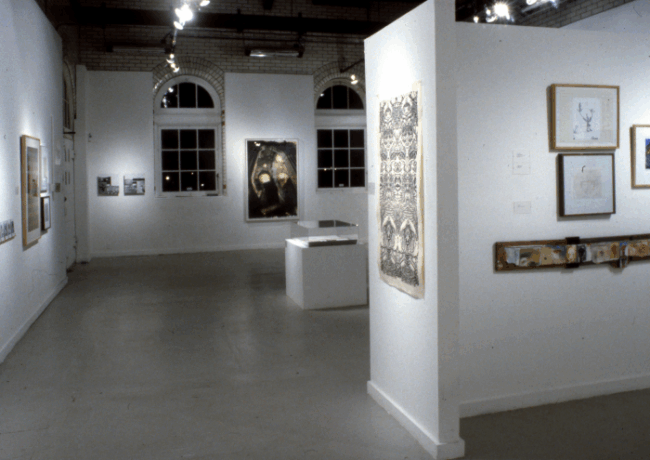
Installation view, “Works on Paper, 1990,” Beaver College Art Gallery
The artists in this year’s exhibition include Betsey Batchelor, Norinne Betjeman, Rachel Bliss, Marjorie Ellenbogen, Marcie Feldman, Esther Rose Fisher, Bilge Friedlaender, Carl Fudge, David Goerk, Neysa Grassi, Sharon Horvath, Lydia Hunn, Harry Kalish, David Kettner, Matthew Lawrence, Michael Macfeat, Deborah Margo, Kate Moran, John J.H. Phillips, Florence Putterman, Thomas W. Roberts, Tony Rosati, Anne Skoogfors, Merle Spandorfer, Marion Spirn, Jude Tallichet, Gregory Tobias, Sarah Van Keuren, and Brian L. Wagner.
Beaver College Juried Student Art Exhibition
March 8 – 25, 1990
March 8 – 25, 1990
Phoebe Adams: Selected Works 1984–1989
February 8 – March 4, 1990
February 8 – March 4, 1990
Beaver College Art Gallery is pleased to present Phoebe Adams on Thursday, February 8, at the Beaver College Art Gallery, located in the Spruance Art Center.
The exhibit includes a selection of Adams’ work from 1985 to 1989 and is the first career summary for this artist.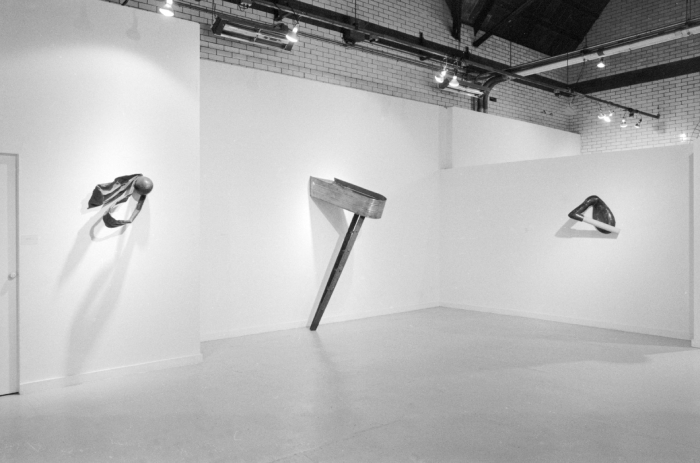
Installation view, “Phoebe Adams: Selected Works 1984-1989,” Beaver College Art Gallery
There will be a public reception for the artist from 7:00 to 9:00 PM in the gallery. At 6:00 PM, immediately preceding the reception, Adams will give a lecture in the Little Theatre on campus regarding her work. Both events are free and open to the public.
Phoebe Adams has emerged as one of this area’s most prominent artists and in the past few years she also has achieved increasing national recognition. Her unique cast bronze sculptures, to which she has recently added copper and wood, are rooted in physiological phenomena, appearing by turns archeological and anatomical. They derive from the tradition of biomorphism as pioneered by Jean Arp, Joan Miro and, more recently, Louise Bourgeois. Adams’ sculptures evoke a wide range of associations with organic processes such as fossilization and decomposition and with natural forms such as shells, ammonites, human organs and bones, crustacean appendages, pods and cocoons. In her oeuvre images of growth and transformation are metaphors for psychic processes: the manner in which ideas grow, turn in on themselves and give birth to new thoughts.
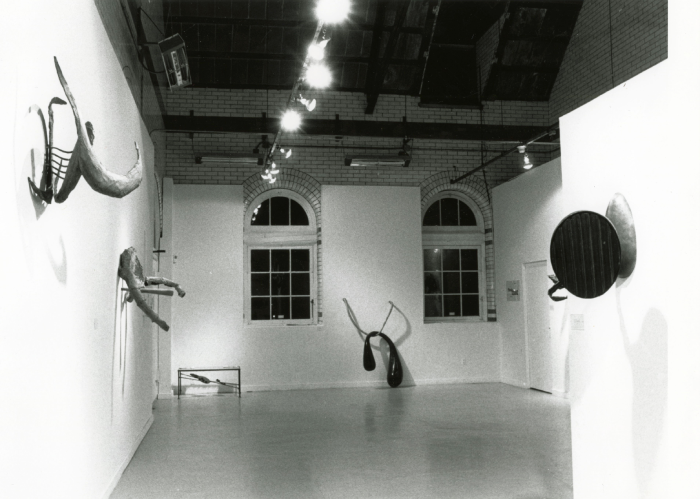
Installation view, “Phoebe Adams: Selected Works 1984-1989,” Beaver College Art Gallery
“The presence of such an accomplished artist in our community warrants attention and recognition,” noted Beaver College Gallery Director Paula Marincola, “and we are very pleased to be organizing this overview of Phoebe Adams’ work.”
Adams’ work has been included recently in major exhibitions across the United States, including 1988’s highly regarded “Sculptures: Inside Outside” at the Walker Art Center, Minneapolis, and the forthcoming “Sculpture on the Edge” at the deCordova Museum in Lincoln, Massachusetts. For the Walker Art Center Adams also was commissioned to create a permanent public sculpture for their new sculpture garden, which includes works by most of the major sculptors working today. Adams is the recipient of a National Endowment for the Arts fellowship and two Pennsylvania Council on the Arts grants. Her work is in the permanent collections of the Walker Art Center; The Metropolitan Museum of Art, New York City; the Guggenheim Museum, New York City; and both the Philadelphia Museum of Art and the Pennsylvania Academy of Fine Arts. Represented by Curt Marcus Gallery, New York City, and Lawrence Oliver Gallery, Philadelphia, Adams teaches sculpture at Moore College of Art and at the University of the Arts in Philadelphia.