2026
2025
Hiro Sakaguchi: Landscapes of a Restless Mind
August 27 — December 14, 2025
Spruance Gallery
Curated by Cynthia H. Veloric, PhD
Arcadia Exhibitions is pleased to present “Hiro Sakaguchi: Landscapes of a Restless Mind” from August 27 through December 14, 2025 in the Spruance Gallery.
Curated by Cynthia H. Veloric, PhD, this show contains drawings and paintings surveying the entirety of this well-regarded Philadelphia artist’s career.
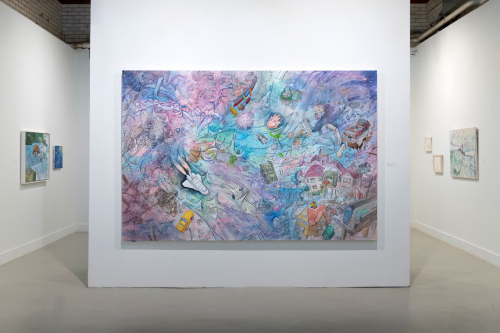
Installation view “Hiro Sakaguchi: Landscapes of a Restless MInd,” Spruance Gallery, Benton Spruance Art Center. Photo: Sam Fritch
From Cynthia H. Veloric’s curatorial essay
Hiro Sakaguchi has spent the last thirty years witnessing, recalling, and re-interpreting a world in literal flux. Born in Japan and living in the Philadelphia region since the 1990s, by all appearances he is a calm, thoughtful, reticent man. This outer solemnity stands in stark contrast to the intricacy, intensity, and chaos of his speculative landscapes – amalgams of locales and objects drawn from memories of his childhood and his global wanderings.
Whether working on smaller compositions on paper or large-scale canvases, Sakaguchi’s paintings and drawings reveal an inner restlessness through highly complex compositions, combinations of bold colors, and sharp ecological commentary that are simultaneously dark and playful. Regardless of scale, the audience becomes enveloped in Sakaguchi’s inner world as they attempt to unravel the complexity of his vision.
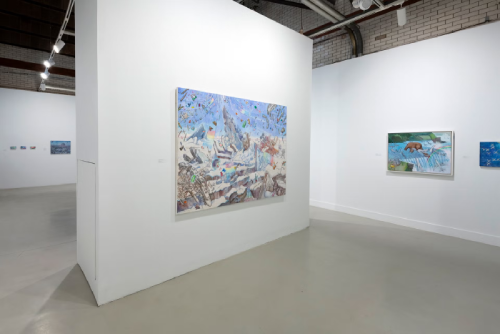
Installation view “Hiro Sakaguchi: Landscapes of a Restless Mind,” Spruance Gallery, Benton Spruance Art Center. Photo: Sam Fritch
Though grounded locally, the artist does not feature his daily environment. Rather, what surfaces are his memories of and his emigration from Japan. Though transportation vehicles—planes, boats, cars, and trains carry numerous connotations in his oeuvre, they mostly represent escape and travel. Airplanes stand ready on the ground to whisk him away, or they carry him on their wings while in flight.
Childhood toys play a prominent role in Sakaguchi’s imagery and carry multivalent associations. At times they are sprinkled playfully across a cheery landscape; other times they turn into armaments. A model battleship may become a peaceful Noah’s ark complete with animals, swing sets, and gardens. Yet ecological chaos can emanate from tanks, missiles, cargo ships, airplanes, cars, nuclear reactors, and oil rigs, draining the earth of natural resources, creating toxic waste, and contributing to CO2 emissions.
Whether presenting catastrophic landscapes or visions of a personal utopia, Sakaguchi overlays them all with candy-colored paint washes. This beauty obfuscates potential risks and contributes to a sense of optimism and joy.
An opening reception will be held on September 4, 2025 from 4:00 – 7:00 PM, where both the artist and the curator will be available to discuss the show and answer questions. On November 5, 2025 a gallery talk featuring Sakaguchi and Veloric will take place beginning at 6:00 PM. Light refreshments will be available and both events are free and open to the public.
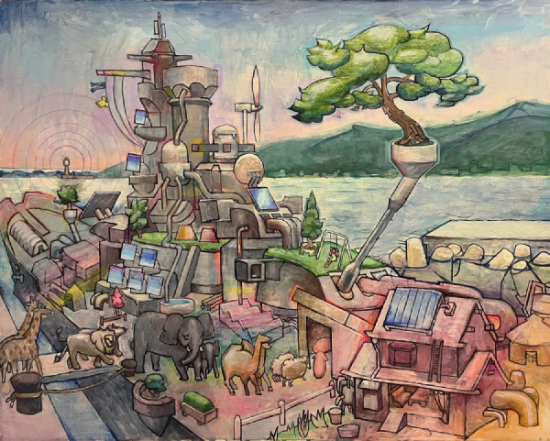
Recommission of a Battleship, 2013, acrylic on canvas, 40” x 30”. Courtesy of the artist.
ABOUT THE ARTIST
Hiro Sakaguchi was born in Nagano, Japan and grew up in Chiba City, near Tokyo. He was born as a twin. He moved to the United States in the 1990’s to study art at the University of the Arts (BFA) and the Pennsylvania Academy of the Fine Arts (MFA). He currently has a studio and resides in Lansdowne, a close suburb of Philadelphia, PA.
Sakaguchi has had numerous solo and group exhibitions, having shown at various venues internationally such as the Philadelphia Museum of Art, the Secession Museum, Austria, the Mori Museum, Tokyo, and the KIASMA Museum of Contemporary Art in Helsinki, Finland. Sakaguchi has also exhibited at PULSE art fair in Miami and at the Melbourne Art Fair in Australia, both with Mizuma Art Gallery, Tokyo.
In 2011 Sakaguchi exhibited his first museum solo show, No Particular Place to Go, at the Morris Gallery of the Pennsylvania Academy of the Fine Arts. His 2014 / 2015 solo exhibition, Avert, Escape or Cope With, at the Delaware Center for Contemporary Art was reviewed in ART NEWS, June 2015. In 2015 Sakaguchi exhibited a two-person show at Nancy Margolis Gallery, NYC, alongside Anne Canfield. In 2019, he participated in the Philadelphia Fine Art Fair through Seraphin Gallery, Philadelphia.
Artworks by Hiro Sakaguchi can be found in both public and private collections internationally including the Philadelphia Museum of Art and the Woodmere Art Museum, Philadelphia. He has representation at Seraphin Gallery in Philadelphia, Galerie Heubner & Heubner in Frankfurt, and Nancy Margolis Gallery in New York.
Jane Geayer: Selections from the Permanent Collection
June 16 – October 5, 2025
June 16 – October 5, 2025
Arcadia Exhibitions is pleased to present “Jane Geayer: Selections from the Permanent Collection” in the Rosedale Gallery from June 16 – October 5, 2025. The works on display represent the artistic legacy of Jane Geayer (1935–2000), a 1956 graduate of Beaver College whose career as a studio artist, teacher, and designer spanned nearly four decades.
These paintings were selected from the array of pieces provided to the University by Geayer’s estate after her passing. This collection, which includes examples of landscapes and abstract compositions, surveying Geayer’s entire career, reveals an artist of great intellectual dexterity, capacity, and curiosity.
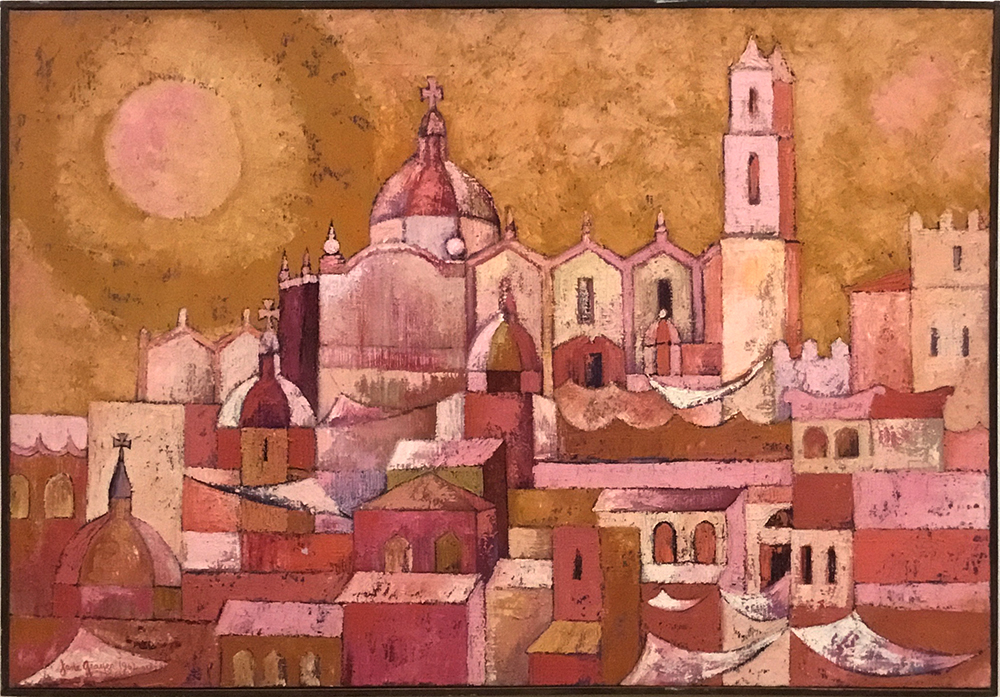
Taxci, 1962, acrylic, courtesy of Arcadia University Permanent Art Collection.
During her lifetime, Geayer exhibited throughout the northeastern United States. Her work was featured in group exhibitions at the Newark Museum, the Montclair Art Museum, the New Jersey State Museum, the Philadelphia Art Alliance, and the Guild of Creative Art in Shrewsbury, New Jersey, of which she was a founding member. Through these pursuits, as well as her teaching and commercial endeavors, this longtime resident of Sea Bright, New Jersey sustained herself as a relevant and vital source of creative activity, enhancing her community throughout her entire adult life.
Jane Geayer’s creativity continues to have a positive impact on the students who attend her alma mater. Her intention was that the works entrusted to the University be sold, and that the proceeds be used to support a named scholarship established in her honor. The Jane Geayer ’56 Endowed Scholarship continues to be awarded to undergraduate students with financial need with preference given but not limited to juniors pursuing courses of study in Fine Arts and Creative Writing.
In keeping with this directive, all works on display are available for sale, with all proceeds going to the enrichment of the scholarship fund. Please contact gallery@arcadia.edu to inquire about purchases.
No Particular Order: Illustrations by Anuj Shrestha
November 18, 2024 – October 19, 2025
November 18, 2024 – October 19, 2025
Arcadia Exhibitions is pleased to present “No Particular Order: Illustrations by Anuj Shrestha” from November 18, 2024 – October 19, 2025 in the Harrison Gallery, University Commons.
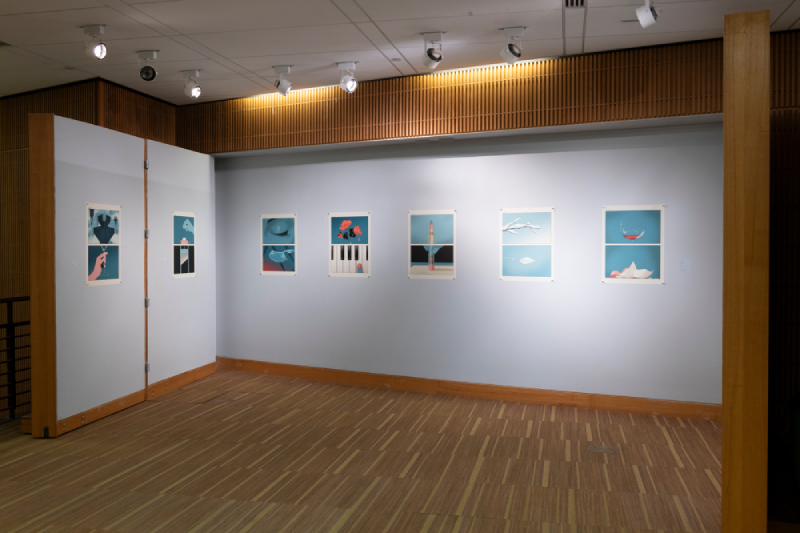
Installation view, No Particular Order: Illustrations by Anuj Shrestha. Photo: Sam Fritch
Though widely recognized for his compelling commercial illustrations in The New York Times, The New Yorker, The Washington Post, ProPublica, and Wired, “No Particular Order” focuses on Shrestha’s personal creative output.
In Shrestha’s illustrations the viewer is confronted by volatile and divisive subjects, such as urban warfare, terrorism, displacement, racism, and xenophobia. Through his use of simple shapes, clean lines, a sparse, sometimes monochromatic palette, and subtle juxtapositions, Shrestha depicts these topics with a kind of subdued, almost mundane stillness. In this way he provides viewers with an opportunity to consider something dark and horrific in a manner that provides a psychological space for contemplation and dialogue.
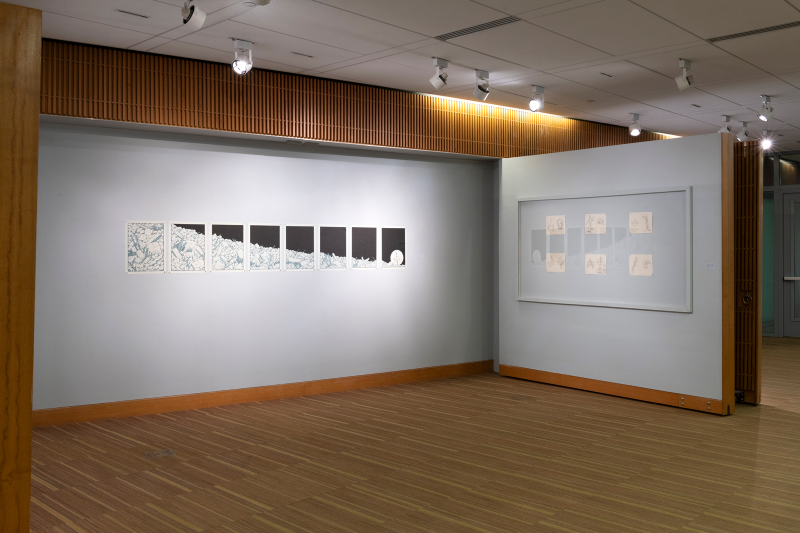
Curated by Matthew Borgen with assistance from Willow Edmonds ’26, the exhibition features prints from several of the artist’s most recent illustration series and comics. Included in the show are selections from Studies, a collection of 2 panel comics relating visual and conceptual symmetry. Prologue / Epilogue, a series depicting the rubble of bombed out buildings, reflects on themes of destruction and regeneration. The exhibition will also include images taken from Shrestha’s 2018 comic National Bird which explores the presence of surveillance in a “free” society.
Please return to this site for further information on upcoming events related to the exhibition.
ABOUT THE ARTIST
Anuj Shrestha is an illustrator and cartoonist currently residing in Philadelphia after having lived in nearly all four corners of the United States. His illustration work has appeared in The New York Times, The New Yorker, The Washington Post, ProPublica, Wired and Playboy, among others and has been featured in the Society of Illustrators and American Illustration annuals. He has won two gold medals for his comics from the Museum of Comics and Cartoon Art Festival Awards of Excellence and a gold medal from The Society of Illustrators.
Kris Graves: Privileged Mediocrity – Memorialization in America
August 19, 2024 – May 25, 2025
August 19, 2024 – May 25, 2025
Arcadia Exhibitions is pleased to present “Kris Graves: Privileged Mediocrity – Memorialization in America” from August 19, 2024 – May 25, 2025 in the Rosedale Gallery, University Commons.
Curated by Matthew Borgen with assistance from Willow Edmonds ’26, the exhibition features artworks from Graves’ recent project “Privileged Mediocrity,” which illustrate the impact of racism and power on the nation’s built environments.
LECTURE RECORDING
The show consists of 7 paired photographs; 14 prints total. One half depicts publicly funded memorials of Southern Generals from the American Civil War, documented immediately after the 2020 Black Lives Matter protests, showing graffiti-covered statues with some already removed from their pedestals. The other half features prints from a sub-series titled A Bleak Reality, where Graves captures images of the exact locations where unarmed Black men were killed by police officers. These photographs document a more organic form of memorialization through temporary murals or the placement of stuffed animals, flowers, and other ephemera.
The repetition of these paired images highlight the necessity for public discourse about the ongoing struggle over control of historic narratives within public spaces, and how power and wealth influence who is memorialized, how, and why.
Graves will lecture on his work on October 29, 2024 at 6:00PM in the Great Room, University Commons. Light refreshments will be available in the Rosedale Gallery immediately afterwards. The event is free and open to the public.
PRIVILEGED MEDIOCRITY
“Privileged Mediocrity” examines systemic unfairness in the United States. Using a mix of conceptual and documentary photographic practices, I reacted to the subtleties of societal power and its impact on the built environment of America and the construction of public and private space. The ideas within explore how racism, capitalism, and power have shaped our country — and how that can be seen and experienced in everyday life.
A BLEAK REALITY
“A Bleak Reality” is a series of eight photographs taken at the exact locations where unarmed Black men were killed by police officers. While each photo represents a single life and death, they collectively address the broader issues of institutionalized racism and violence against the Black community, especially Black men. These social divisions and the startling lack of empathy are exacerbated by perpetuating harmful stereotypes. Kris Graves traveled across the country to document the physical spaces where these lives ended, spaces that continue to be replaced by new tragedies. This reality is measured not only in numbers or statistics but in individual lives.
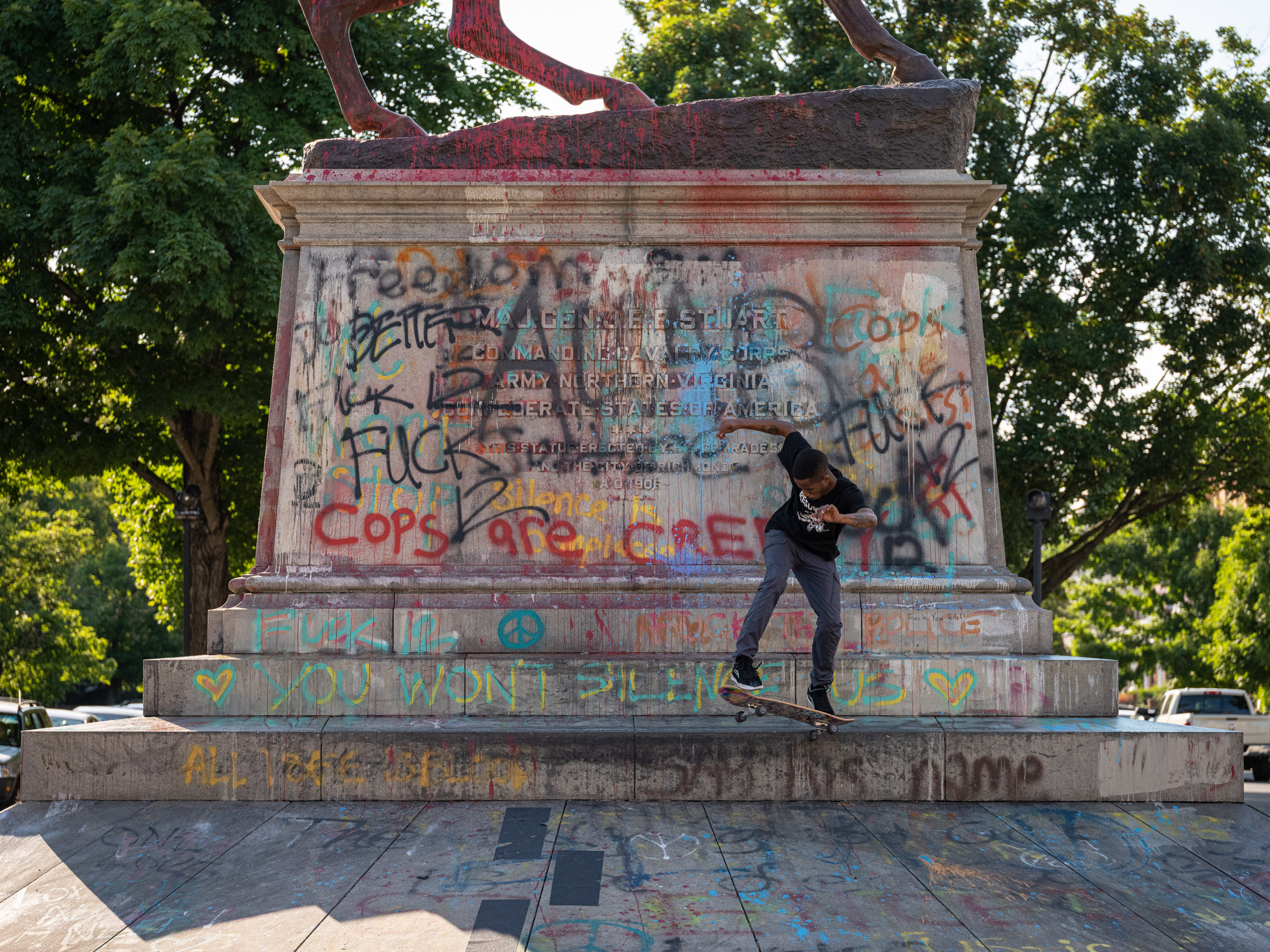 Kris Graves, J.E.B. Stuart Monument, Richmond, Virginia, 2010- 2022, Archival pigment print, 16″ x 20″
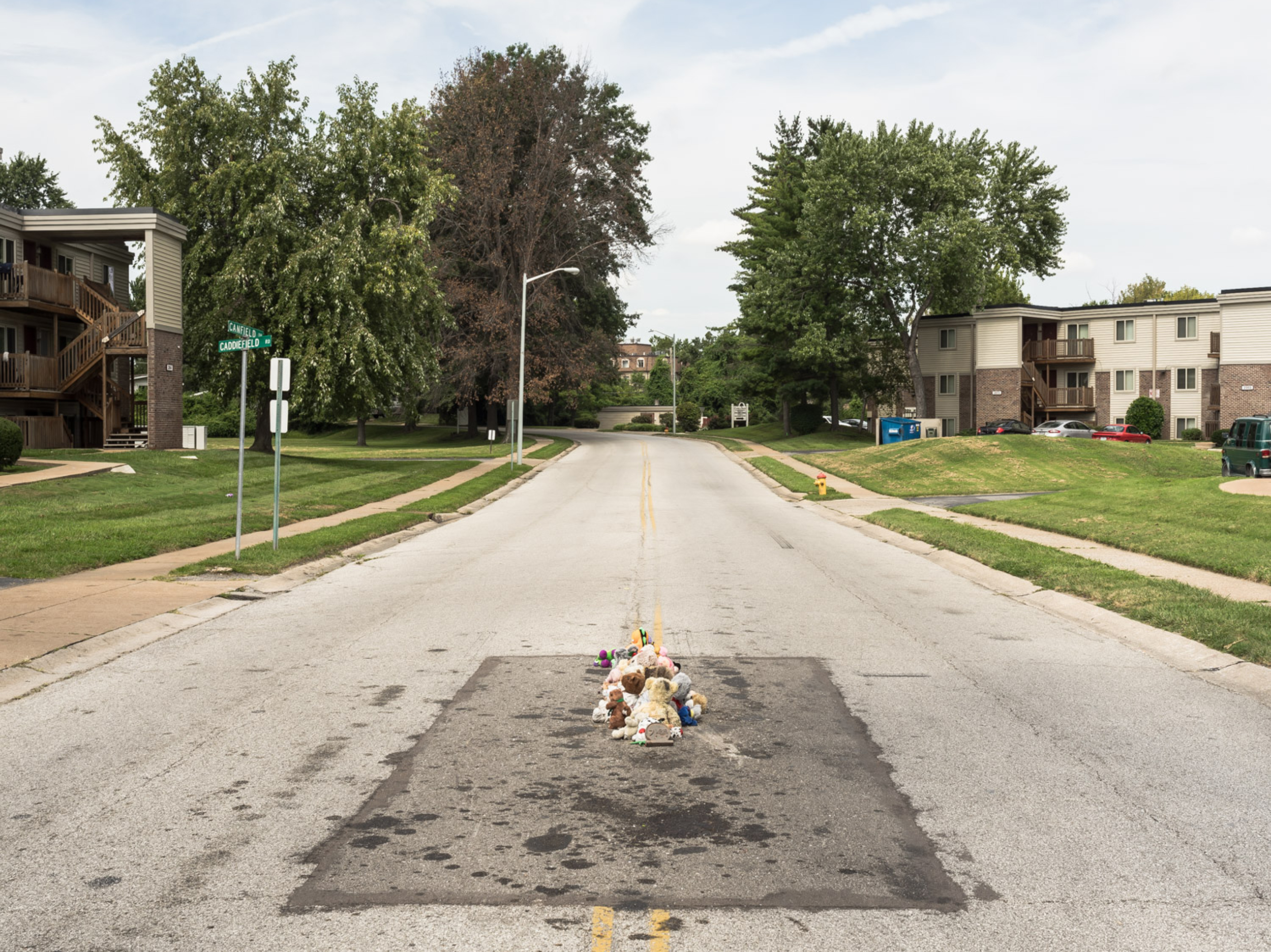 Kris Graves, The Murder of Michael Brown, Ferguson, Missouri, 2010 – 2022, Archival pigment print, 16″ x 20″
ABOUT THE ARTIST
Kris Graves (b. 1982 New York, NY) is an artist and publisher based in New York and California. Graves creates artwork that deals with societal problems and aims to use art as a means to inform people about cultural issues. Using a mix of conceptual and documentary practices, Graves photographs the subtleties of societal power and its impact on the built environment. He explores how capitalism and power have shaped countries– and how that can be seen and experienced in everyday life. Graves also works to elevate the representation of people of color in the fine art canon; and to create opportunities for conversation about race, representation, and urban life. He photographs to preserve memory.
Graves attended S.U.N.Y. Purchase College (BFA, Visual Arts) and has been published and exhibited globally, including Museum of Modern Art, New York; Getty Institute, Los Angeles; and National Portrait Gallery in London, England; among others. Permanent collections include the Metropolitan Museum of Art, Getty Institute, Schomburg Center, Whitney Museum, Guggenheim Museum, Museum of Fine Arts, Houston; Brooklyn Museum; and The Wedge Collection, Toronto; amongst others.
Senior Thesis Exhibition
April 25 – May 11, 2025
April 25 – May 11, 2025
Arcadia University’s Department of Visual and Performing Arts, in conjunction with Arcadia Exhibitions, is pleased to present the Senior Thesis Exhibition from April 25 through May 11, 2025.
For this show the galleries, corridors, and studios of the Benton Spruance Art Center are transformed into a single expansive exhibition space. For the graduating seniors, the bodies of work on view, encompassing a full range of creative disciplines and approaches, represent the concluding research of their intensive, year-long capstone experience.
An end of year exhibition highlighting the work of Arcadia’s graduating art seniors is a tradition that dates back to the Department’s move to the Glenside campus from Jenkintown in 1935. Over time the opening of the exhibition has evolved into a celebration for the entire campus community, marking the end of Arcadia’s Thesis Week, which includes presentations and displays from every major.
Additionally, the first night of the exhibition is a moment when many alumni of the Department of Visual and Performing Arts choose to make their return to campus. They come to support friends, to converse with former mentors, or just to celebrate their connection to the larger community.
The opening reception was held on April 25, 2025 beginning with a special sneak preview reception for alumni at 6:00 PM. The show opened to the Arcadia community and the general public at 7:00 PM with light refreshments provided.
Beginning in 2016, the alums attending the reception are given the opportunity to vote on their favorite individual thesis presentation. This year’s Alumni Prize was awarded to Ciara Cassisse, Professor Potter, and Veronica Snead.
The students included in this year’s exhibition include: Delaney Aikins, Lichen Balay, Ellie Breault, Miette Brennan, Jamees Phillip Calvello, Ciara Cassisse, “Creepie,” Sydney Connors, Alikah Cramer, Autym Dahlman, Connor Dennis, Ryan Erdman, Emily Feldman, Emily Fisher, Stevie Orion, Sophia Habarth, Frankie Herman, Jenna Hill, Sam Jacona, Reilly Marasco, Cody Gillick-Meeks, Alessandra Mitchell, Amelia Opshinsky, Kayla Pimpinella, Masai Pines-Elliott, Catherine Portelli, “Professor Potter,” Michael Rizzo, Raenya Rogers, Kaity Silvers, Alexa-Skye Simon, Julia Siragusa, Veronica Snead, Cat Sontag, Justin Steerman, and Helaina Toth.
Forward Progress: Faculty + Staff Exhibition
February 12 – April 20, 2025
February 12 – April 20, 2025
Arcadia Exhibitions is pleased to present “Forward Progress: Faculty + Staff Exhibition,” on view from February 12 through April 20, 2025 in the Spruance Gallery, Spruance Art Center. The exhibition features works from 17 full and part-time instructors and staff working within the Arcadia Art + Design Department.
Installation view, “Forward Progress: Faculty + Staff Exhibition, Spruance Gallery, photo: Sam Fritch
This show represents a return to the format of a themed group exhibition, last undertaken in 2016 with “Revolutions of Making.” For this iteration, the participants were asked to present or create works that consider the term “Forward Progress,” a theme predominant within the rhetoric of the 2024 presidential election. Faculty and staff were given latitude to consider the theme either as it relates to their own creative practice or as a starting point to comment on the current social or political landscape.
According to Director Matthew Borgen, “The notion of asking the members of the Department of Art + Design to react to a single theme not only lends the show a degree of curatorial cohesion, but also offers our students an opportunity to see how the professionals they work with are addressing issues at the forefront of their own lives and research.”
This exhibition was curated and organized by Matthew Borgen in collaboration with a student committee which includes Willow Edmonds ’26, Molly Russom ’25, and Kelsie Winship ’26.
The artists represented in this exhibition include: Betsey Batchelor, Ash Garner “THECOLORG,” David Guinn, James Heimer, Arianna Kendra, June Lee, Carole Loeffler, Jennifer Manzella, Kyle Margiotta, Karen Misher, Christian “Patch” Patchell, Krista Profitt, Abbey Ryan, Abigail Synnestvedt, Idalia Vasquez-Achury, Julia Way, and Maryann Worrell.
John Rhoden: An American Artist Around the World a lecture by Dr. Brittany Webb
February 13, 2025
February 13, 2025
The Arcadia University College of Arts and Sciences, in cooperation with University Advancement, is pleased to present “John Rhoden: An American Artist Around the World,” a lecture by Dr. Brittany Webb, on February 13, 2025 at 6:00 PM in the Beaver College Room, Landman Library.
Webb is the Evelyn and Will Kaplan Curator of 20th Century Art and the John Rhoden Collection at the Pennsylvania Academy of the Fine Arts (PAFA). In this lecture, Webb will detail how John Rhoden’s ambition inspired him to pursue artistic training and mentorship in and beyond the American South, and how his global travels shaped the life he made and the artwork he produced abroad and at home.
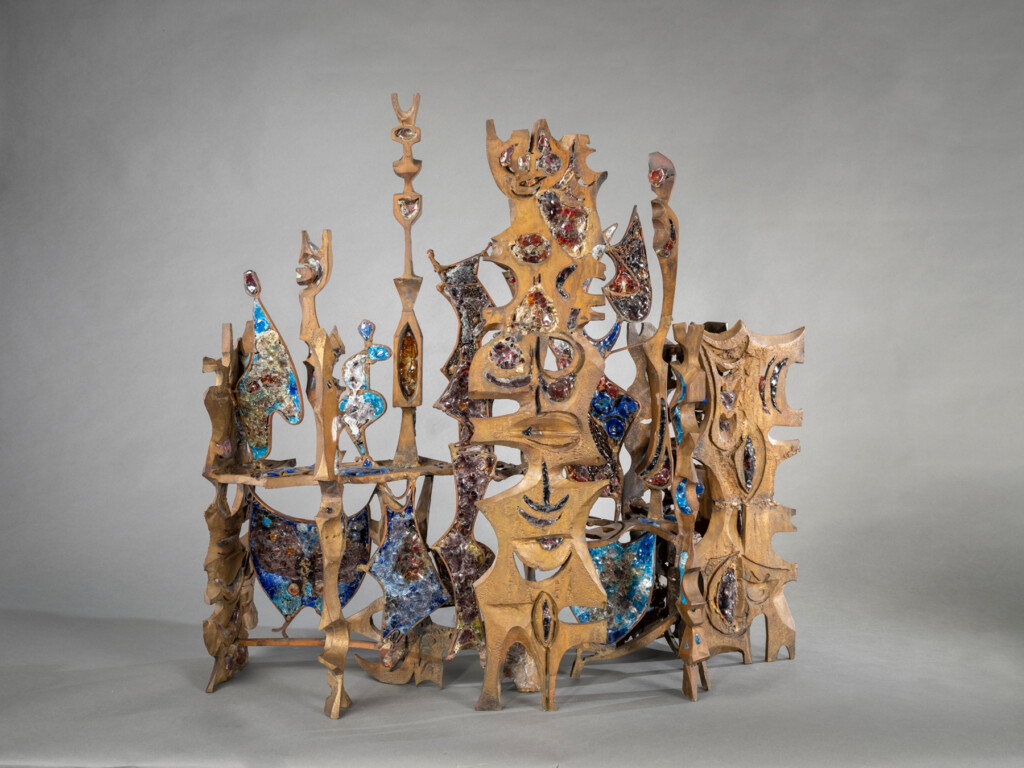
John Rhoden, Untitled, n.d., bronze and glass or resin, 38 1/4 x 40 x 11 in. Gift from The John Walter Rhoden and Richanda Phillips Rhoden Collection at the Pennsylvania Academy of the Fine Arts. photo: Sahar Coston-Hardy
This presentation celebrates the generous gift of two bronze sculptures by Rhoden to Arcadia University by PAFA. At the reception, immediately following the lecture, guests will be able to view these works on display in their permanent home in the Susan Smyth Shenker Grand Reading Room.
ABOUT THE LECTURE
Artist John Rhoden (1916-2001) was born in Birmingham, Alabama and discovered a passion for sculpting that took him around the world before he settled in Brooklyn, New York. After studying at Talladega College and Columbia University, Rhoden became the first Black American visual artist in residence at the American Academy in Rome (1952-1954) and went on to visit more than twenty countries as part of artist delegation cultural diplomacy tours. In this lecture, Brittany Webb will detail how Rhoden’s ambition inspired him to pursue artistic training and mentorship in and beyond the American South, and how his global travels shaped the life he made and the artwork he produced abroad and at home.
Dr. Brittney Webb, Evelyn and Will Kaplan Curator of 20th Century Art and the John Rhoden Collection at the Pennsylvania Academy of the Fine Arts
ABOUT THE LECTURER
Dr. Brittany Webb is the Evelyn and Will Kaplan Curator of 20th Century Art and the John Rhoden Collection at the Pennsylvania Academy of the Fine Arts (PAFA). Her most recent exhibition, Determined to Be: The Sculpture of John Rhoden, debuted at PAFA in October 2023 and is currently on view at the Birmingham Museum of Art in Birmingham, Alabama. Dr. Webb’s curatorial work has been supported by grants from the Henry Luce Foundation, National Endowment for the Arts, the Terra Foundation for American Art, the William Penn Foundation, and the Wyeth Foundation for American Art. She earned a PhD from Temple University and a BA from the University of Southern California.
2024
Perpetual Inventory: A Ruminative Installation by Scott Kip
September 3 – December 22, 2024
September 3 – December 22, 2024
Arcadia Exhibitions is pleased to announce the presentation of a new project by Philadelphia-based artist Scott Kip. Advancing his work both as a sculptor and a producer of installations, Kip’s project will occupy the 1100-square foot space of the Spruance Art Gallery—originally an electric power station (constructed in 1894)—and capitalize on its utilitarian architecture, including its 33-ft. height. Built primarily from repurposed wood, the installation’s unconventional spaces, linked by corridors and stairs, will allow visual access to a sequence of chamber-like enclosures displaying tableaus of objects from the five decades of Kip’s life. Kip likens the experience to that of walking through the door of an abandoned building found ajar in which, as he has stated, “the anxiety of trespass is pitted against the urge to explore.”
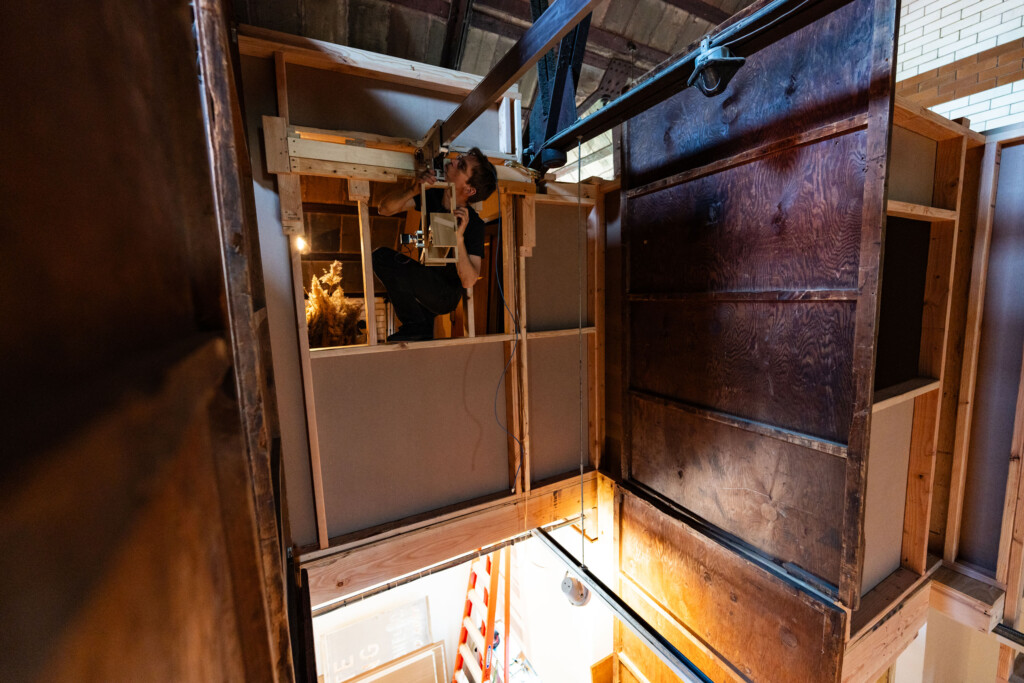
In progress view of “Perpetual Inventory: A Ruminative Installation by Scott Kip.” Photo: Ashley Selig.
Kip’s practice has been informed by skills gained working as a cabinet maker, machinist, and clockmaker, including his 18 years as a restoration woodworker and technician for the five-story Wanamaker Grand Court Organ as well as his work maintaining the Philadelphia City Hall Tower clock. These vocations have given Kip intimate access to idiosyncratic, non-public spaces that have helped cultivate the tone and tenor of his work.
Construction on Kip’s project, which was conceived as both a residency and installation, began the first week of June and will proceed on site through the end of August.
The project is curated by Richard Torchia and supported by a grant from Edna W. Andrade Fund of the Philadelphia Foundation.
Installation view of “Perpetual Inventory: A Ruminative Installation by Scott Kip.” Photo: Sam Fritch.
ABOUT THE ARTIST
Scott Kip attended University of the Arts (1995-1999) where he majored in Craft/Furniture Making. He began to exhibit in 2008, initially focusing on his Illuminated Structures, model-like sculptures installed in precise alignment, which became the subject of his 2010 Wind Challenge exhibition for the Fleisher Art Memorial. Subsequent development of these works led to his first solo exhibition at Marginal Utility, followed by a solo exhibition at Delaware Contemporary (2014). His first installation, Transitional Objects, (Marginal Utility, 2015), was followed by a more compact, portable variation, The Enchanted Hunter (Penn State Abington Art Gallery, 2018). Kip’s work has been enthusiastically reviewed in Title Magazine, The Philadelphia Inquirer, Art Papers,One Review a Month, and on multiple occasions in Artblog, where he received a Liberta Award (2015) for Transitional Objects. Kip was in residence with the Asian Arts Initiative in 2014 and has facilitated projects related to clock mechanics and mechanical music at Temple Contemporary, Drexel University Art Gallery (Bower Bird Productions), along with longstanding affiliations with the Wanamaker Organ, The Mutter Museum, and the City Hall clock, and the Masonic Temple. From 2011 to 2015 he taught in the sculpture department at the Pennsylvania Academy of the Fine Arts.
Installation view of “Perpetual Inventory: A Ruminative Installation by Scott Kip.”. Photo: Sam Fritch.
Artifacts of Life and Death: Examining Domestic and Funerary Ceramics from West Africa
April 29 – September 29, 2024
April 29 – September 29, 2024
This student-generated exhibition focuses on pottery of the Bura, Chamba, Dakakari, and Nupe cultures of West Africa donated to the University in 2008 by David and Karina Rilling.
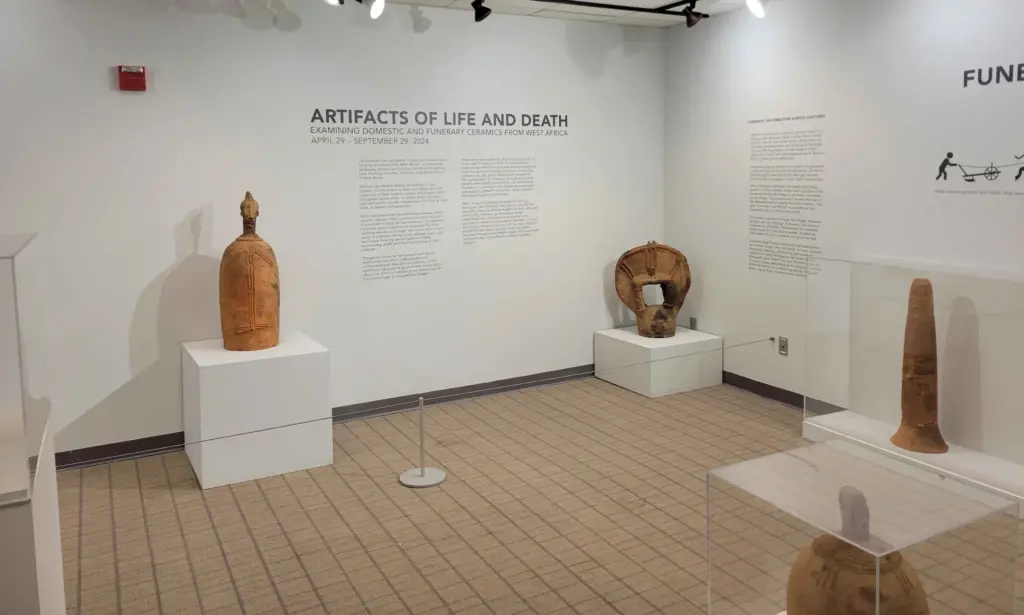
Installation view of Artifacts of Life and Death: Examining Domestic and Funerary Ceramics from West Africa, photo: Willow Edmonds.
Most often hand-built and fired by the women of these cultural groups, the ceramic objects in this show offer insights into both the funerary and domestic rituals of these West African societies. The primary goal for this exhibition is to spark further conversations about the ethics of collecting and preserving the cultural heritage of marginalized groups.
OPENING RECEPTION
Artifacts of Life and Death: Examining Domestic and Funerary Ceramics from West Africa
Monday, April 29, 2024
4:30 PM, Judith Taylor Gallery, Landman Library
Light refreshments will be provided and the event is free and open to the public
Senior Thesis Exhibition
April 26 – May 12, 2024
April 26 – May 12, 2024
Arcadia University’s Department of Visual and Performing Arts, in conjunction with Arcadia Exhibitions, is pleased to present the Senior Thesis Exhibition from April 26 through May 12, 2024.
For this show the galleries, corridors, and studios of the Benton Spruance Art Center are transformed into a single expansive exhibition space. For the graduating seniors, the bodies of work on view, encompassing a full range of creative disciplines and approaches, represent the concluding research of their intensive, year-long capstone experience.
An end of year exhibition highlighting the work of Arcadia’s graduating art seniors is a tradition that dates back to the Department’s move to the Glenside campus from Jenkintown in 1935. Over time the opening of the exhibition has evolved into a celebration for the entire campus community, marking the end of Arcadia’s Thesis Week, which includes presentations and displays from every major..
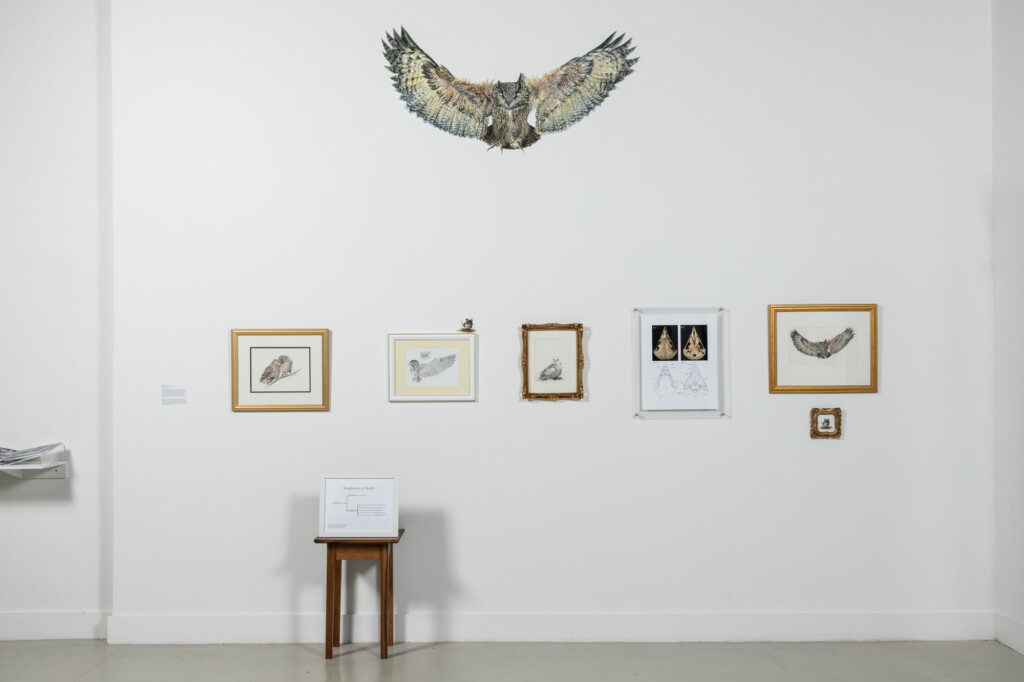
Installation view of Heidi Herbawi’s display in Senior Thesis Exhibition 2024. Photo: Emily Fisher.
Additionally, the first night of the exhibition is a moment when many alumni of the Department of Visual and Performing Arts choose to make their return to campus. They come to support friends, to converse with former mentors, or just to celebrate their connection to the larger community.
Beginning in 2016, the alums attending the reception are given the opportunity to vote on their favorite individual thesis presentation. This year’s Alumni Prize was awarded to Heidi Herbawi, Caitlyn Rudolph, and Jess Schnell.
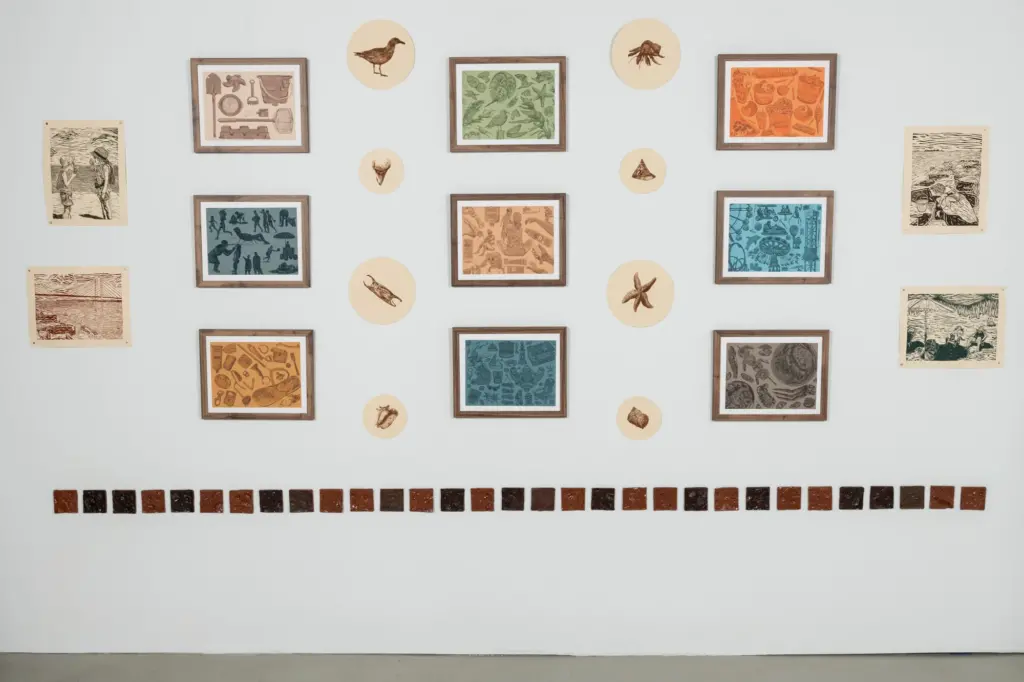
Installation view of Caitlyn Rudolph’s display in Senior Thesis Exhibition 2024. Photo: Emily Fisher.
The students included in this year’s exhibition include: Thomas Agnew, Deirdre Bailey, Shyann Bilbrough, Elliot Broussard, Allen Chen, Grace Clark, Drevon Elmore, Ethan Gernerd, Micah Gordley, Heidi Herbawi, Sadie Hicks, Laura Kessler, Dara Krampert, Tans Martin, Briannie Matos, Bird Miehle, Taylor Nurko, Caitlyn Rudolph, Jess Schnell, Samantha Simpson, Shane Stauffer, Mary Vaihinger, and Brooke Wilkes.
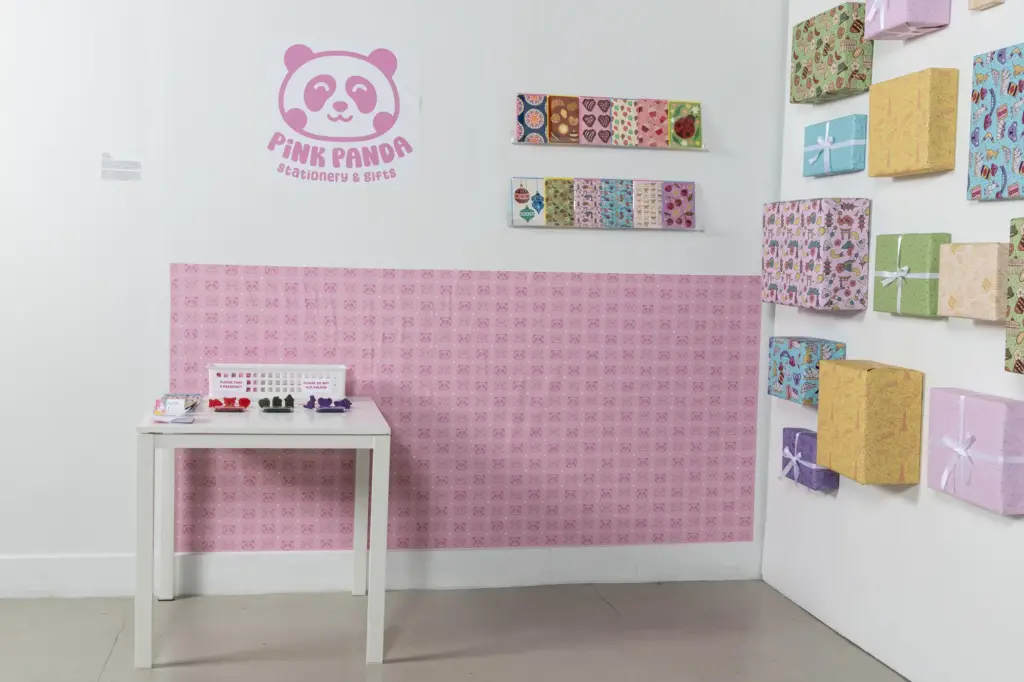
Installation view of Jess Schnell’s display in Senior Thesis Exhibition 2024. Photo: Emily Fisher.
Kitty Rauth: The Mirror Room
March 18 – Ocotber 11, 2024
March 18 – Ocotber 11, 2024
Arcadia Exhibitions is pleased to present “Kitty Rauth: The Mirror Room,” from March 18 through October 11, 2024 in the Harrison Gallery, University Commons.
In their recent work, the Chicago-based artist uses cast sugar, often formed to replicate decorative glassware, as a poetic material to engage in conversations around classed systems of etiquette, racialized labor, and the body politics that surround the marketing and production of the product.
LECTURE RECORDING
For “The Mirror Room,” Rauth, a 2014 graduate of Arcadia, continues to explore these issues by focusing on the personal coincidence that Grey Towers Castle and the former William Welsh Harrison Estate, the current home of Arcadia University, were first constructed utilizing proceeds from the sugar refining industry in the late nineteenth century.
The title of the exhibition refers to one of the most iconic spaces within Grey Towers Castle, an immense, elaborately furnished room on the first floor with mirrored surfaces on all four walls, used originally by the Harrisons and today by the University for hosting special events and celebrations. For the artist, the space acts simultaneously as a symbol for the unfettered opulence of the so-called “Gilded Age”, as well as a place for introspection and self-analysis.
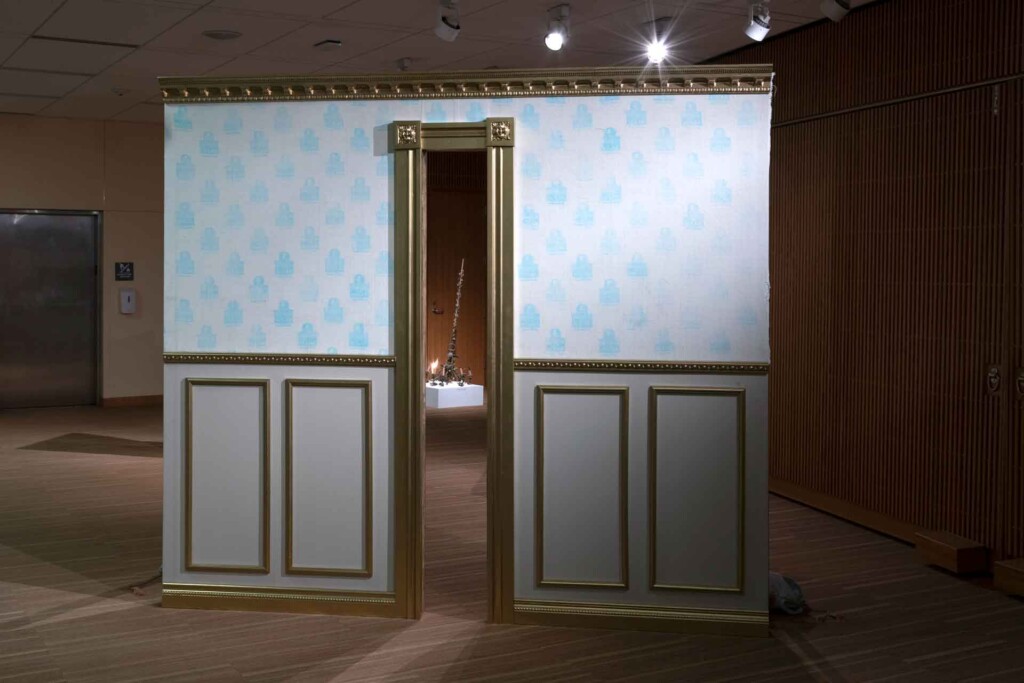
The Mirror Room, 2024, Harrison Gallery, University Commons, Photo: Sam Fritch
In the gallery, coincidentally named for William Welsh Harrison, Rauth will be appropriating and arranging objects and architectural forms from the well-known Cheltenham Township landmark to create a new space for both the artist and visitors to reflect upon the dysfunctional systems of power that led to the accumulation of wealth that funded the estate’s creation. Further, this act of contemplation takes place in the presence of the Castle, which can be clearly viewed through the windows of the gallery.
A lecture and reception will be held for this exhibition in September 2024. Please return to this site for specific dates and times.
This exhibition is presented in conjunction with (re)FOCUS 2024, a Philadelphia citywide exhibition event celebrating the 50th anniversary of “Philadelphia Focuses on Women in the Visual Arts.” Like its 1974 predecessor, (re)FOCUS is a collaboration among 40 of the Philadelphia region’s museums, art schools, and galleries highlighting the work of women-identified and BIPOC artists. For information about other exhibitions and events visit (re)FOCUS.org.
ABOUT THE ARTIST
Kitty Rauth (b. 1992, New Jersey) is an artist and organizer based in Chicago, IL. Drawing from personal histories of growing up in systems of etiquette, their work finds poetic spaces that consider care and interdependency, community, abundance, flamboyance, and death. She has exhibited nationally, including LVL3 (CHI), David Salkin (CHI), SPRING/BREAK (NYC), and Brewhouse Association (PGH), among others. A former staff and artist-member of Vox Populi Gallery in Philadelphia, Rauth supported the organization from 2014-2020, and has since established a 15-member collective studio space on Chicago’s southwest side. In 2024, she was selected for Newcity’s Art 50: Chicago’s Art World Vanguard. Rauth graduated with their BFA from Arcadia University in Glenside, PA and their MFA in Studio Art from the Sculpture Department of the School of the Art Institute of Chicago. She currently serves as the Artistic Director of Comfort Station, a multidisciplinary art space in the Logan Square neighborhood of Chicago, and serves as a Lecturer in Contemporary Practices and Art Administration at SAIC.
Alumni Spotlight Lecture: Kitty Rauth
“Dining with Ghosts: Re-examining the Wealth Streams that Built Grey Towers Castle”
October 10, 2024, at 4:30 PM
Great Room, University Commons
A reception will immediately follow in Harrison Gallery. The event is free and open to the public.
A Strong In-Your-Face Word: Works from the Brodsky Center at PAFA
February 6 – April 21, 2024
February 6 – April 21, 2024
Arcadia Exhibitions is pleased to present “A Strong In-Your-Face Word: Works from the Brodsky Center at PAFA,” an exhibition featuring prints and handmade paper editions commissioned by the Brodsky Center at its printmaking and papermaking studios. Presented in the Spruance Gallery from February 6 through April 21, 2024, “A Strong In-Your-Face Word” proposes artworks that can be seen as emblematic of the continual fluidity of the priorities and strategies contributed by artists to the feminist movement from the 1960s to this day.
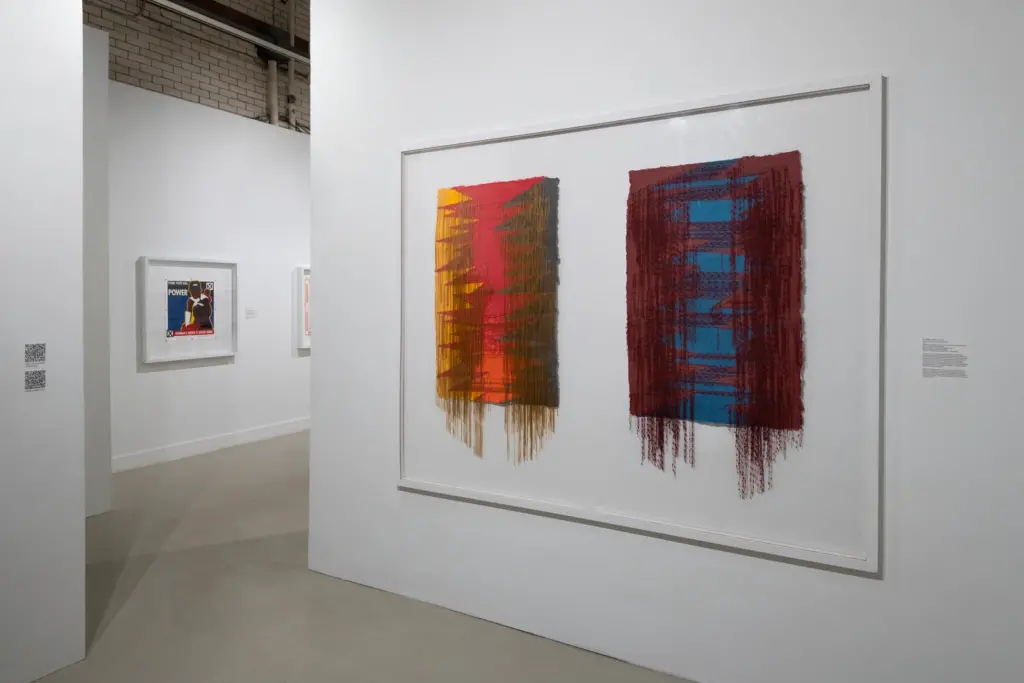
Installation view, “A Strong In-Your-Face Word: Works from the Brodsky Center at PAFA, Spruance Gallery, photo: Sam Fritch
Curated by Grace Harmer, “A Strong In-Your-Face Word” joins a host of exhibitions and events in Philadelphia organized to celebrate the 50th anniversary of the 1974 citywide exhibitions and programming entitled “FOCUS: Philadelphia Focuses on Women in the Visual Arts,” led then and now by Philadelphia artist Diane Burko and artist, curator, writer, and activist Judith K. Brodsky.
The title “A Strong In-Your-Face Word,” inspired by a 2008 essay by Martha Rampton, hints at the deeper sociopolitical and gender equity goals that the term feminism has come to represent in the second decade of the 21st century. The artworks in this exhibition critically engage the nuances of second-wave feminism while concurrently exploring the ideological frameworks redefining the movement in the present. Recognizing the historical limitations of the term feminism in capturing diverse identities and experiences across gender, race, and cultural backgrounds, these works aim to broaden the scope of the movement embracing the need to redefine feminism since the original “FOCUS” exhibition.
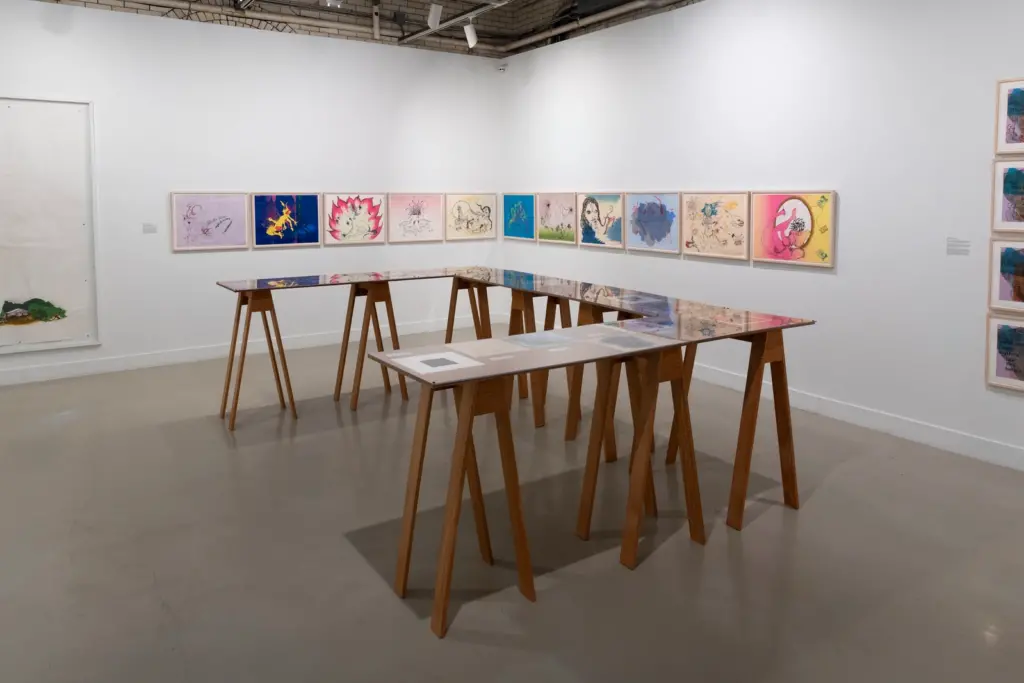
Installation view, “A Strong In-Your-Face Word: Works from the Brodsky Center at PAFA”, Spruance Gallery, photo: Sam Fritch
Featured artists include Emma Amos, Eleanor Antin, Nancy Azara, Zoë Charlton, Jonathan Lyndon Chase, Liz Collins, Betsy Damon, Mary Beth Edelson, Lauren Ewing, Chitra Ganesh, Sharon Hayes, Harmony Hammond, Joyce Kozloff, Yolanda López, Diane Neumaier, Farah Ossouli, Nell Painter, Faith Ringgold, Miriam Schapiro, Carolee Schneemann, Joan Semmel, Sylvia Sleigh, Joan Snyder, Nancy Spero, May Stevens, Athena Tacha, June Wayne, and Martha Wilson.
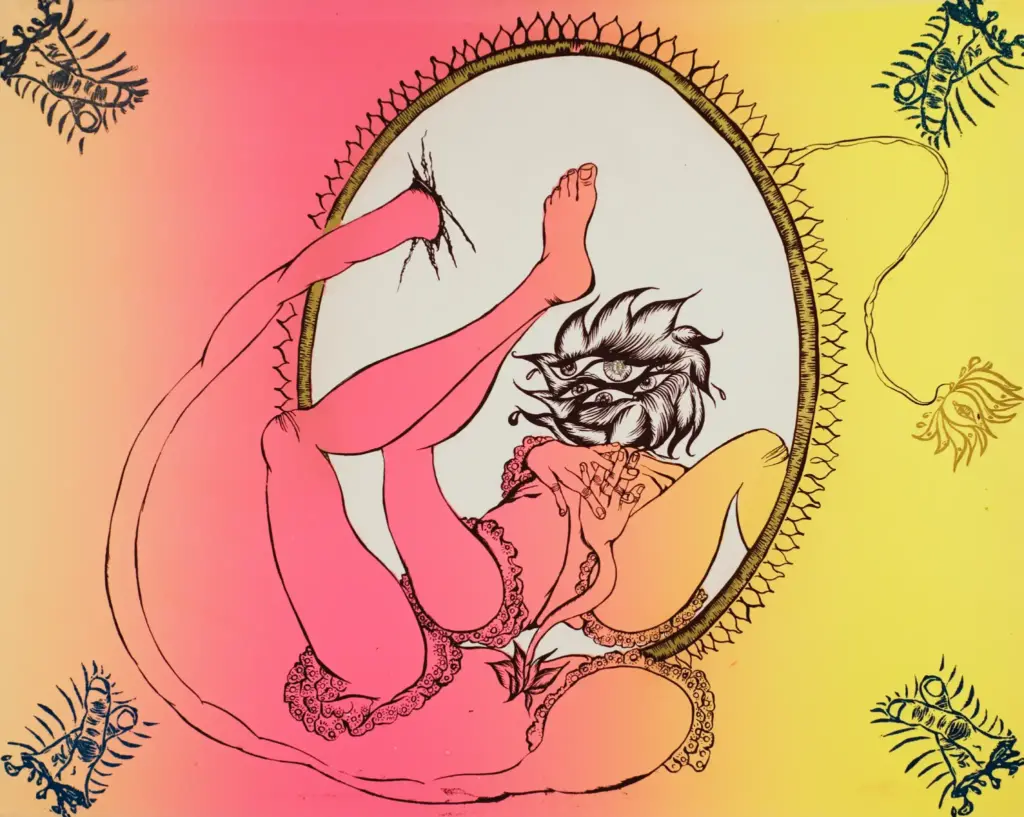
Chitra Ganesh (American, b. 1975), “Delicate Line (Corpse She Was Holding),” 2009–2010 (detail). Monotype with two-color silkscreen, two-color linoblock dusted with blue glitter, one-color linoblock dusted with gold glitter, and one-color glued plastic jewel on Arches 88 paper. 22 x 28 inches. Edition of 20. Published by the Brodsky Center at PAFA, Philadelphia. Copyright the artist and the Brodsky Center at PAFA, Philadelphia. Photography courtesy of the artist and the Brodsky Center at PAFA. Photo by Peter Jacob.
Judy Brodsky taught at Arcadia University from 1972 to 1978. On the occasion of “FOCUS,” Brodsky and the then Art Department Chair Jack Davis brought to Philadelphia the exhibition “Lee Krasner: Selections from 1946–1972,” and invited Krasner (1908–1984) to lecture on campus. In 1986, Brodsky became the founding director of the Rutgers Center for Innovative Print and Paper at Rutgers University, which was later renamed Brodsky Center in her honor. The Brodsky Center joined PAFA in 2018. Dedicated to printmaking and papermaking residencies for women and artists of color, it has pioneered institutional diversity, equity, and inclusion, and continues to foster innovative ideas and narratives.
Opening event for A strong in-your-face Word
Gallery Talk
February 28, 2024, 4:30 PM
Spruance Gallery, Benton Spruance Art Center
Join curator Grace Harmer, and printmaker Jennifer Manzella for an informal conversation about the works in the show, and how they reflect the evolution of the Feminist movement from the 1960s to today. The talk will be followed by a reception with light refreshment.
The event is free and open to the public
Student Biennial 2024
January 16 – February 18, 2024
January 16 – February 18, 2024
Arcadia Exhibitions is pleased to present “Student Biennial 2024”, on display January 16 – February 18, 2024 in the Harrison Gallery. This exhibition is the tenth in a series at Arcadia featuring works by current students juried by an esteemed visiting arts professional. Any Arcadia student registered for classes during the Fall 2023 semester was eligible to submit up to three works for consideration.
This year’s juror is Samantha Mitchell, the lead curator/production manager at Center 4 Creative Works, Wynnewood, Pennsylvania. In advance of the exhibition, Mitchell will be giving a lecture on her artistic practice in the Great Room, University Commons on November 6, 2023 at 4:30 PM, followed by a reception in the Harrison Gallery. Students interested in submitting works to the Biennial are urged to attend.
Mitchell selected 36 entries by 30 artists from a pool of 100 submissions by Arcadia first-years, sophomores, juniors, and seniors. The works selected include digital and film photographs, paintings, prints undertaken in a variety of techniques, several examples of functional ceramics, poster designs, collage, an artist book, as well as drawings completed in graphite, and colored pencil.
About the Juror
Samantha Mitchell is an artist, writer, and arts educator based in Philadelphia. She was born in New York City and graduated from Oberlin College in 2008. She lived and worked in Illinois, Utah, California, and Oregon before enrolling in the MFA program of Pennsylvania Academy of the Fine Arts, graduating in 2012.
Aside from her work in the studio, Mitchell is co-founder and director of THIS MUST BE THE PLACE, a publishing and curatorial project that foregrounds work by neurodivergent artists. She is the Lead Curator/Production Manager at the Center for Creative Works, a studio for adults with developmental disabilities. She worked as a managing editor for Title Magazine, a publication devoted to writing on the arts in Philadelphia, for five years, and contributes writings to Hyperallergic, The Brooklyn Rail, Sculpture Magazine, and Brut Force. Mitchell is a member of Tiger Strikes Asteroid, Philadelphia, a national collective of artist-run galleries.
Her work has been exhibited at the Smithsonian National Portrait Gallery, Gross McCleaf Gallery, Snyderman-Works, Avery Gallery, AUTOMAT, Grizzly Grizzly, Schau Fenster (Berlin) and the International Print Center (NYC), and is part of the permanent collection at the Minneapolis Institute of Art, the Woodmere Museum, and the Pennsylvania Academy of the Fine Arts.
2023
David Kettner: Selected Works, 1968 – 2023
September 30 – December 17, 2023
September 30 – December 17, 2023
Samantha Mitchell: Land Forms
August 29 – December 3, 2023
August 29 – December 3, 2023
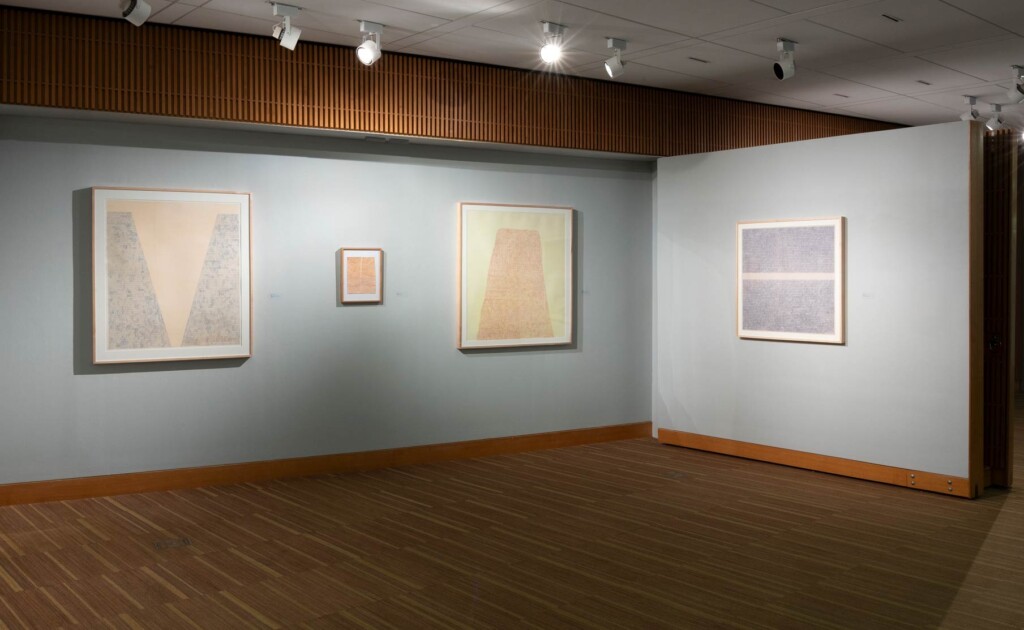
Installation view “Samantha Mitchell: Land Forms”, Rosedale Gallery, University Commons, photo: Sam Fritch.
Arcadia Exhibitions is pleased to announce the exhibition “Samantha Mitchell: Land Forms” on view in the Harrison Gallery from August 29 – December 3, 2023.
The show will consist of works on paper and panel from the past seven years depicting Mitchell’s recollections of land forms she has experienced and documented through a deliberate, meditative buildup of small repetitive marks using ink, watercolor, graphite, and colored pencil.
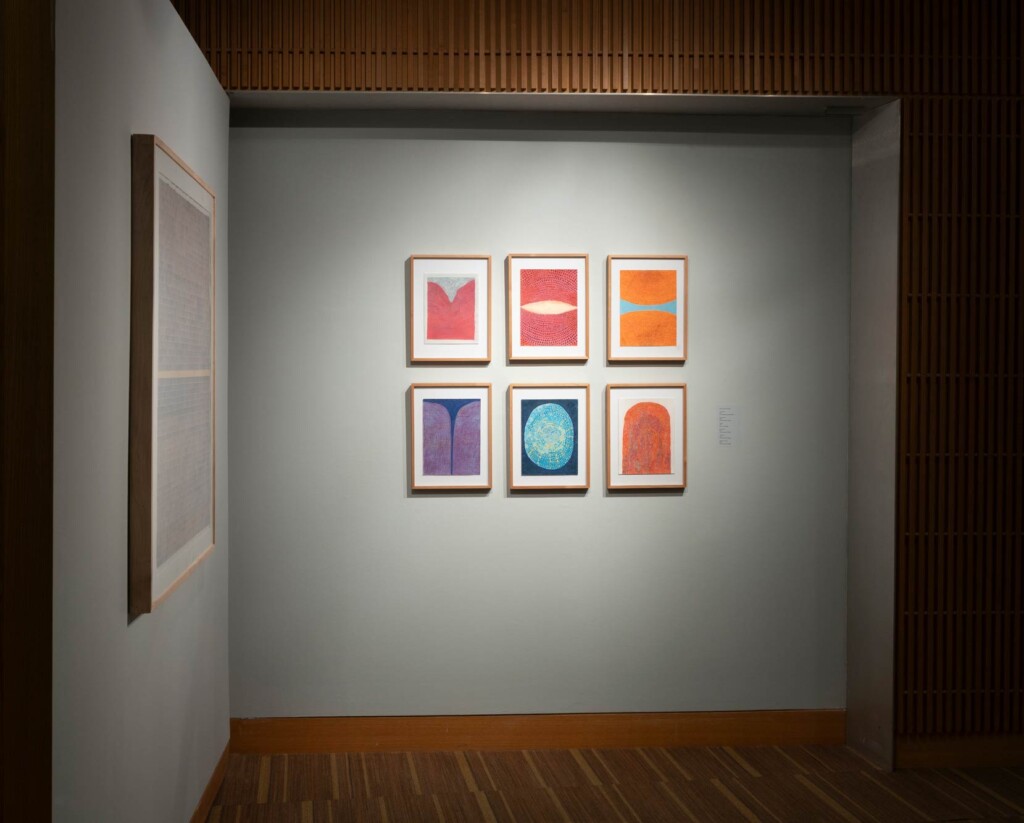
Installation view “Samantha Mitchell: Land Forms”, Rosedale Gallery, University Commons, photo: Sam Fritch.
Central to the artist’s practice is the idea that the process of remembering is a creative act. The gorges, canyons, buttes, and horizons that appear repeatedly in these works are not reproductions of the landscapes that Mitchell has seen, but of the activity of recalling those places. The use of small, consistent lines or shapes to build these monumental forms are akin not only to the brain piecing together fragments of a distant memory, but also of the natural elements like wind, water, heat, and pressure that slowly form the terrain over time.
Installation view “Samantha Mitchell: Land Forms”, Rosedale Gallery, University Commons, photo: Sam Fritch.
To explore these ideas Mitchell has experimented widely with both medium and scale. The largest works, measuring approximately 60 by 42 inches, such as Cordillera Highway Anticline, 2016, are paintings on paper utilizing a combination of graphite, thick and thin watercolor applications, and India ink. Smaller works on paper, such as Red Mound, 2023, are rendered in India ink or colored pencil on a toned paper. For pieces such as The Way Up, 2021, Mitchell paints on board covered with a watercolor ground made with marble dust, with her distinctive markings rendered in watercolor, gouache and ink.
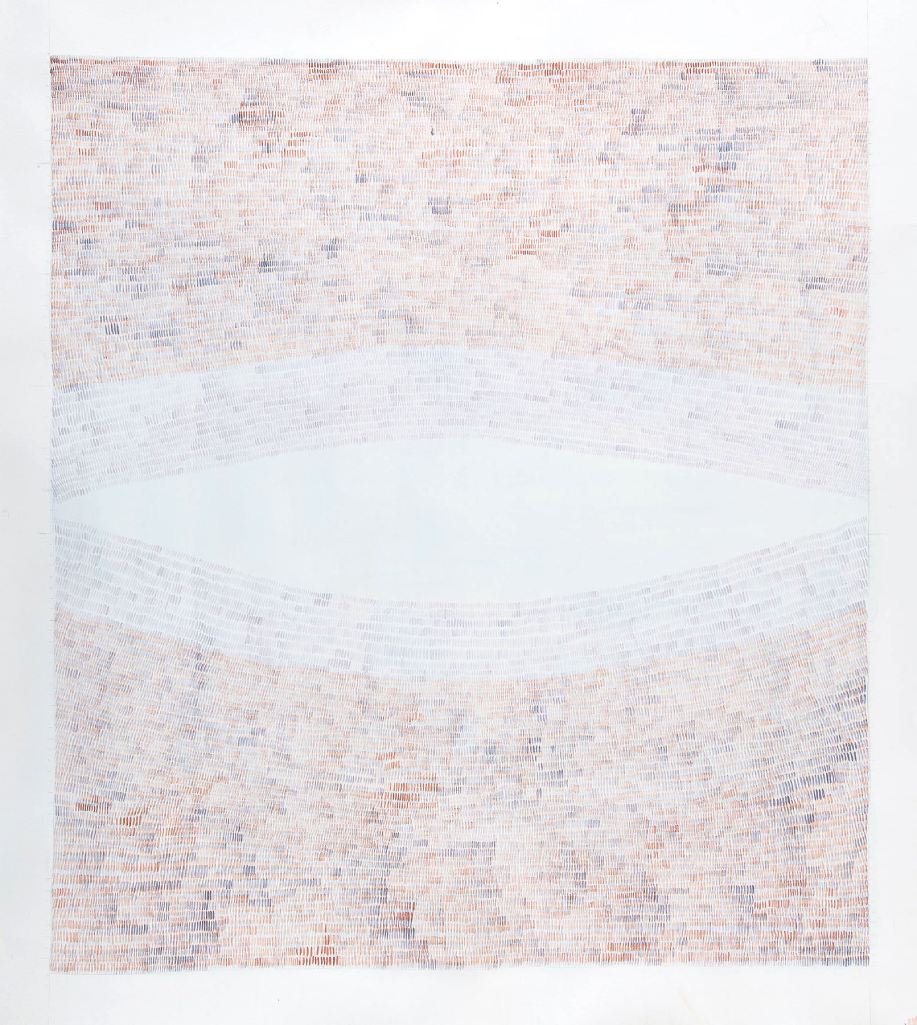
Samantha Mitchell, Cordillera Highway Anticline, 2016, Graphite, watercolor and India ink on paper, 60 x 42 1/2 inches
According to Mitchell, the “large works on paper articulate sublime encounters with landscape on a human scale, with grid-oriented marks that reference horizons and land formations. More recent pieces – largely created at home during the COVID lockdown and concurrent with raising two young children – are smaller meditations, memories of spaces that have become physically inaccessible.”
“Samantha Mitchell: Land Forms” will be on view along with another exhibition in the University Commons, “Arcadia Collects: Art, Objects + Ephemera from the University Archives” in the Rosedale Gallery. An event celebrating both exhibitions will be held in the Great Room of the University Commons on Thursday, September 21, 2023 at 6:30 PM. The evening will begin with a lecture by Anastasia Rousseau, university archivist, in conjunction with the “Arcadia Collects” exhibition.
Immediately following Rousseau’s talk, a reception will be held in both the Rosedale and Harrison Galleries where artist Samantha Mitchell will be available to discuss her works on paper. Both events are free and open to the public.
Mitchell will be lecturing on her work on November 6, 2023 at 4:30 in the University Commons Great Room. A reception will be held in the Harrison Gallery immediately afterward.
ARTIST STATEMENT
My work mediates impulses for order and chaos, creating a unified habitat for both. This compulsion comes from witnessing change – in memory, in the landscape, in objects, in perception – through organic processes, that are both generative and destructive. Working in the language of small, consistent marks, my process feels like chipping away, working slowly towards a larger whole.
I am seeking to communicate an embodied experience inside, on top of, and around landscapes I have known and that I think about. Mark-making becomes a form of meditation, opening a liminal space between being and remembering into being.
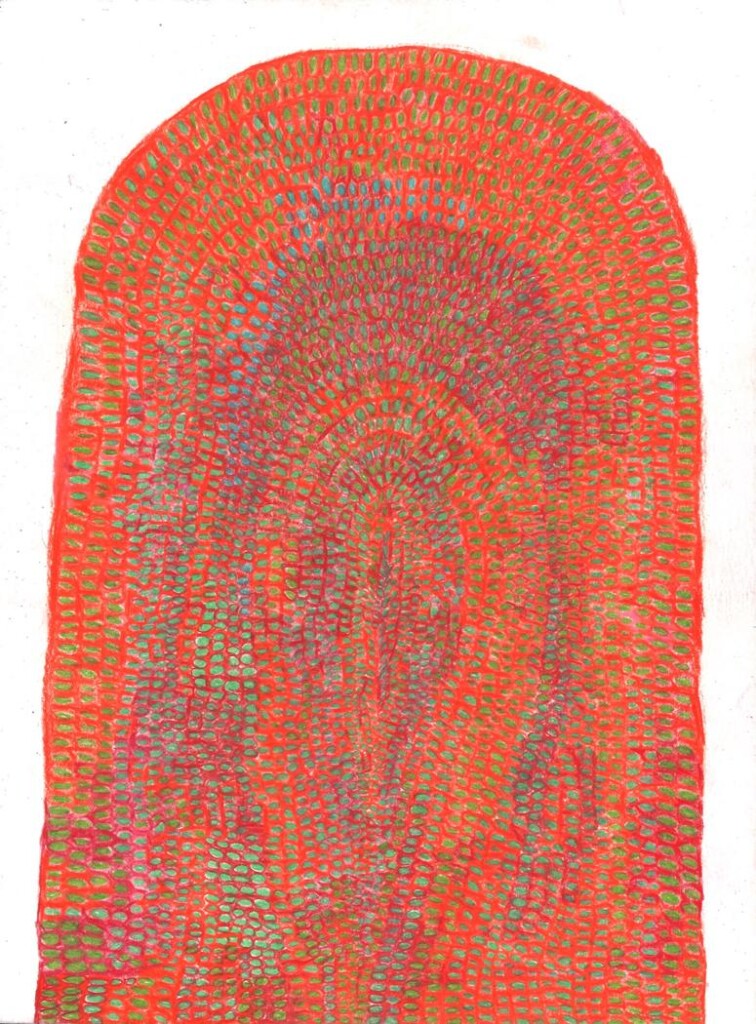
Samantha Mitchell, Red Mound, 2023, Colored pencil on paper, 12 x 9 inches
ABOUT THE ARTIST
Samantha Mitchell is an artist, writer, and arts educator based in Philadelphia. She was born in New York City and graduated from Oberlin College in 2008. She lived and worked in Illinois, Utah, California, and Oregon before enrolling in the MFA program of Pennsylvania Academy of the Fine Arts, graduating in 2012.
Aside from her work in the studio, Mitchell is cofounder and director of THIS MUST BE THE PLACE, a publishing and curatorial project that foregrounds work by neurodivergent artists. She is the Lead Curator/Production Manager at the Center for Creative Works, a studio for adults with developmental disabilities. She worked as a managing editor for Title Magazine, a publication devoted to writing on the arts in Philadelphia, for five years, and contributes writings to Hyperallergic, The Brooklyn Rail, Sculpture Magazine, and Brut Force. Mitchell is a member of Tiger Strikes Asteroid, Philadelphia, a national collective of artist-run galleries.
Her work has been exhibited at the Smithsonian National Portrait Gallery, Gross McCleaf Gallery, Snyderman-Works, Avery Gallery, AUTOMAT, Grizzly Grizzly, Schau Fenster (Berlin) and the International Print Center (NYC), and is part of the permanent collection at the Minneapolis Institute of Art, the Woodmere Museum, and the Pennsylvania Academy of the Fine Arts.
Arcadia Collects: Arts, Objects, + Ephemera From the University Archives
July 5, 2023 – July 28, 2024
July 5, 2023 – July 28, 2024
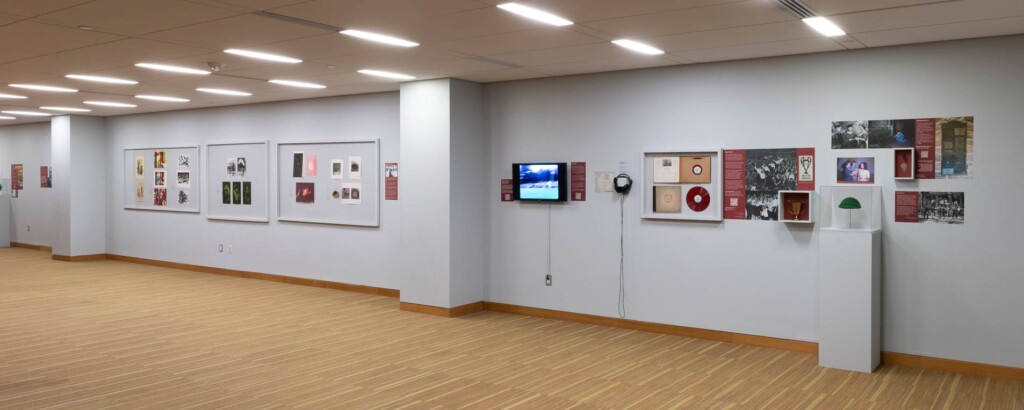
Installation view, “Arcadia Collects: Art, Objects + Ephemera from the University Archives”, Rosedale Gallery, University Commons, photo: Sam Fritch
Arcadia Exhibitions is pleased to announce the exhibition “Arcadia Collects: Art, Objects + Ephemera from the University Archives” on display in the Rosedale Gallery from July 5, 2023 – October 6, 2024.
Produced by Arcadia Exhibitions in collaboration with Anastasia Rousseau, project archivist, “Arcadia Collects” highlights important moments in the cultural history of Beaver College / Arcadia University through photographs, artifacts, and video while also offering a behind-the-scenes look at the inner workings of an active, living archive.
Included are audio recordings from Song Contest, the most popular social event at Beaver in the mid-20th century, photographs of the first European Field Trip in 1948, and rare color footage of the 1948 May Day celebration, digitized for this exhibition. Many of the displays are supplemented with QR codes where viewers can view additional images and more in-depth information.
Items from the Pati Hill Collection are also on display in the exhibition. Rousseau has selected a number of xerographs found through the process of cataloging the collection – some being shown publicly for the first time – that reveal a variety of Hill’s visual experimentations centered around the photocopier.
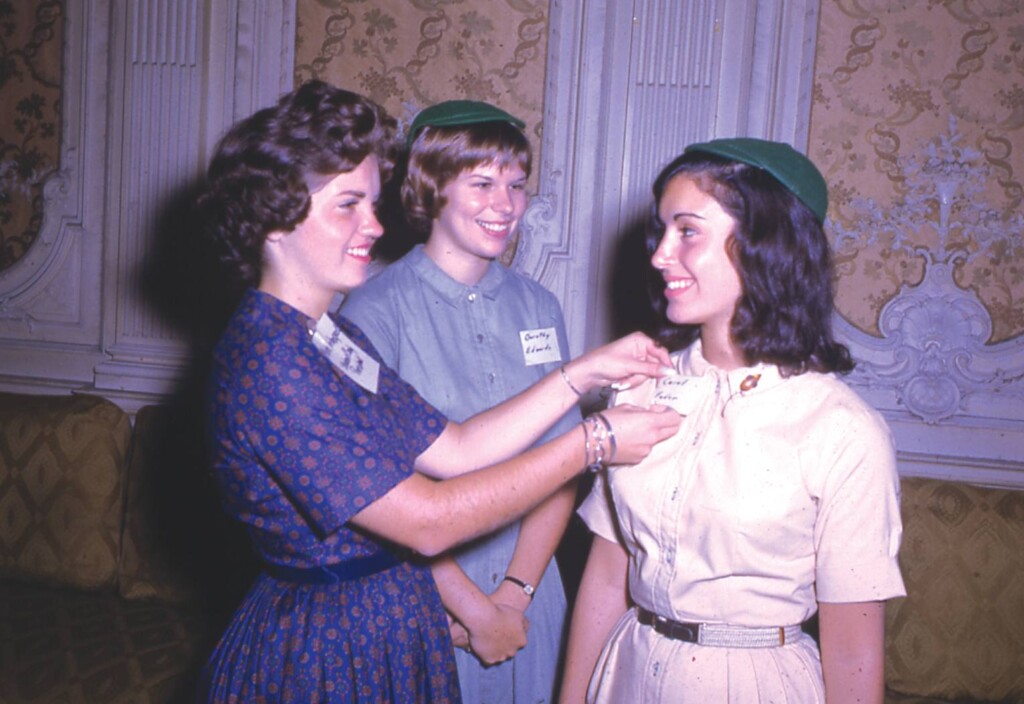
Student Government Association President Merle Arbogast capping a freshman in the Rose Room, Grey Towers Castle, 1961. Photo courtesy University Archives.
Frame from 16mm footage of the 1948 May Day Celebration. Courtesy University Archives.
First Beaver College European Field Trip, 1948. Photo courtesy Phyllis Jane (Greenberg) Weiner ’51.
An event to celebrate the openings of “Arcadia Collects: Art, Objects + Ephemera from the University Archives” and “Samantha Mitchell: Land Forms” will be held in the Great Room of the University Commons on Thursday, September 21, 2023 at 6:30 PM. The evening will begin with a lecture by Rousseau about the University Archives and the Pati Hill Collection.
Immediately following the talk, a reception will be held in both the Rosedale and Harrison Galleries where artist Samantha Mitchell will be available to discuss her works on paper. Both events are free and open to the public.
Quentin Morris: Works on Paper
June 13 – September 17, 2023
June 13 – September 17, 2023
Arcadia Exhibitions is pleased to present “Quentin Morris: Works on Paper.” The exhibition will be on view in Spruance Gallery from June 13 through September 17, 2023.
This exhibition of drawings and paintings on paper by Philadelphia-based artist Quentin Morris (b. 1945) features 37 examples from a five-decade practice dedicated to the production of monochromatic works. Executed in a range of black mediums on a variety paper of supports, these previously unexhibited drawings and paintings were selected from the artist’s studio and date from 1977 to 2013.
Morris began his exploration of the color black while he was a student at the Pennsylvania Academy of the Fine Arts in the early 1960s during the height of the Civil Rights Movement. His intention, as articulated in a written statement to which he has remained committed since that time, is “to present black’s intrinsically enigmatic beauty and infinite depth; to relentlessly refute all negative cultural mythologies about the color, and ultimately to create work that innately expresses the all-encompassing spirituality of life.”
Quentin Morris is represented by Larry Becker Contemporary Art, Philadelphia and Blum & Poe, Tokyo, Los Angeles, and New York.
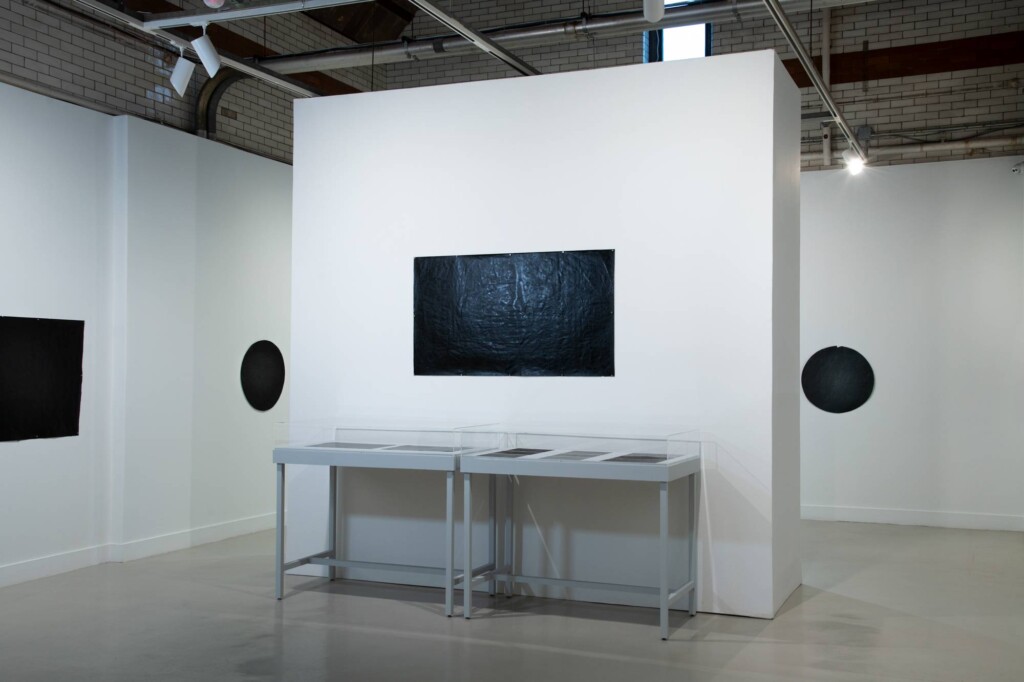
Morris’s unwavering dedication to the black monochrome positions his work at a singular juncture in the evolution of this form of abstraction. With roots in early Modernism—the paintings of Kazimir Malevich in particular—as well as in Asian art, this legacy has endured due to its capacity to embrace tensions between the transcendental/spiritual and the formal/material while also engaging questions of perception and cultural determination. These are embodied not only by the rigor of Morris’s lifelong commitment to his project but also by his identity as an African-American and a devout practitioner of Nicheren Shoshu Buddhism, followers of which chant the phrase “Nam-Myoho-Renge-Kyo.” When repeatedly voiced, these Japanese words, which mean “Devotion to the Mystic Law of the Lotus Sutra,” facilitate concentration in meditation in a manner that is analogous to viewing solo exhibitions of Morris’s work.
The constraints that Morris has established for his project paradoxically ensure its incisive focus as well as its expansive openness to nuance and variety, options that include his choice of primary supports—canvas and paper. Morris’s production of canvases has generally been confined to rectilinear and circular formats that evolved from his early, pre-stretched canvases (30 x 24 inches) to unstretched six-foot squares and circular canvases with diameters of six and ten feet. His works on paper, however, are executed within a much more varied range of formats that have advanced his investigation in ways that foreground its embrace of chance and accident, as well as its resourcefulness.
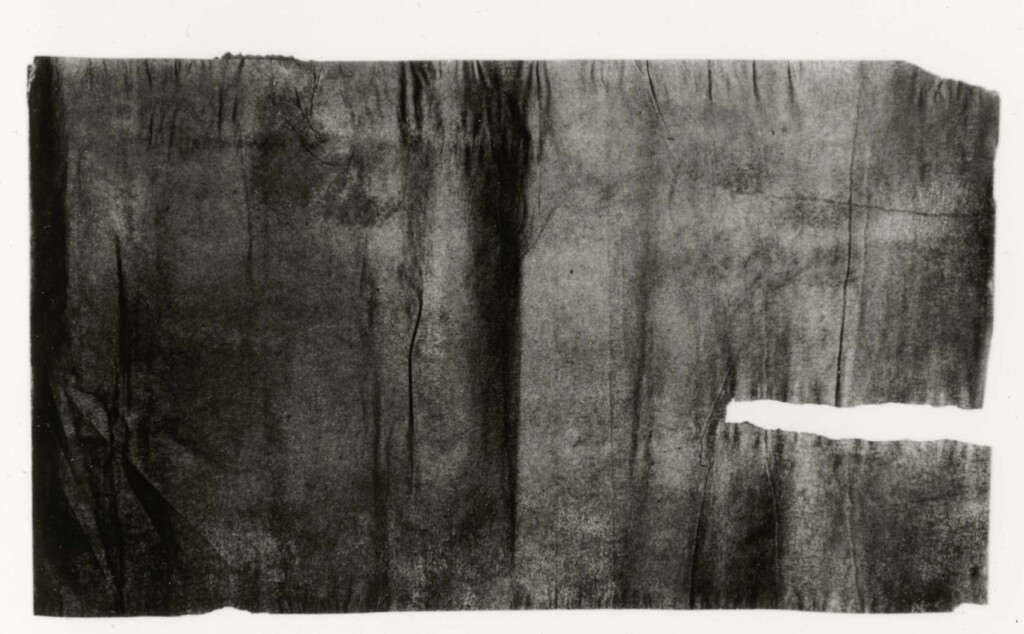
The scale of these paintings and drawings ranges from letter-size sheets to the nearly 14-feet horizontal, scroll-like work from 1977, one of the earliest works in the exhibition. This painting, along with several other examples on brown wrapping paper, demonstrate a capacity for boldness while also speaking to the fragility of their paper supports, the rough edges of which are rendered even more vulnerable by their presentation. Morris’s preference for hinging these works to the wall without frames ensures that viewers have direct access to their surfaces while making the works extremely reactive to the site of their display. Their textures absorb and reflect light in volatile ways. Surfaces that appear glossy from one angle can read as matte from another.
All of the drawings in the exhibition are presented in two vitrines, some of which were executed on printed flyers and newsletters mailed to Morris’s home. (Close inspection will reveal the presence of a mailing label adhered to a 15″ x 21″ graphite work from 1987.) The machine-cut edges of these sheets are in sharp contrast with the torn contours of the larger paintings on brown paper, which, in some instances, evoke fragments and artifacts.
Morris’s canvases have generally been executed using a mixture of silkscreen ink and polymer acrylic, whereas the mediums he applies to paper are much more diverse. These can include graphite, charcoal, crayon, marker, printing inks, and spray paint. These materials can be absorbed so densely into the paper that the results offer striking forms of material metamorphosis. A trio of works from 2001 on gray Fabriano paper—gifted to him, like much of the paper he uses—are distinguished by skein-like fluctuations in tone as well as networks of creases that result from the paper’s response to wet materials, including water itself. In the case of dry media, layers of graphite can transform the given paper into an object resembling a sheet of metal.
The exhibition includes a grouping of thirteen circular works, a format he introduced to his canvases in the early 1980s and initiated on paper in the late 2000s. Morris trims these circles (each approximately 26 inches in diameter) by hand, a process that starts by folding the sheet of paper in half and inscribing a semicircle on the folded paper with a pencil attached to a string. While the sheet is still folded, Morris cuts along the drawn line. The resulting circles are somewhat irregular but consistently modular enough to encourage the viewer to savor their spectrum of differences. These range from mottled, organic textures to evidence of Morris’s direct gestural manipulation of silkscreen ink and polymer acrylic.
Each circle is bisected by visible folds, and in one instance, sliced into two equal parts. The different angles of these folds readily suggest the axes or equators of celestial objects. Although Morris may register such pictorial readings, he refutes any intention to portray or represent in the same way that he denies any value to the printed content of the found papers he uses. This posture is likewise supported by his refusal to title any of his works, which he labels only by the year and month of their production. The severity of Morris’s approach, however, is consistently tempered by forms of discovery, acceptance, and a practical, no-nonsense attitude that has resulted in an uncanny and monolithic practice that is continually culminating while simultaneously renewing itself.
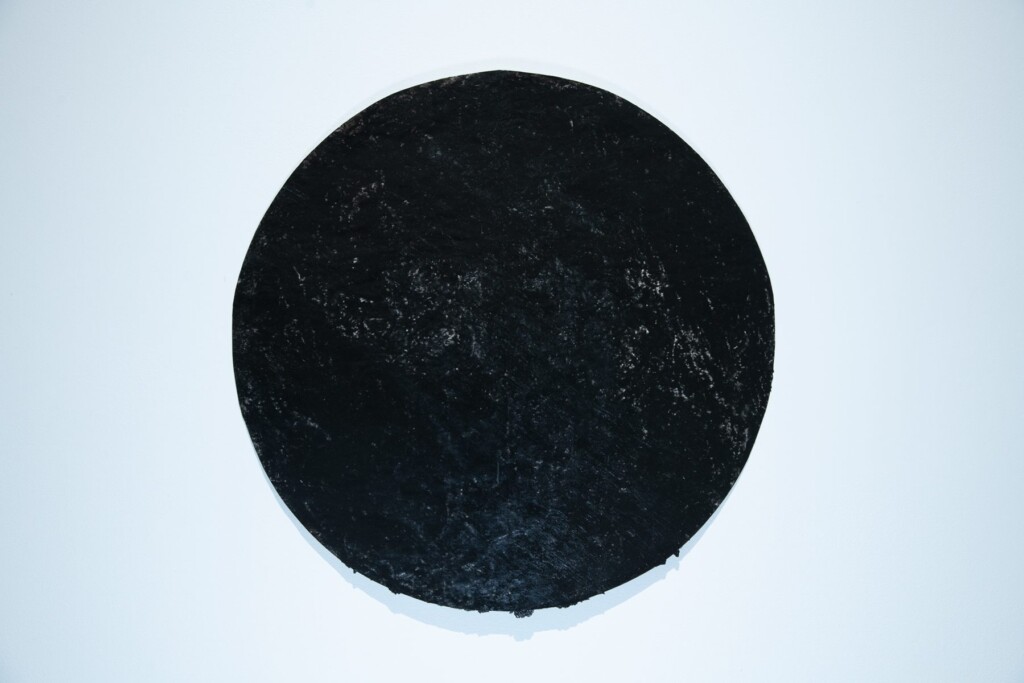
Quentin Morris has exhibited in museums and galleries nationally and regionally, including, most recently, in a career retrospective at Blum & Poe, New York City (2017) and in the group exhibition “20/20: The Studio Museum in Harlem and Carnegie Museum of Art” (2017). His work is included in the permanent collections of the Carnegie Museum of Art, the Pennsylvania Academy of the Fine Arts, and the Philadelphia Museum of Art.
“Quentin Morris: Works on Paper” marks the eighth time that Morris will be presenting his work at Arcadia. He was a popular veteran of the gallery’s series of “Works on Paper” juried exhibitions, which originated in the 1970s as an annual drawing competition for regional artists and continued until 2009 as a biennial. His work was juried into six shows between 1991 and 2009 by Robert Storr, Thelma Golden, Laura Trippi, Mark Rosenthal, Bill Arning, and Connie Butler. The Philadelphia Museum of Art acquired its only example of Morris’s work for its permanent collection as a purchase prize (selected by director Anne d’Harnoncourt) from the 1991 iteration of the exhibition. One of his 10-foot diameter paintings was curated by then gallery director Paula Marincola into the first iteration of “A Closer Look,” a group exhibition with Carolyn Healy, Michael MacFeat, and Anne Seidman, each of whom, like Morris, had been previously selected into a juried “Works on Paper” show.
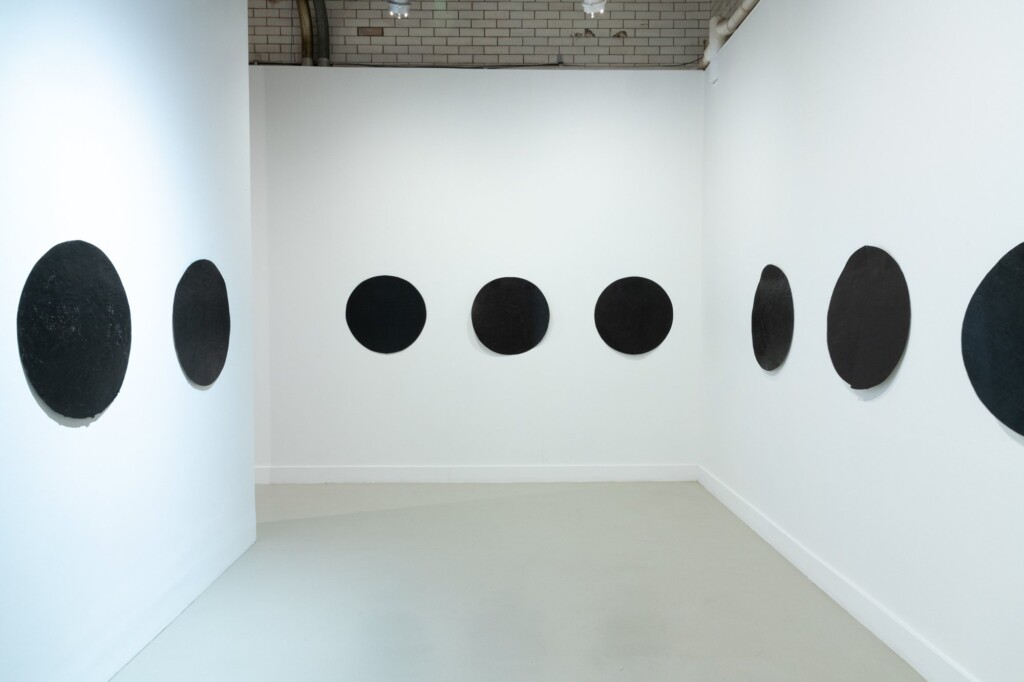
Installation view, “Quentin Morris: Works on Paper,” Spruance Gallery, photo: Sam Fritch
Senior Thesis Exhibition
April 28 – May 15, 2023
April 28 – May 15, 2023
Arcadia University’s Department of Visual and Performing Arts, in conjunction with Arcadia Exhibitions, is pleased to present the Senior Thesis Exhibition from April 28 through May 14, 2023.
For this show the galleries, corridors, and studios of the Benton Spruance Art Center are transformed into a single expansive exhibition space. For the graduating seniors, the bodies of work on view, encompassing a full range of creative disciplines and approaches, represent the concluding research of their intensive, year-long capstone experience.
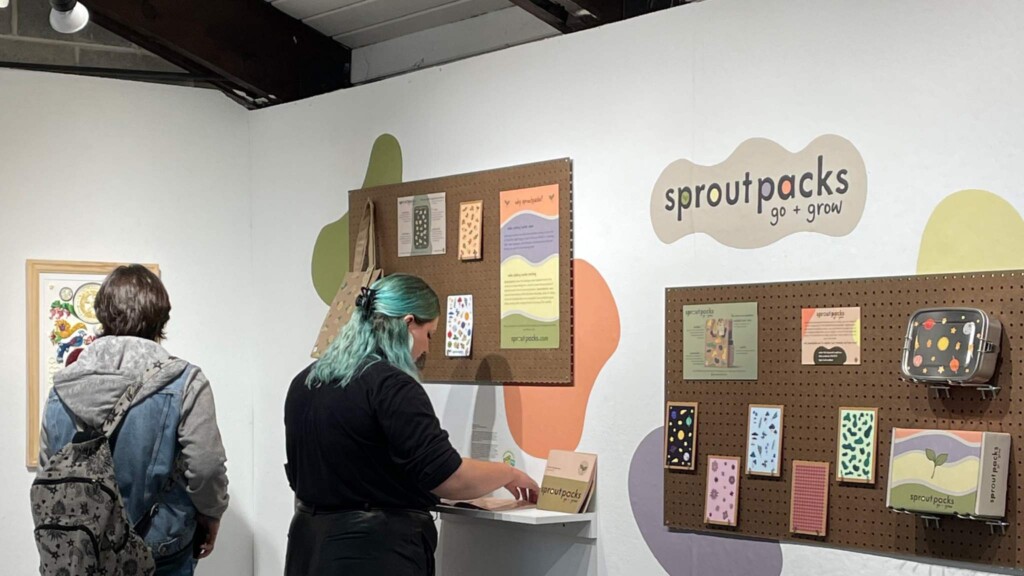
Installation view, “Senior Thesis Exhibition 2023,” Morgan Glista, Sproutpacks, Benton Spruance Art Center, photo: the Department of Art and Design.
An end of year exhibition highlighting the work of Arcadia’s graduating art seniors is a tradition that dates back to the Department’s move to the Glenside campus from Jenkintown in 1935. Over time the opening of the exhibition has evolved into a celebration for the entire campus community, marking the end of Arcadia’s Thesis Week, which includes presentations and displays from every major.
Additionally, the first night of the exhibition is a moment when many alumni of the Department of Visual and Performing Arts choose to make their return to campus. They come to support friends, to converse with former mentors, or just to celebrate their connection to the larger community.
Beginning in 2016, the alums attending the reception are given the opportunity to vote on their favorite individual thesis presentation. This year’s Alumni Prize was awarded to Riley Bennett, Daphne Marquis, and Charlie Smirga.
The opening reception will be held on April 28, 2023 beginning with a special sneak preview reception for alumni at 6:00 PM. The show opens to the Arcadia community and the general public at 7:00 PM with light refreshments provided.
The students included in this year’s exhibition include: Gianna Bates, Riley Bennett, Jasper Boyd, Angie Brewer, Emily Brown, Camryn Burns, Shannon Collins, Anaiah Cupe, Toni Feliciano, Katy Freeman, Morgan Glista, Keeanu Graham, Makenzie Hillegass, Roxy Iliescu, Sage Kalanik, Emily Lickey, Bristol Long, M Lynch, Daphne Marquis, Grace McCaughey, Julyanna McNamara, Theo Miller, Thomas Mulcahy, Nadine Novotni, Sarah Orvis, Trinity Peters, Emily Renée, Rey’Na Riggans, Charlie Rose, Elle Sauls, Ellie Schnell, Deanna Shaller, Charlie Smirga, Jessica Smith, Madison Van Tassel, Svea Williams, Katerina Zisman.
Pati Hill: Separating Color
Judith Taylor Gallery
March 22 – April 15, 2023
Judith Taylor Gallery
March 22 – April 15, 2023
“Separating Color” is an exhibition curated by Svea Williams as part of their apprenticeship processing the Pati Hill Collection. Throughout their apprenticeship they became particularly interested in Hill’s use of color and motion in her later work and chose to focus on these elements for their exhibition. The exhibition title refers to the process of color separation by which an image is divided into three “process” colors – cyan, magenta, and yellow – which, when combined with a black “key” layer, produce a full color CMYK image. Though Hill is well known for her work with black and white IBM copiers, she experimented extensively with color toner and began working with a full color copier in the 1990s. The images in this exhibition were produced using a copier that scanned the image once for each process color, giving Hill time to shift the object between each pass and create a sense of movement.
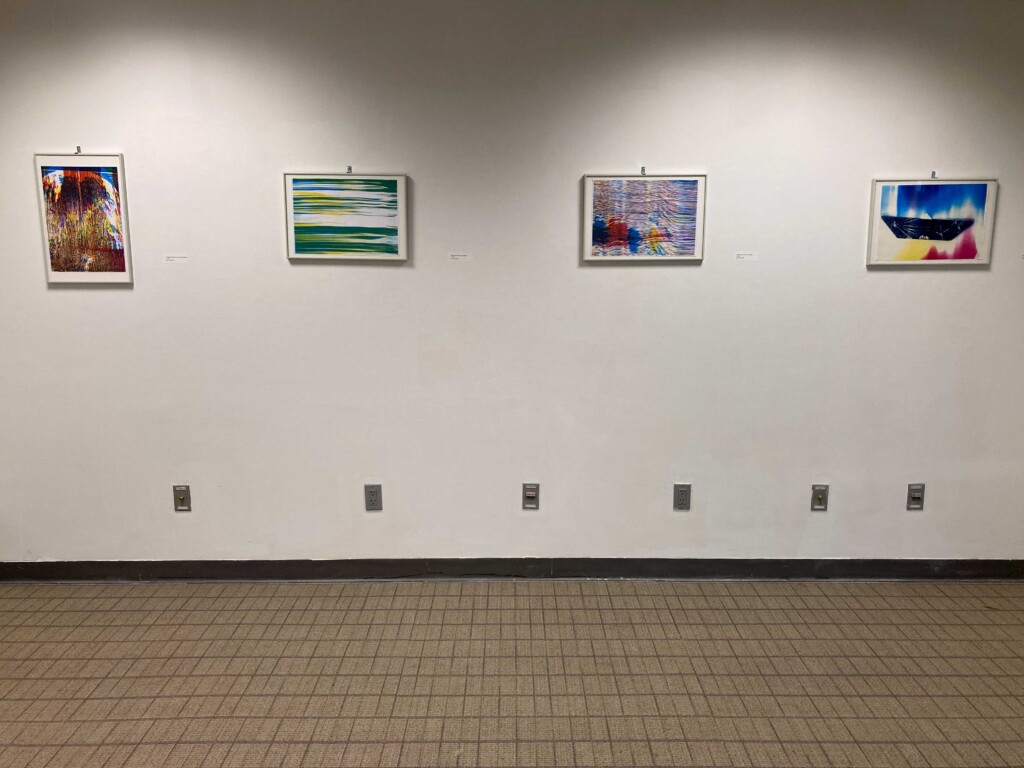
Installation view. Photo: Willow Edmonds
David Cox: What and Where Things Are
March 6 – July 30, 2023
March 6 – July 30, 2023
Arcadia Exhibitions is pleased to present “David Cox: What and Where Things Are” from March 6 through July 30, 2023 in the Harrison Gallery, University Commons. This solo exhibition by the Philadelphia artist and 2005 Arcadia University alum features a selection of oil and gouache paintings. These range from traditional still lifes and compositions of groups of painted wooden blocks (fabricated and arranged by the artist) to color charts and hyper-realistic renderings of clouds.
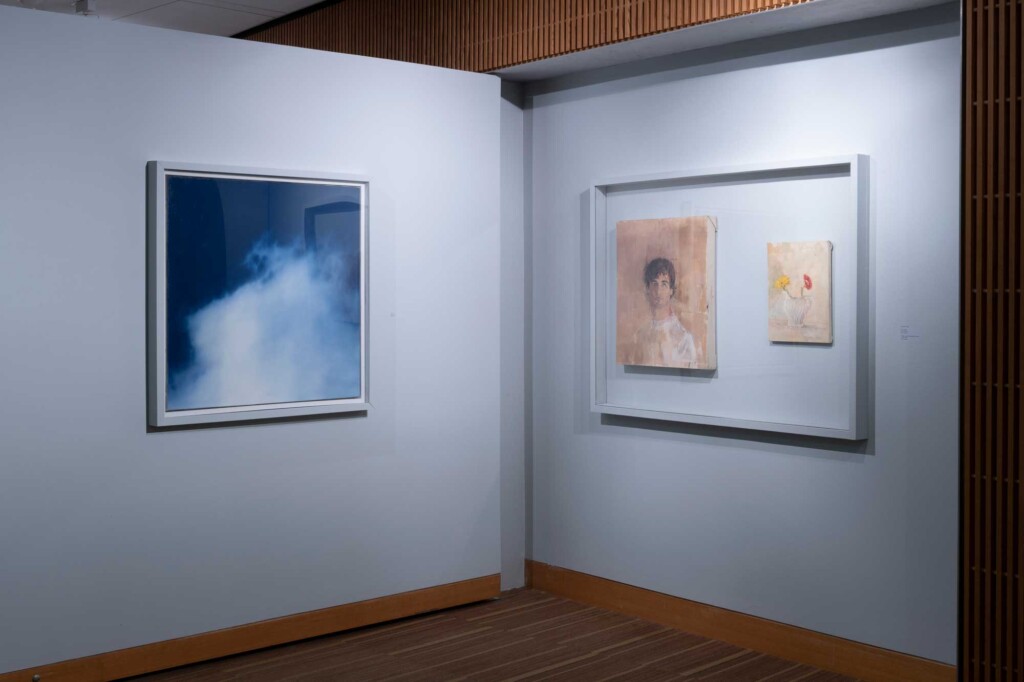
What links the various bodies of work presented in the show are Cox’s lifelong curiosity concerning the nature of reality and a drive to depict and express his existence without reliance on logical thought or the shared meaning of language influenced by his intensive research and understanding of Zen Buddhist philosophy.
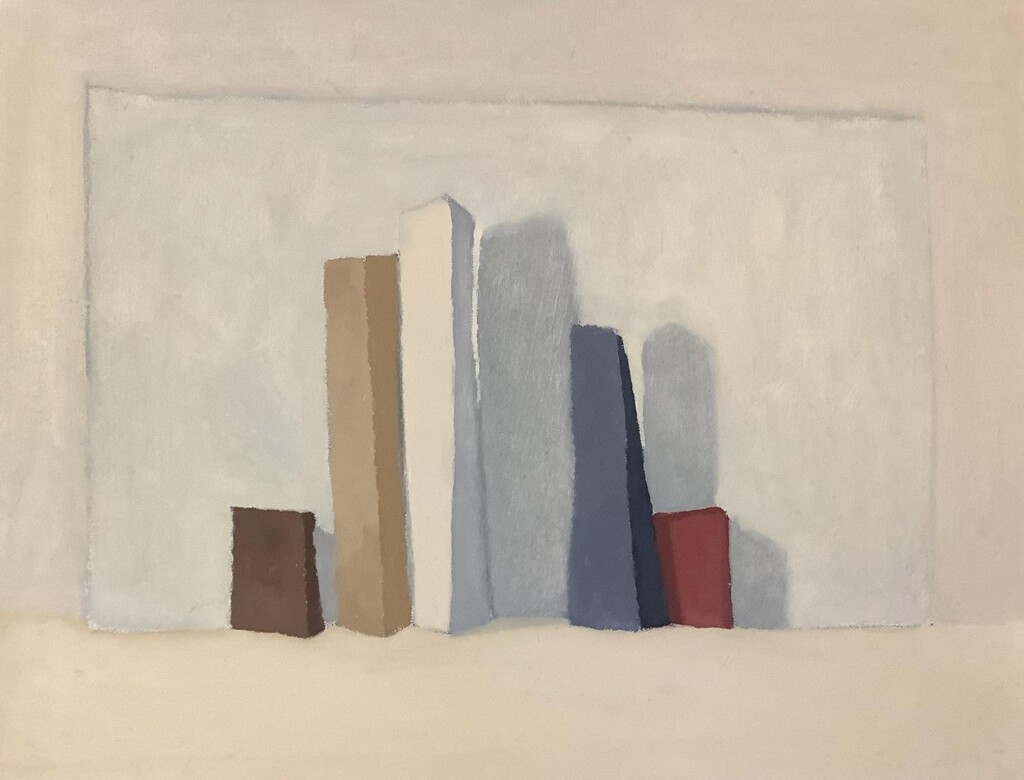
Brown), c. 2009-2015, oil on canvas, 14″ x 18″,Courtesy Nina Zollo
David Edward Cox was born in 1976 and was raised in Montgomery County just outside of Philadelphia. He was introduced to painting at a young age, beginning work with oils at 12 years old.
At Muhlenberg College, Allentown, Pennsylvania, Cox pursued undergraduate studies in philosophy and painting. Upon beginning graduate work at Arcadia University in 2003, Cox chose to focus on his study of painting, finding that as his practice progressed he was able to satisfy his passion for both subjects.
Cox’s work has been shown in New York City and throughout the Philadelphia region. Notable venues include the Profiles Gallery at New York Design Center (2016), Woodmere Art Museum (70th Annual Juried Exhibition, 2010), and at Chestnut Hill Gallery, Philadelphia (2016-17). His paintings are represented in numerous private collections.
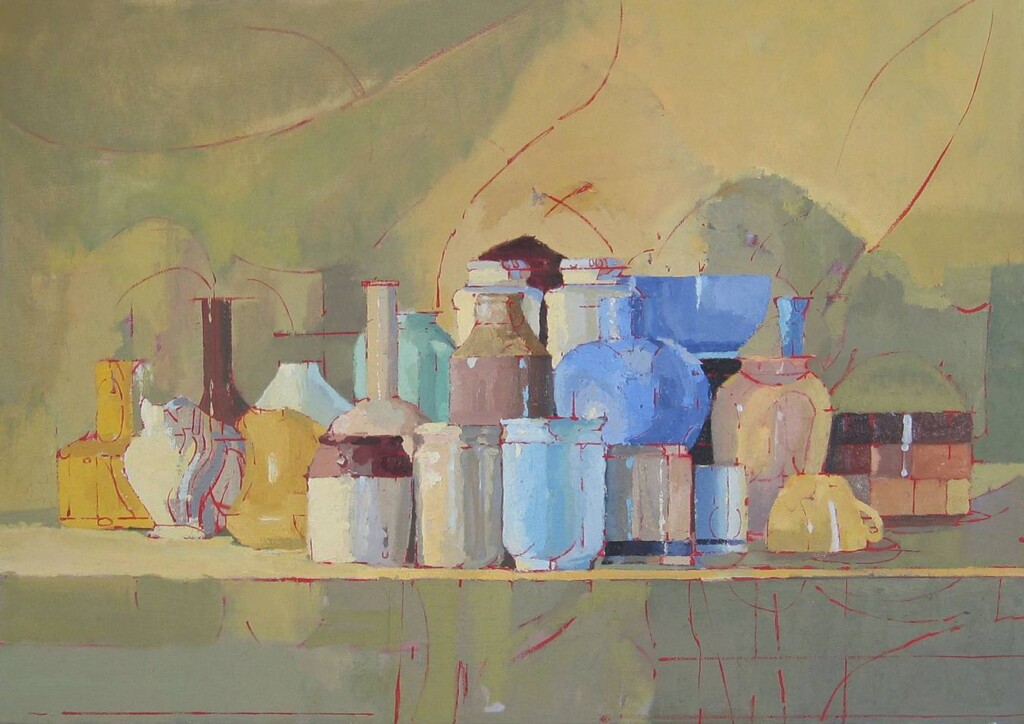
Still Life: Yellow Vessel on Left), c. 2005-2006, oil on canvas, 34″ x 24″, Courtesy Nina Zollo
The Highwaymen: Fast Painting the American Dream
February 23 – April 23, 2023
February 23 – April 23, 2023
Arcadia Exhibitions is pleased to present “The Highwaymen: Fast Painting the American Dream,” on view from February 23 to April 23, 2023. The exhibition features sixteen tropical landscape paintings produced between the 1960s to the early 1990s by eight core members of a loosely affiliated group of 26 African American artists (25 men and one woman) based in Central Florida.
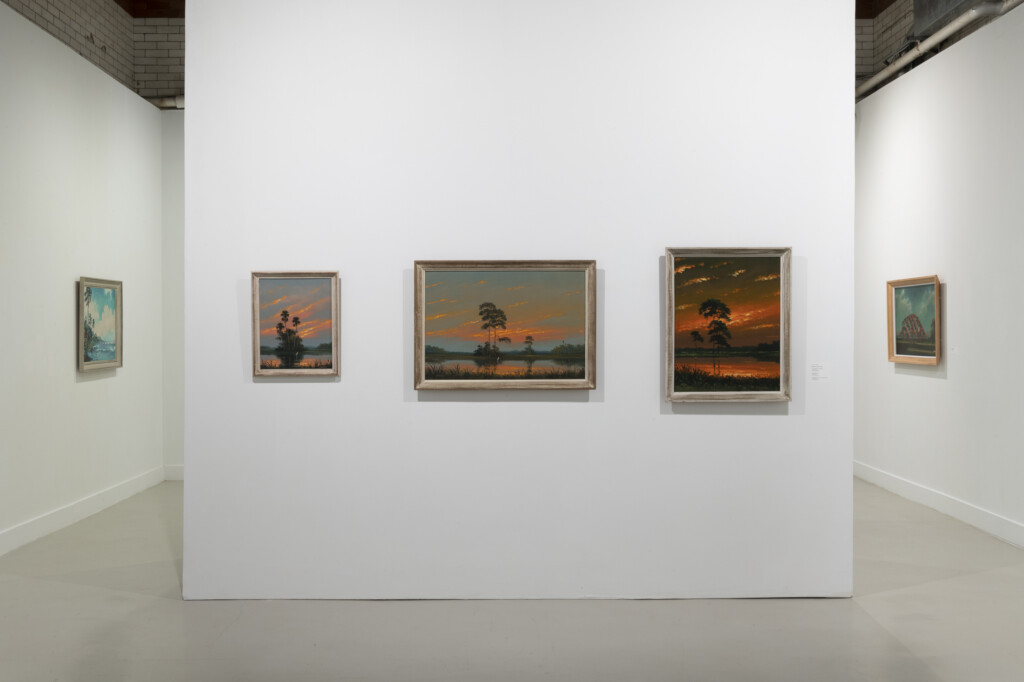
Installation view “The Highwaymen: Fast Painting the American Dream,” Spruance Gallery, Benton Spruance Art Center. Photo: Sam Fritch.
Largely untrained as artists, this informal cohort of young painters was rediscovered in the mid-1990s when they were retrospectively named the Highwaymen to refer to their innovation of an entrepreneurial strategy that harnessed landscape painting as a vehicle to bypass low-paying work in the state’s citrus groves. Shut out of the museum and the gallery system by racial segregation and Florida’s Jim Crow laws, the artists traveled the recently completed interstate roads and highways of Florida’s east coast, selling their paintings at reasonable prices “door-to door and store-to-store” from the trunks of their cars. Their mostly white patrons included a growing population of new homeowners as well as hotels, restaurants and doctor’s offices looking for affordable décor during the post-war boom period. In the process, the Highwaymen engendered a unique iteration of romantic regionalism that helped cultivate the iconography of Florida that nurtured the myth of the Sunshine State.
The sixteen paintings on view depict idyllic back-country marshes, windswept beaches, and conditions of light and weather that the artists knew first-hand, all executed in a range of “fast painting” processes. These include the use of “wet-on-wet” techniques, palette knives loaded with paint, and assembly-line methods that could yield up to 20 examples a day. Primarily rendered in oil on Upson board (an inexpensive roofing material) cut in standard sizes from 4 ft by 8 ft. sheets, the paintings were framed by the artists with off-the-shelf crown moldings that facilitated stacked storage and transport that allowed the works to sold while still wet often on the day they were made.
This collaborative enterprise, which some historians estimate yielded more than 200,000 paintings during its heyday from the late 1950s to early 1980s, can now be regarded as a hybrid practice that merged the classical traditions of the Hudson River School with folk art by way of Warhol’s Factory. Described by Artforum critic Zack Hatfield, as “brazenly formulaic but fringed with fantasy, these paintings parade a wonderfully unprecious attitude about living with, and making one’s living from, art.”
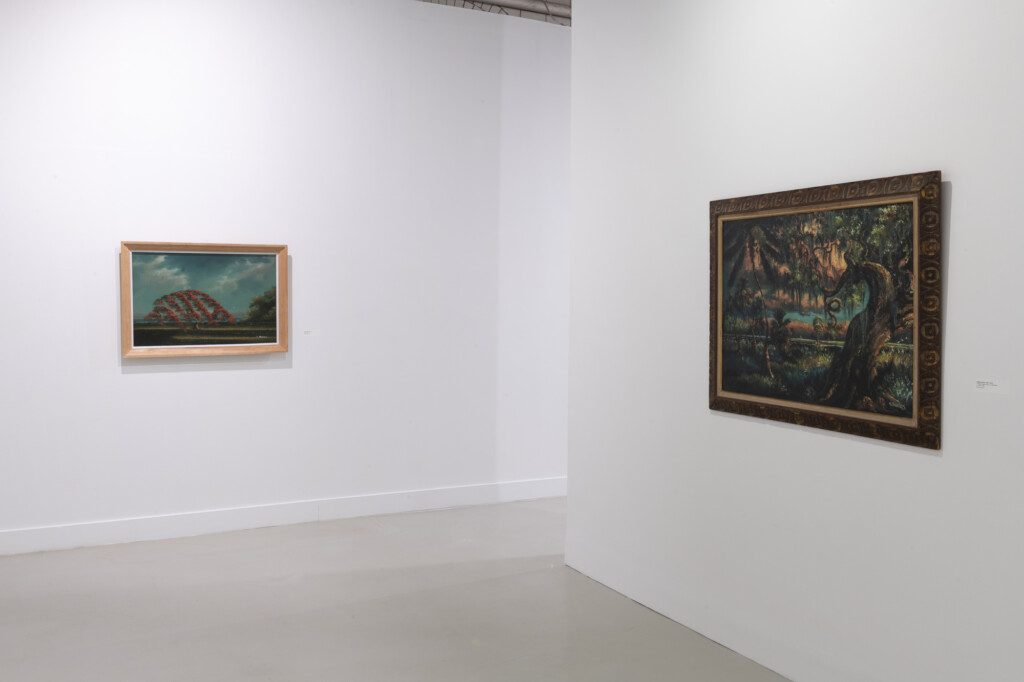
Installation view “The Highwaymen: Fast Painting the American Dream,” Spruance Gallery, Benton Spruance Art Center. Photo: Sam Fritch.
In addition to serving as a compelling example of overcoming systemic racism and economic oppression, the phenomenon of the Highwaymen is also a story of formal invention via emulation and subversion. The work was inspired by the success of A.E. “Bean” Backus (1906 -1990), the white mentor of the group known as “the dean of Florida Landscape painting” based in Fort Pierce, Florida. In 1954, Backus formally trained the 19-year-old Harold Newton, convincing him to abandon his focus on religious subjects. The following year, 14-year-old Alfred Hair began attending Backus’s Saturday-morning classes and came to realize, as Highwaymen historian Gary Monroe states, “that as an African American artist he could not attain the same level of success as his white mentor unless he sold scores of paintings at much lower prices.”
Hair’s solution included developing myriad forms of accelerating the painting production, including contracting friends to prepare boards, build frames, and peddle his paintings on the road. Monroe adds that Hair “didn’t know that by working away to build inventory he would inadvertently strip away artifice to reveal archetypes, imagery that was as sublime as it was descriptive.” His efforts exposed a market for painted fantasies of the region and his success motivated others in his circle to follow his lead. Newton, who is represented in the exhibition by four examples, is now recognized for his technical expertise while Hair is regarded as the group’s driving force and catalyst.
The exhibition includes works by Al Black (b. 1940), Mary Ann Carroll (1940-2019), Willie Daniels (b. 1950-2021), James Gibson (1938-2017), Alfred Hair (1942-1970), Roy McClendon (b.1932), Harold Newton (1934-1994), and Livingston Roberts (1942-2004).
Their paintings are included in the A.E. Backus Museum (Fort Pierce, Florida) the collection of the Smithsonian’s National Museum of African American History and Culture (Washington, D.C.), and the Florida Artists Hall of Fame (Tallahassee, Florida).
On Tuesday, March 28, Gary Monroe, Professor of Visual Art, Daytona Beach Community College and author of five books about the Highwaymen (four published by University Press of Florida), will lecture about the group and their work. Monroe’s talk will take place in the Great Room, University Commons and begin at 6:30 PM.
All works included in the exhibition are on loan courtesy The Walker Collection of Florida Self-Taught Art.
Special thanks to Lance Walker, Dorothy Hussey, and Gary Monroe with additional gratitude to Nina Johnson, Alex Baker, and John Ollman.
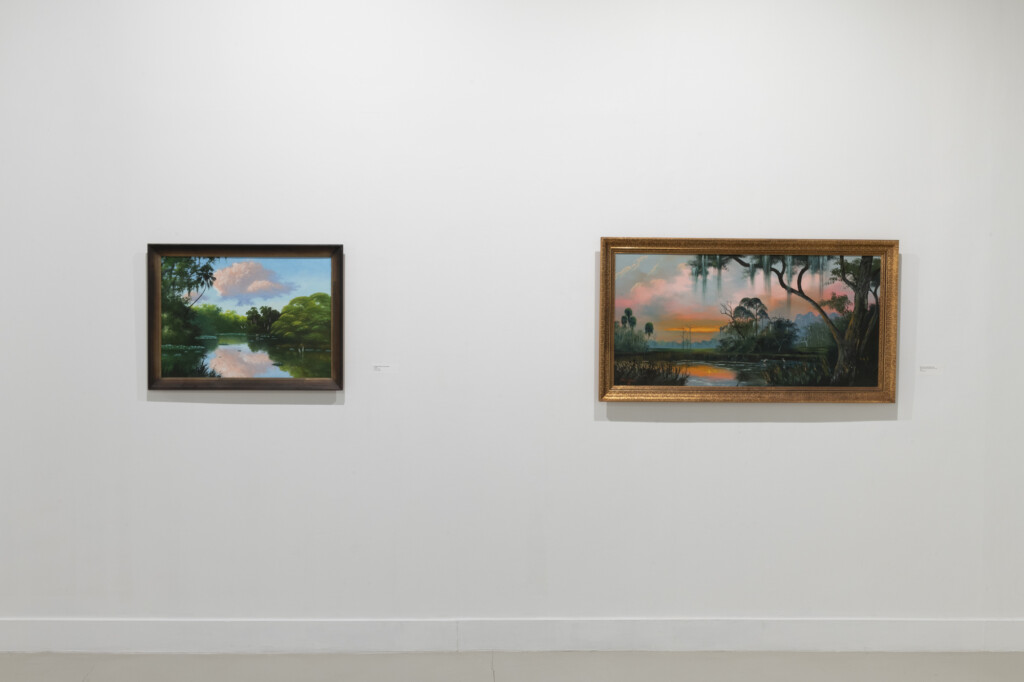
Installation view “The Highwaymen: Fast Painting the American Dream,” Spruance Gallery, Benton Spruance Art Center. Photo: Sam Fritch.
The Royal (Ave) Visit: A Juried Student Photography Exhibition
February 20 – June 11, 2023
February 20 – June 11, 2023
Juried by Adam Hess, Director, Landman Library
Arcadia Exhibitions, in collaboration with Marketing and Communications, is pleased to present “The Royal Visit: A Juried Student Photography Exhibition,” in the Rosedale Gallery, University Commons February 20 through June 11, 2023.
The exhibition consists of twelve, 18 by 24 inch framed photographs taken by 10 students as part of a competition to document the site of the former Bishop McDevitt High School before it undergoes renovations to serve the future needs of the University. The show was juried by Adam Hess, director of Landman Library.
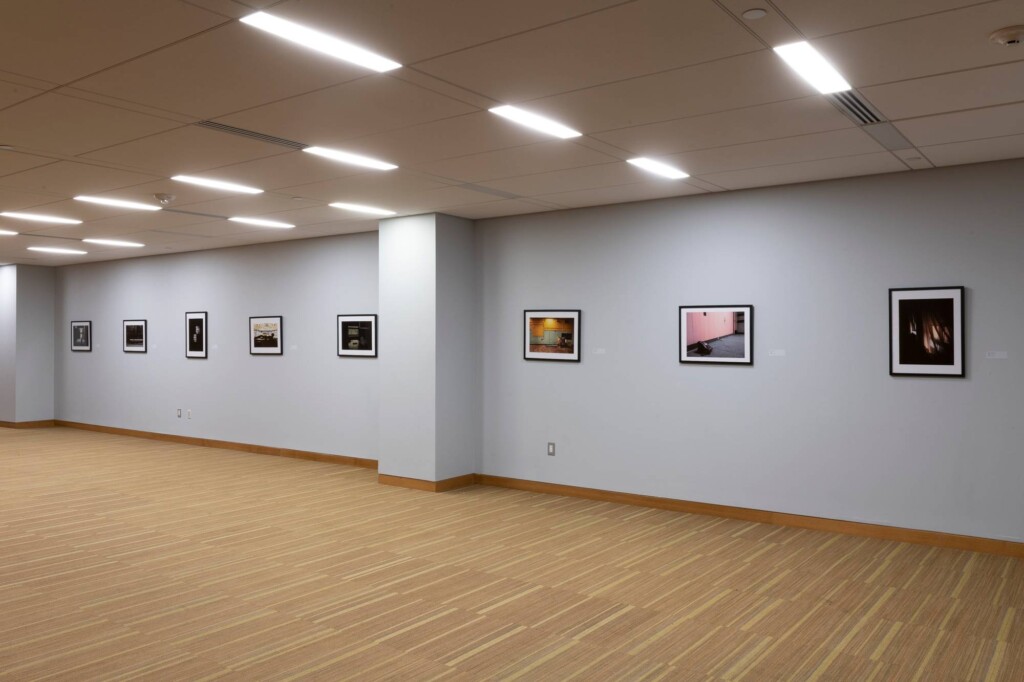
Installation view, “The Royal (Ave) Visit: A Juried Student Photography Exhibition,” Rosedalle Gallery, University Commons
This past December students were offered the opportunity to explore the facility and photograph the offices, classrooms, laboratories, athletic facilities, storage areas, cafeteria, chapel, television studio, grounds, and other spaces. Though the building was left in excellent condition by its former inhabitants, the spaces still contained many unique objects left by the Archdiocese of Philadelphia after the sale of the building which denote its long use and history.
For example, chalkboard writings, decorations, artwork, equipment, and pictures of faculty and students remained untouched in the building after the school closed at the end of the 2020-2021 academic year. Much of this evidence of previous use is captured in the photographs in the exhibition.
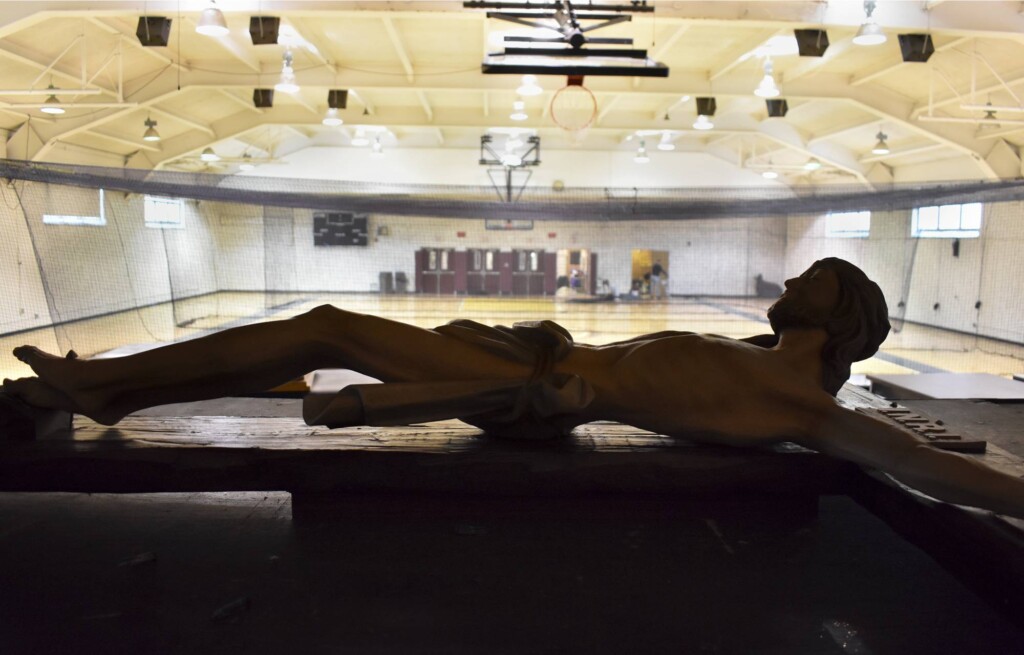
According to Hess, who holds an MFA in photography from Louisiana State University, “The entries for the exhibition were outstanding overall. Of particular interest, the submissions included many close-up details that documented decades of teaching and learning, as well as many religious icons and artifacts that were left behind.”
“Our juror did an excellent job of choosing images that not only recorded the building at this important transitional moment, but also contain the individual artists’ ideas and creative voices.” says Exhibitions Coordinator Matthew Borgen.
Hess made his selections from a pool of 75 images submitted by 25 students. Participating artists include; Caeden Conklin ’25, Willow Edmonds ’26, Claire Griffin ’22, Makenzie Hillegass ’23, Becca Hoyer ’26, Diego McLendon ’26, Jewel T. Miller ’24, Trinity Z Peters ’23, Masai Pines-Elliot ’25, and Kelsie Winship ’26.
“We hope that this exhibition serves as a catalyst for productive conversations about the long-term future of this property and how it may best serve our students, faculty, staff, and the greater Cheltenham Township community.” added Borgen.
2022
Owen Ahearn-Browning, Timothy O’Donovan, and David Schmuckler: Character Studies
October 18, 2022 – February 5, 2023
October 18, 2022 – February 5, 2023
Arcadia Exhibitions, in collaboration with Center for Creative Works, is pleased to present “Owen Ahearn-Browning, Timothy O’Donovan and David Schmuckler: Character Studies” from October 18, 2022 to February 5, 2023 in the Rosedale Gallery, University Commons.
The theme of personal narrative unites the work of these three artists, each of whom explore elements of their individual experience through some kind of storytelling. In his spoken-word performances, Owen Ahearn-Browning recites prose poems told through various alter egos – “I Mr. Angry Man Owen,” “I serious and curious kid Owen,” and “I Dwight K Schrute from The Office,” among others – that trace an assortment of moments, lived and experienced through film and television. A true citizen of the world, Timothy O’Donovan has resided in Wales, South Africa, and all over the United States. His art practice traces his travels through landscape painting and extensive writings, which he reads aloud in performances set to music. David Schmuckler’s work is singularly concerned with the aesthetic of horror films which inspire elaborate installations incorporating painting and sculpture. He activates these spaces by physically entering them, fully-costumed as specific characters, and exploring these invented personas through rhythmic, repetitive choreographies.
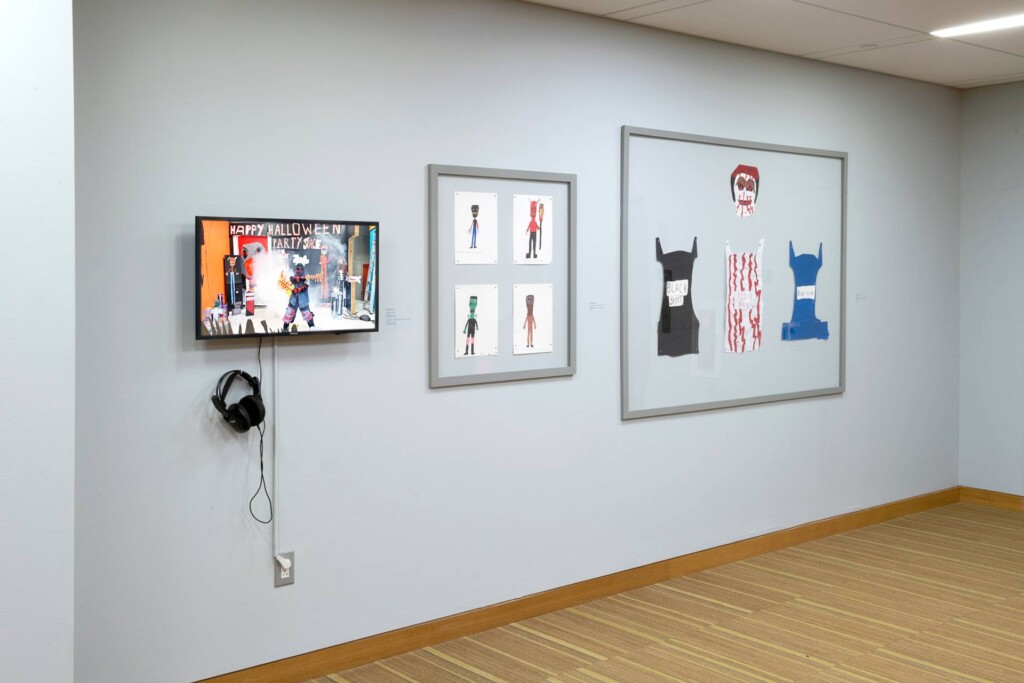
Installation view, “Owen Ahearn-Browning, Timothy O’Donovan, and David Schmuckler: Character Studies”, Rosedale Gallery. Photo: Sam Fritch.
Center for Creative Works (CCW) is a studio for adults with developmental disabilities. With two locations – in South Kensington, Philadelphia and Wynnewood, Pennsylvania – CCW works with over one hundred artists on creative and professional development in the arts. Participants learn skills in drawing and painting, as well as printmaking, ceramics, woodworking, music, sculpture, and textiles. A staff of mentor artists teaches professional materials and techniques, with the goal of developing participants as artists, artisans, and designers. The organization fosters individual expression and skill development, promoting its artists’ work through public exhibitions, art fairs, and other events in the community. CCW is committed to realizing the potential for everyone to contribute in truly meaningful and productive ways, and to support its artists in building their cultural identity as members of their community.
CCW grew from the Lower Merion Vocational Training Center (LMVTC), which was founded by Resources for Human Development in 1972. LMVTC followed a sheltered workshop model, in which participants do traditional vocational contract work, such as stuffing envelopes and shredding paper. Transforming into an arts program in 2010, CCW became a place for participants to explore creative ways to earn money, express themselves, engage with and contribute to their communities, and build artistic skills. Through exhibiting and selling artwork, working on contract design jobs, and developing products, artists are able to attain ownership over the work that they engage in, while developing sophisticated aesthetic sensibilities.
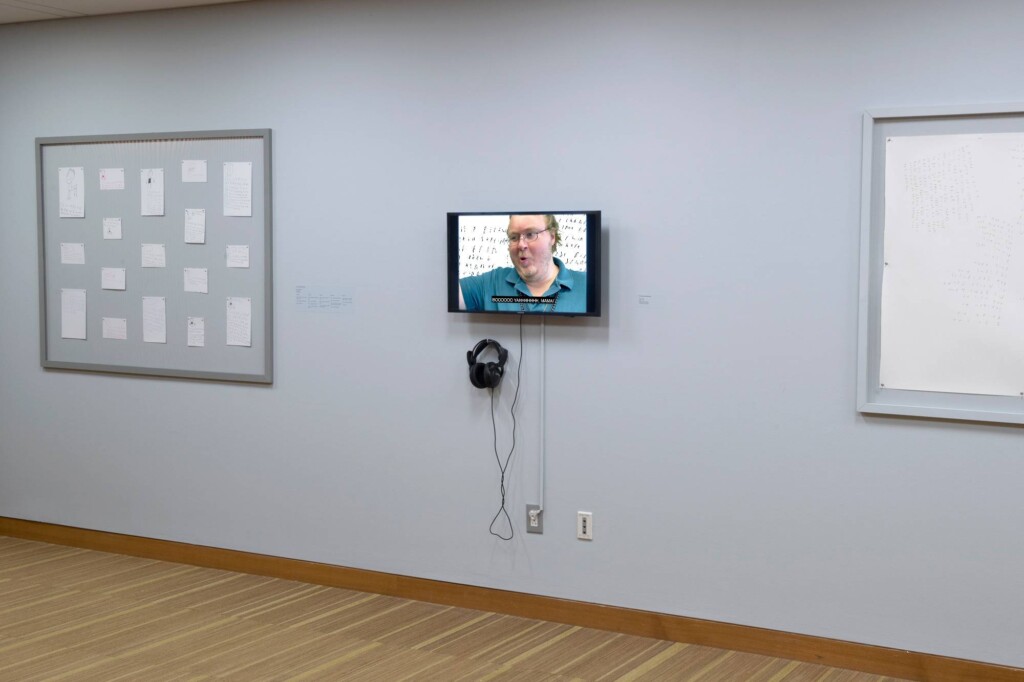
Installation view, “Owen Ahearn-Browning, Timothy O’Donovan, and David Schmuckler: Character Studies”, Rosedale Gallery. Photo: Sam Fritch.
Work by CCW artists has been embraced by the greater Philadelphia arts community, and has been exhibited at the Outsider Arts Fair (NYC), Outsider Arts Fair (St Louis), Crawford Gallery (Cork, Ireland), ArtYard (Frenchtown, New Jersey), Delaware County Community College Art Gallery (Media), Woodmere Museum (Philadelphia), Fleisher/Ollman Gallery (Philadelphia), FJORD Gallery (Philadelphia), Summertime Gallery (NYC) Rosemont College (Bryn Mawr), Haverford College (Haverford), and many other venues.
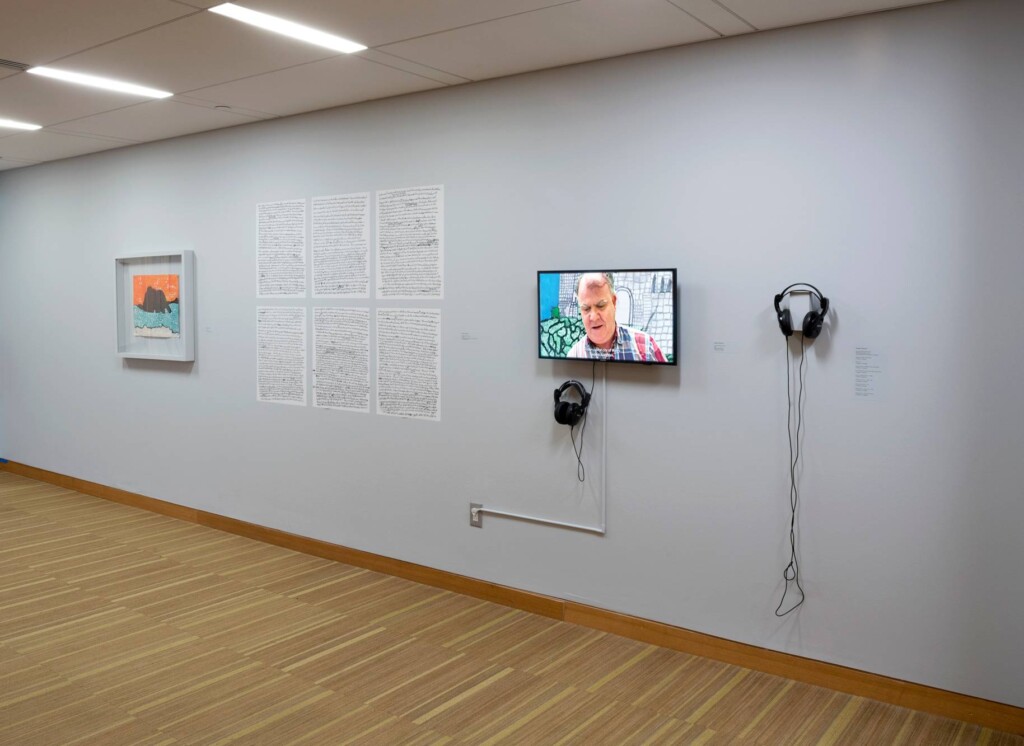
Installation view, “Owen Ahearn-Browning, Timothy O’Donovan, and David Schmuckler: Character Studies”, Rosedale Gallery. Photo: Sam Fritch.
ABOUT THE ARTISTS
DAVID SCHMUCKLER
David Schmuckler (b. 1989) has a passion for horror that runs deep through everything he makes. Schmuckler began his career as an artist in 2014 at Center for Creative Works as a painter and illustrator. Creating singular compositions of masks and figures in costumes based on Google-image search-sourced imagery of Halloween phantasmagoria, his work deconstructs representations of horror in popular culture.
Schmuckler recently expanded his oeuvre to include sculpture, video, sound, installation, and performance. His performance Vampire Evil Devil Demon Monster (2021), the culmination of the past two years of Schmuckler’s practice, is a multi-media exploration of a demonic alter ego. “I AM VAMPIRE EVIL DEVIL DEMON MONSTER,” Schmuckler tells his audience. Wearing a painted and hand-embroidered costume, Schmuckler transforms himself using his voice and found materials to create the sounds of thunder, rain, fire, screaming, devil laughter, demon growls, satanic voices, knives being sharpened, and lightning. To render the aural landscape of a haunted house inhabited by demons, he includes claws that scratch, doors that creak, and echoes that roar. Nodding to his favorite horror movies, which include mass-media icons of the genre such as Michael Myers and Jason Voorhees, Schmuckler transports us to a fantastic world of his own making.
Schmuckler’s work has been exhibited at Weird Days (now Summertime) (Brooklyn), AUTOMAT Gallery (Philadelphia), and the Outsider Art Fair (NYC).
TIMOTHY O’DONOVAN
I like the idea of seeing nature by itself in its own form. I feel very comfortable with nature when I take hikes and walks wherever I am visiting or residing. I’ve been to a place that’s very similar to Venice, Italy, when I went on vacation with my mom in Las Vegas. Cardiff, Wales is where I was born. I later resided in South Africa, after I had accommodations in New Zealand. I went from South Africa to the United States.
I feel more in control of my life and my emotions when I make a piece of artwork. If there is too much tension, I paint and draw while listening to natural music, sounds of the ocean, and Enya, and Vangelis. I feel less stressed. I have a pretty difficult time processing things, but gradually it comes back to memories of thought about what I would like to do with my artwork. I use a lot of different mediums to contain my pieces of artwork
I am a learning-disabled individual and have been since birth. I’ve been independent since age 14, and have been a self advocate for 17 years. I have been coming to the Center for Creative Works for eleven years, and have lived independently for fourteen years. – T.O.
Timothy O’Donovan (b. 1964) has traveled extensively in his lifetime and references landscapes and landmarks that he has seen from all over the world in his artwork. From the castles of Wales to the beaches of South Africa, his work captures diverse settings with meticulous detail. Primarily working with pen and ink, pencil, and watercolor, he has developed a process that is simultaneously focused and improvisational, combining tight marks with emotionally charged washes of color. O’Donovan’s artworks have been exhibited at Haverford College, Neumann University, Bryn Mawr Rehab, ArtYard, and Philadelphia’s City Hall, among other venues. Recently, O’Donovan has pursued spoken word audio work and is in the process of translating his written life story into a series of recorded prose poems set to music. He has performed at The Free Library of Philadelphia and The Rotunda in West Philadelphia.
OWEN AHEARN-BROWNING
I love doing art about different places like that place called Cynwyd Elementary School that is near the middle school I went to for three years but the elementary school I was at for only one year only for a little while.
And my artwork is also on the fact that I have always loved being a free and energized man.
I think it’s about time I enjoyed swimming in the Lower Merion High School Pool when the Chestnut Hill College Pool is gone and another thing I do art on is the different foods I still eat sometimes like chocolates or pizza I mean any of that and I also think that it’s about time I wrote about basketball at Baldwin and the Upper Dublin Swimming Place on Saturday.
I think I need to do more artwork on different old times so any way that is all so anyway thank you again for all your time and okay both ciao and bye. – O.A.-B.
With a passion for storytelling, Owen Ahearn-Browning (b. 1992) creates dynamic spoken-word pieces that are created to be read aloud. Delivered in a distinctive style that is half song/half shout with a clear syncopated rhythm, sometimes accompanied by instrumentation, Ahearn-Browning’s writings trace meandering stories that flow easily from describing his experiences to fiction. His narrative thread spans time and space, pulling content from television and his own childhood with equally powerful immediacy and sense of ownership. Shorter writings on note cards are paired with cryptic, humorous drawings that articulate deceptively simple statements of objective truths, which are both ironic and deeply sincere.
Ahearn-Browning grew up in Lower Merion and still lives in the Ardmore area. He has created several publications with Center for Creative Works, including Book About Furniture and full-length albums with CCW’s Pop! Pop! Pop! Records, including Owen Sings Like Michael Jackson. His work has been exhibited at The Brodsky Gallery in the University of Pennsylvania’s Kelly Writers House and The Woodmere Art Museum, among other spaces. In 2022 he performed with The Moth in Havertown.
ABOUT THE PERFORMANCE
Arcadia Exhibitions, in collaboration with Center for Creative Works, is pleased to announce an evening of performance works in conjunction with the exhibitions on view in the University Commons through February 5, 2023: “Owen Ahearn-Browning, Timothy O’Donovan and David Schmuckler: Character Studies” and “Karen Misher: Home and Other Reflections”.
The works presented will serve to underscore the power of personal narrative that unites the two exhibitions.
The evening will begin with a spoken word presentation of Ode to Fairy Cup Mother by Karen Misher, associate professor in the Department of Art and Design, as well as a Beaver College alumna.
The performance relates to the wearable sculpture Fairy Cup Mother on display in the Harrison Gallery as part of “Home and Other Reflections”, a solo exhibition that represents Misher’s impulse to document and share the complexity of her daily existence as a mother of twin boys with autism. Ode to Fairy Cup Mother recounts the story of a woman Misher met while on vacation in the Dominican Republic who provided crucial aid to her family when they left home having forgotten to bring a supply of Play-Doh cups, seemingly innocuous objects that are essential to the emotional well being of one of her sons.
Owen Ahearn-Browning, one of the three artists featured in “Character Studies,” will present a selection of spoken word pieces on the theme of being tough and energized. Inspired by a range of personal and pop cultural references – from memories of grade school to NBC’s The Office – his tongue-in-cheek compositions trace a network of emotions experienced both personally and collectively. A video recording of a similar work, The O-Man (2022), is currently on display in the Rosedale Gallery.
Timothy O’Donovan will present a new poem, “When springtime rolls around every year, to me,” as well as some excerpts from his autobiographical project My Personal Life Story Vol 1. Both spoken word pieces will be accompanied by original music composed by the artist. O’Donovan’s poetry and prose are inspired by his passion for international travel and the natural world and chronicle the artists’ experience. Longer sections of My Personal Life Story Vol 1 are also on view in the Rosedale Gallery.
Additionally, there will be a screening of David Schmuckler’s performance Vampire Evil Devil Demon Monster (2021), a multi-media exploration of the artists’ demonic alter ego.
These performances will take place in the Great Room, University Commons, beginning at 6:30 PM. A reception with light refreshments will be held immediately afterwards in the Rosedale Gallery. Both events are free and open to the public. We hope that you are able to join us in celebrating the artists and their work.
Karen Misher: Home and Other Reflections
October 4, 2022 – February 5, 2023
October 4, 2022 – February 5, 2023
Arcadia Exhibitions is pleased to present “Karen Misher: Home and Other Reflections” in the Harrison Gallery, University Commons beginning October 11, 2022 through February 5, 2023. Misher, an associate professor in the Department of Art and Design, as well as a Beaver College alumna, is generally regarded for her metal pieces, worn on the body, which dynamically combine the visual language of jewelry and sculpture.
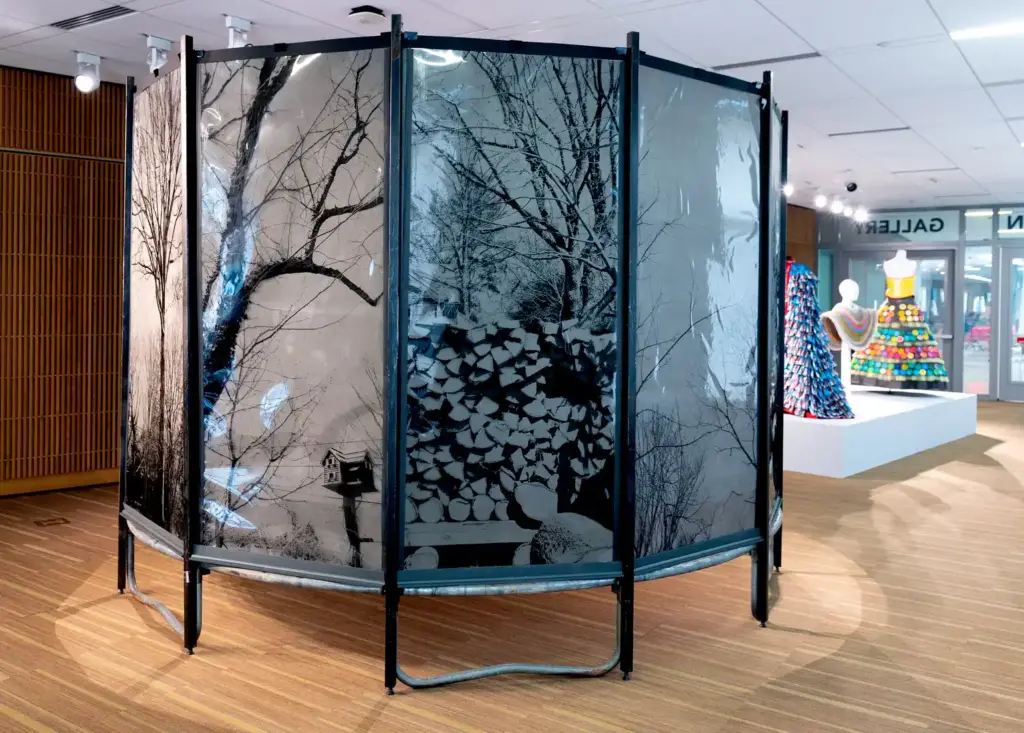
Installation view, “Karen Misher: Home and Other Reflections,” Harrison Gallery, exterior view of Home, 2022, site-specific installation, trampoline parts, steel, digital prints, sampled audio, photo: Sam Fritch
In this exhibition the artist offers a new body of work, shown as a whole for the first time. Although it includes various forms of body adornment, the work also ventures into the domains of large-scale sculpture, video, and sound, highlighting the artist’s multidisciplinary approach to her studio practice. Undertaken over the preceding five years, these pieces represent Misher’s impulse to document and share the complexity of her daily existence as a mother of twin boys with special needs.
At the heart of the exhibition stands Home, a steel-framed, 12-sided, structure constructed on top of the remains of an outdoor trampoline worn out by Misher’s children. On each of the exterior panels of Home are printed black and white images offering various views of the artist’s backyard in winter. While inside the structure viewers will experience overlapping layers of ambient sound that documents Misher’s family in their household environment. This experiential work brings the audience into a familiar setting while also exposing them to the often hidden nuances of the autism experience.
The use of the defunct trampoline as the physical and metaphorical foundation for this installation is just one example of a thematic strategy employed by Misher throughout this series in which she utilizes “vestige objects” to represent specific moments in her family’s narrative.
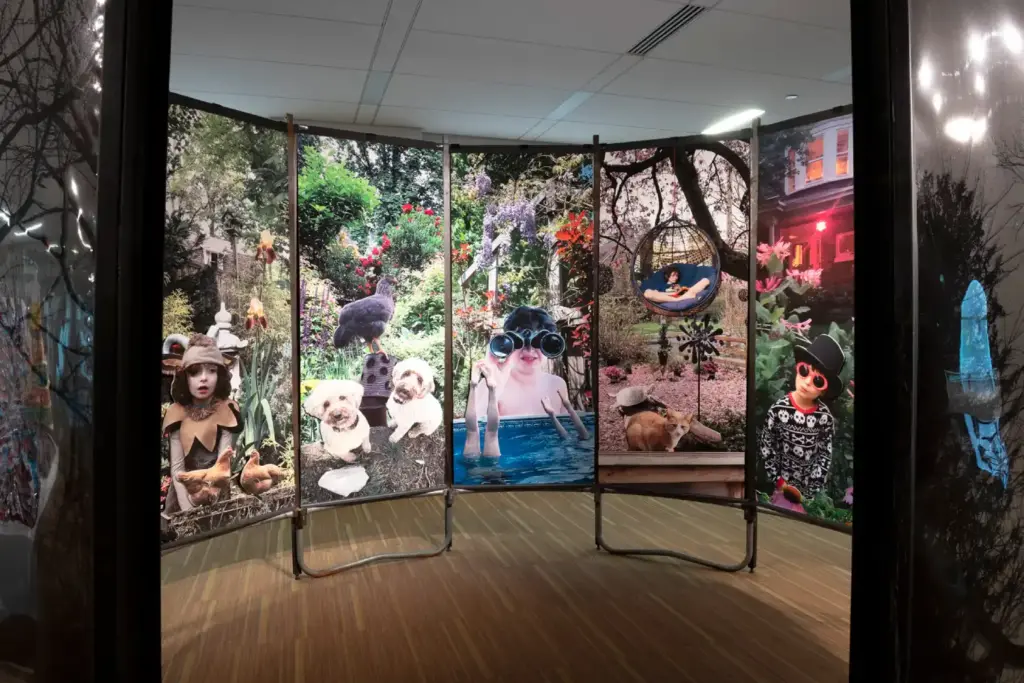
Installation view, “Karen Misher: Home and Other Reflections,” Harrison Gallery, interior view of Home, 2022, site-specific installation, trampoline parts, steel, digital prints, sampled audio, photo: Sam Fritch
Although the instinct for parents to hold onto keepsakes which signify moments in their children’s growth and development is not unusual, Misher’s selections strive to memorialize events that are marked as much by anxiety and crisis as they are by joy and accomplishment. Some of her chosen mementos are more traditional, such as in Blackbird (2015), a necklace containing a lock of her son’s hair. This deliberate evocation of traditional Victorian mourning jewelry serves to commemorate, for Misher, receiving the diagnosis that both her sons were on the autism spectrum.
Conversely, Daily Dose (2017) is a ring fabricated with built-in compartments which house the various medications employed to manage symptoms of autism, including severe anxiety, ability to focus, and obsessive compulsive disorder. The use of these medications symbolizes for the artist, a sacrifice, albeit an essential one, of her children’s purity.
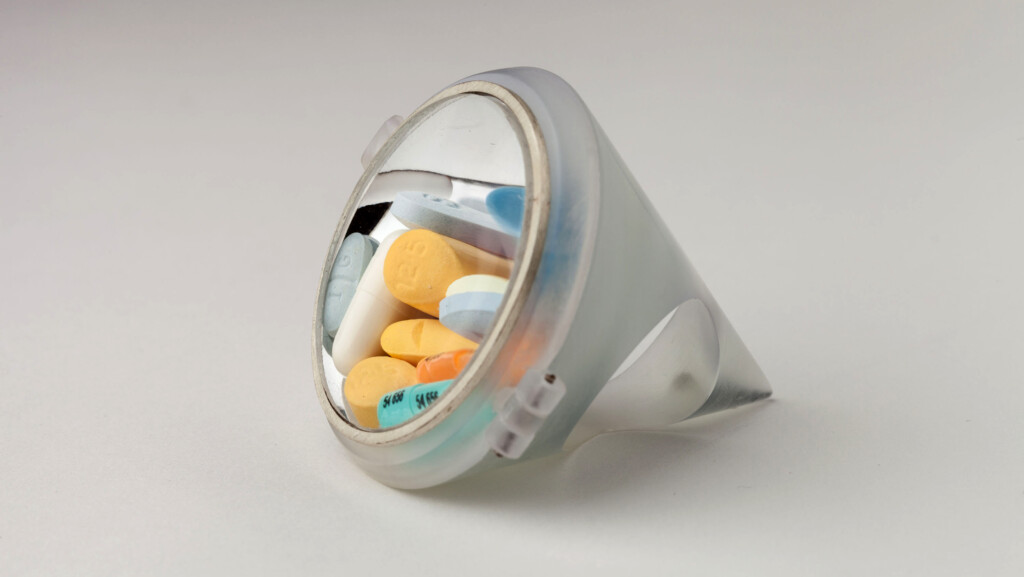
Karen Misher, Daily Dose, 2017, 3D printed resin, concave mirror, prescription medication, and silver, photo courtesy of the artist
Yellow plastic Play-Doh cups, objects vital to one of Misher’s son’s stimming behaviors, play a central role in several works in the exhibition. For example, at the center of the spoken word performance Ode to Fairy Cup Mother (2017) is a brightly colored ball gown adorned with over 400 Play-Doh cup lids. In Ode to Fairy Cup Mother Misher relates the story of a woman her family met while on vacation in the Dominican Republic who aided them in a moment of real crisis. The family left home having forgotten to bring a supply of the essential containers, which almost immediately sent Misher’s son into extreme distress. What seems like an innocuous object to others can create a true crisis for some. Despite the language barrier, and the relative isolation of the resort, the family was able to convey to this woman not only what was needed, but why procuring it was so vital. After many unnerving hours, she returned with a supply of the all-important cups in a manner which, in the moment, Misher related to the feeling of witnessing a miracle.
Misher wears the gown while delivering the performance, the dress acting as a surrogate for her family’s Samaritan. Although the narrative begins with a moment of anxiety, the focus of the work is the establishment of a real emotional connection with a complete stranger – of an instant of truly being seen and understood by the outside world.
Recognizing the presence of Misher’s combination of love, dedication, stress, and frustration in these works is key to understanding her goals as an artist and advocate. Although she does highlight the inherent challenges of home life for a parent of children with autism, it would be over-simplistic to come away from this series with the sense of having witnessed a narrative of personal tragedy.
Rather, Misher’s intention in sharing personal experiences in such an unflinching manner is to remind viewers of the highly subjective nature of the term “normal”. If anything, these works reiterate what anyone involved with raising children comes to understand – that no matter the specific circumstances – with child rearing there is no success without failure, and no elation without exasperation. The challenge Misher has set for herself in making this private world public is to achieve dialogue, acceptance, and understanding for a community that is so often misunderstood.
Proto-Feminism in the Print Studio
Guest Curator: Christina Weyl
September 13 – December 4, 2022
Guest Curator: Christina Weyl
September 13 – December 4, 2022
Senior Thesis Exhibition
April 29 – May 15, 2022
April 29 – May 15, 2022
Student Biennial
February 21 – May 22, 2022
February 21 – May 22, 2022
Out of the Heart: The Life and Art of David Ellinger
Guest Curator: Lisa Minardi
February 3 – May 27, 2022
Guest Curator: Lisa Minardi
February 3 – May 27, 2022
Polly Apfelbaum: For the Love of Una Hale
February 3 – April 17, 2022
February 3 – April 17, 2022
2021
Sun & Sea
An opera-performance by Rugilė Barzdžiukaitė, Vaiva Grainytė, and Lina Lapelytė, as part of the Philadelphia Fringe Festival.
September 30 – October 3, 2021
An opera-performance by Rugilė Barzdžiukaitė, Vaiva Grainytė, and Lina Lapelytė, as part of the Philadelphia Fringe Festival.
September 30 – October 3, 2021
Larry Day: Absent Presence
Guest Curator: David Bindman
In collaboration with Woodmere Art Museum and Rosenwald-Wolf Gallery, University of the Arts
August 30 – November 21, 2021
Guest Curator: David Bindman
In collaboration with Woodmere Art Museum and Rosenwald-Wolf Gallery, University of the Arts
August 30 – November 21, 2021
Senior Thesis Exhibition
May 18 – July 30, 2021
May 18 – July 30, 2021
2020
FALLfest 2020: Together//Apart
Live as of December 2020
Live as of December 2020
8 x 8 Exhibition
Live as of December 2020
Live as of December 2020
Senior Thesis Exhibition
Live as of April 2020
Live as of April 2020
Student Biennial
January 13 – February 9, 2020
January 13 – February 9, 2020
PSEA “Touch the Future” Juried Student Art Exhibition
March 1 – 27, 2020
March 1 – 27, 2020
Student Biennial
January 13 – February 9, 2020
January 13 – February 9, 2020