National AI Literacy Day Sparks Campuswide Conversations at Arcadia
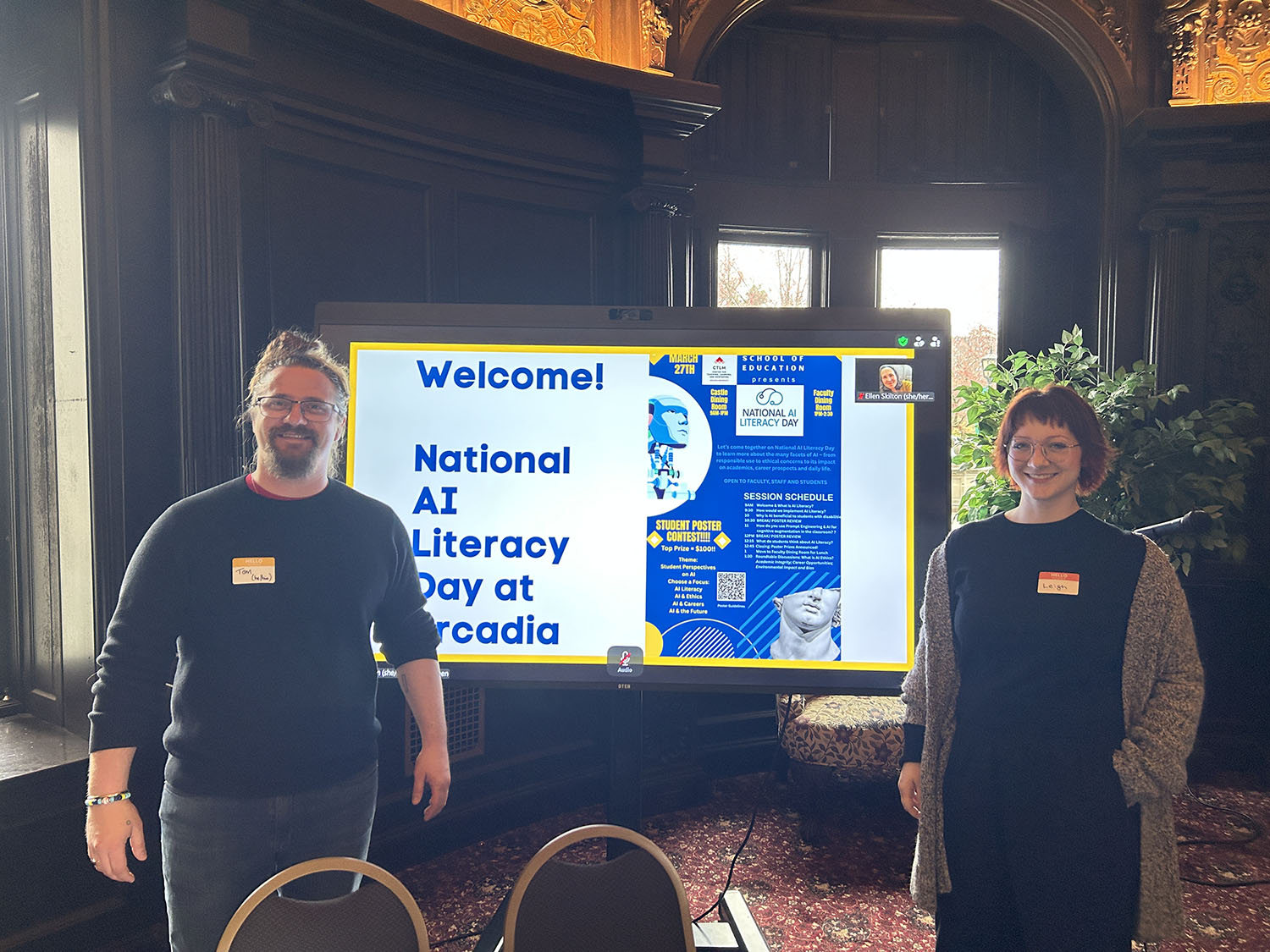
Arcadia’s Center for Teaching, Learning, and Mentoring (CTLM) partnered with the School of Education to celebrate National AI Literacy Day on March 27, with a series of workshops bringing students, faculty, and staff together to learn about and discuss the role of artificial intelligence in education.
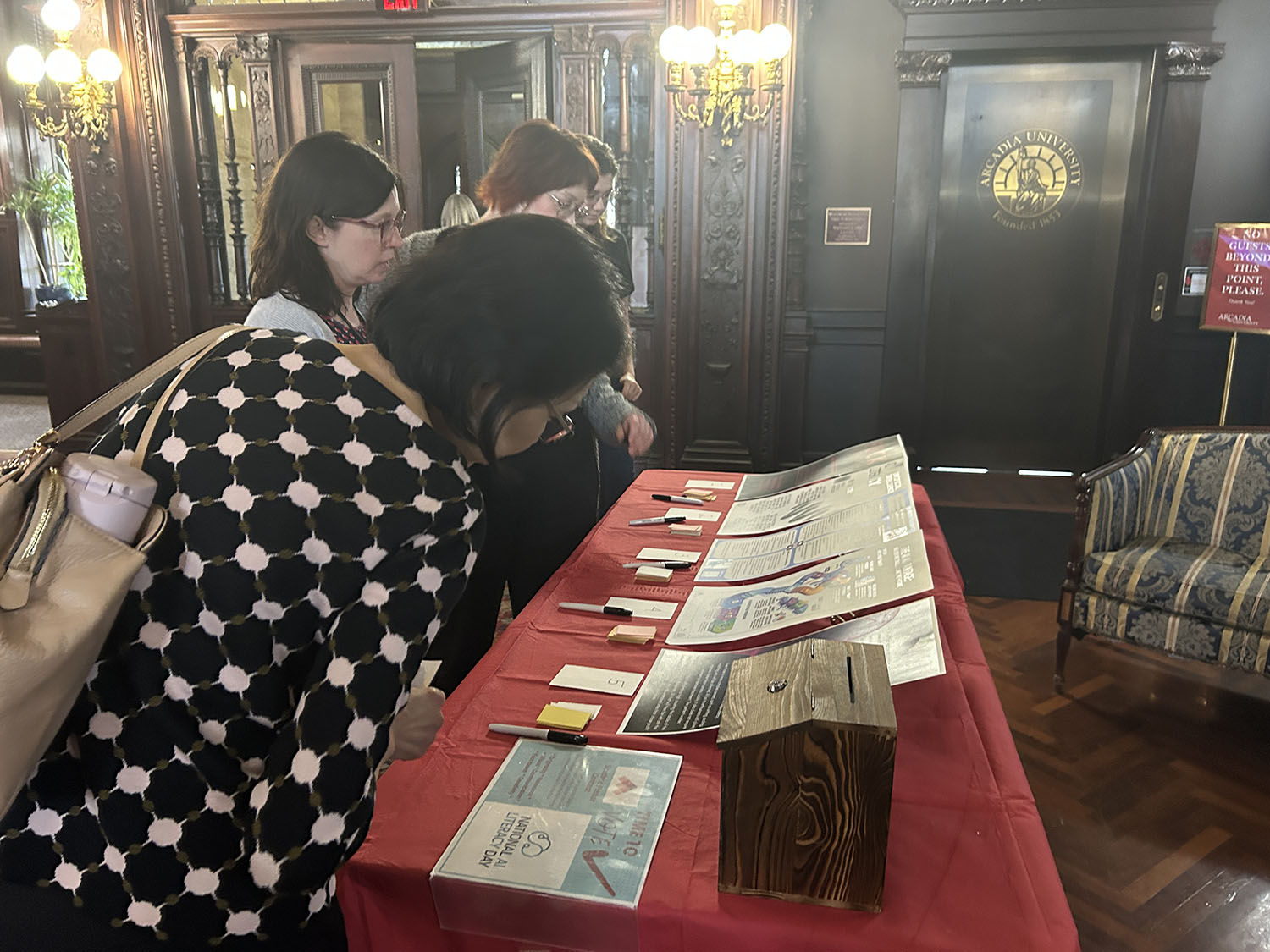
Session topics included understanding AI literacy, benefits for students with disabilities, prompt engineering, cognitive augmentation, students’ opinions on AI literacy, and ethical concerns. The event also included a poster contest inviting students to examine similar themes in their work for a chance to win up to $100.
Adjunct Professor of Religion and CTLM AI Faculty Fellow Tom Berendt and Adjunct Professor of English and CTLM Faculty Fellow Leigh Ferrier ’22, ’25M have developed a course on Canvas to help the Arcadia community better understand the uses, limitations, and ethical implications of AI tools. Anyone interested in taking the asynchronous course can contact the CTLM (ctlm@arcadia.edu) or Berendt (berendtt@arcadia.edu) to learn more.
“I think that everything we’re doing right now is a stepping stone to further engagement,” said Berendt. “There’s a really interesting philosophical debate around the purpose of education and the role of pedagogy. I think some faculty feel like we need to protect students against AI, but others feel that we need to advance their knowledge so that they can actually be relevant in future employment.”
Ferrier noticed many of her students were receiving mixed messages about AI use across their courses.
“I find that a lot of students want someone to talk to them about it,” Ferrier said. “In one class, they’re using it, but in another, ‘don’t ever even think about it.’ So I like to at least start that conversation, because to me, AI literacy is just understanding what it is, knowing how it fits into your life, and how you can interact with it safely, ethically, and to do the least damage to the environment.”
The event aimed to introduce participants to a range of perspectives on AI while encouraging critical engagement with the technology, particularly in fields where its role is still evolving.
“Most people refer to AI literacy in the humanities in relation to avoiding plagiarism,” explained Berendt. “AI literacy has been approached more from the angle of how you shouldn’t be using AI because it’s a form of cognitive offloading. In other disciplines, they are less looking at it as cognitive offloading, and more from the angle of cognitive augmentation, or how you’re working with AI to improve your cognitive abilities. So, depending upon your angle, I think AI literacy in the humanities is about raising the alarm and making students aware of the problems involved with AI. But also having students be well-versed and literate in using it in an appropriate way, so that they can then utilize those skills in future careers.”
As a Healthcare Administration major, Catie Hinton ’26 has found AI tools helpful for processing dense course material.
“There’s a stigma around it, so it can be seen as negative, but I’ve also had a lot of professors encourage us to use it, because there’s a lot of information you have to go through to get the important parts,” she said. “I have ADHD, so I struggle with trying to stay focused on something. So sometimes if it shows me a new perspective or really pulls things out for me, it helps me focus on the main material.”
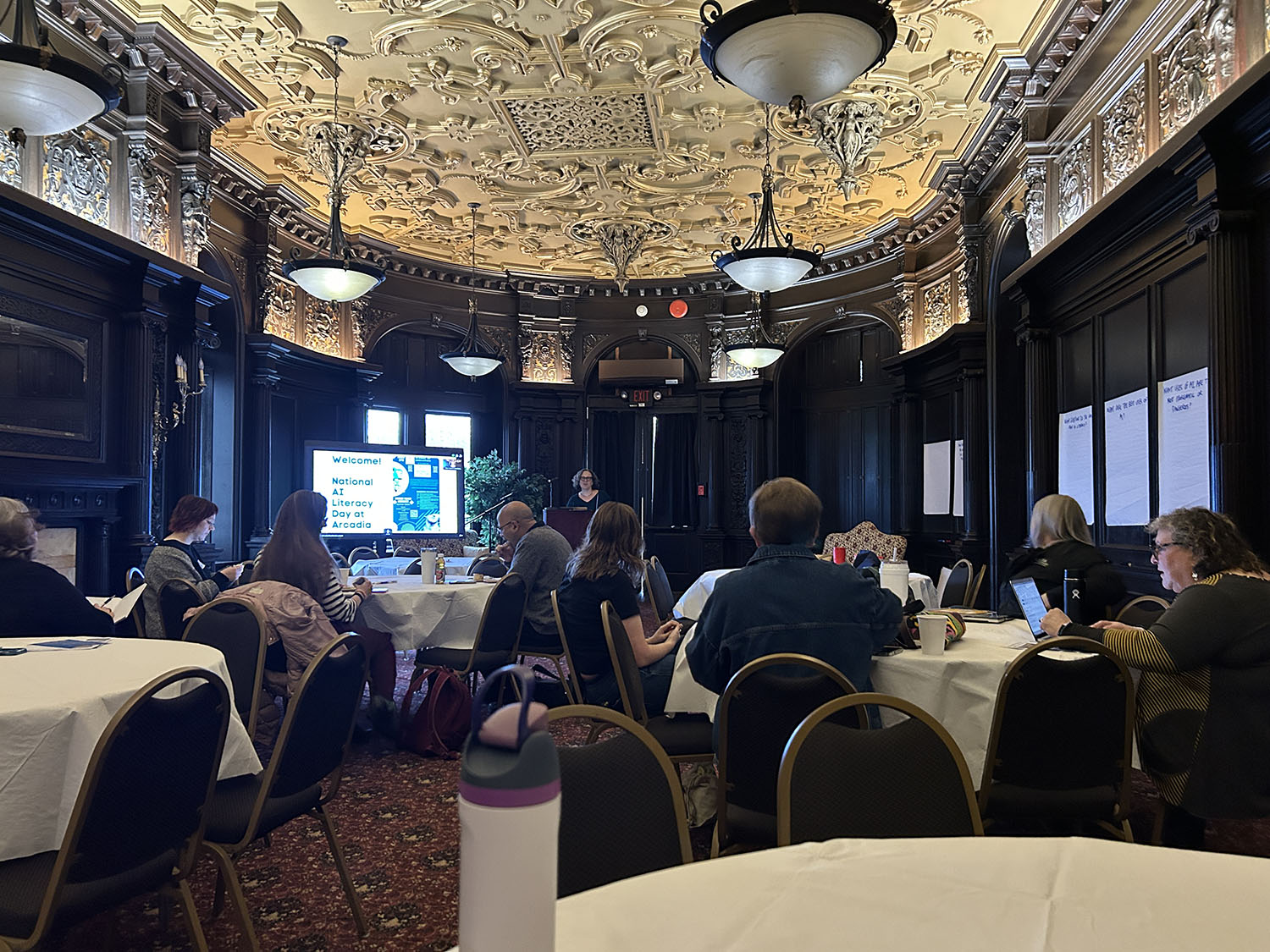
Another key theme was understanding how AI tools function and their limitations.
“It sounds so human, but one of the ways that we talk about it is that it doesn’t think; it accesses information,” Ferrier said. “It’s pulling from data that it’s been trained on; it’s pulling from whatever websites it can actually access, from what it already has, and then just reforms that into sentences that make sense to humans. So in a lot of ways, and because it’s so quick about it, it feels like it’s actually responding to you.”
“If it cannot think, if it’s only based on pattern recognition, then it doesn’t have an emotional experience,” added Berendt. “That’s very hard for most people to understand, because we’re presuming that everyone we communicate with and respond to us has either some agenda, some form of perspective, some form of social conditioning, which AI just doesn’t have. What it does have is bias based upon how it’s been engineered. And that’s where the ethical qualm comes in.”
Simran Bhaskar ’27M found value in exploring how AI can be used in productive ways through the event’s programming.
“AI is being shoved out there and everybody is using AI, so I feel like it’s good to get people informed about how we can use AI in an informative way,” Bhaskar said. “That’s why an event like this is helpful for Arcadia, especially when we’re living in the age where everyone uses AI every single day.”
“We’ve heard a lot of perspectives saying this part of AI is good, this part of AI is bad, and some people don’t even like to say ‘AI,’” added Hinton. “So I think reminding people that if it’s used correctly, it can be a really awesome tool is important.”
Berendt and Ferrier emphasize that the goal of this event is not to encourage or discourage AI use but to ensure awareness and discussion around the topic.
“We’re all at different points in our AI journey,” said Ferrier. “But the point of AI Literacy Day and the point of the course is to just kind of get us closer to all being on the same page, so we can make progressive and intuitive decisions about how the university as a whole wants to engage with it, and how it can benefit our students and their futures.”

